

Differences Between Data Scientist vs Software Engineer
A Data Scientist is a professional analytical data expert with the technical skills to solve complex problems and also find a way to explore what issues need to be solved. And they are responsible for collecting data, analyzing it, and explaining large amounts of data to identify different ways to help and improve operations which makes gaining a competitive edge over rivals. Data scientists will know mathematics and are computer scientists and also part of trend-spotter. And they are good at both the business and IT world.
Data Scientist explains what is going on by processing the history of the data, and they also use various advanced MLA(machine learning algorithms) to identify the occurrence of an event in the future, which helps to make decisions and predictions making use of this predictive causal analytics and prescriptive analytics to improve business and operations. For this process, Data Scientist has to look into data from many angles. A software engineer knows and applies the disciplined, structured principles of software engineering to all levels – design, development, testing, maintenance, and evaluation of the software that will avoid the low quality of the software product.
To suit those requirements, software engineers recommend the latest computer software and operating systems, such as iOS on iPhones and Windows 10. And they are responsible for creating models and diagrams of the computer code; knowledge of technologies is necessary for these professionals.
Software engineers should have skills like technical expertise, demonstrable achievement, and experience using open-source tools. They should be knowledgeable and experienced with pattern design techniques, automated testing processes, and fault-tolerant systems. Software engineers should also know how to create and maintain IT infrastructures, large-scale data stores, and cloud-based systems.
Head-to-Head Comparison Between Data Scientist vs Software Engineer
Below are the top 8 comparisons between Data Scientist vs Software Engineer: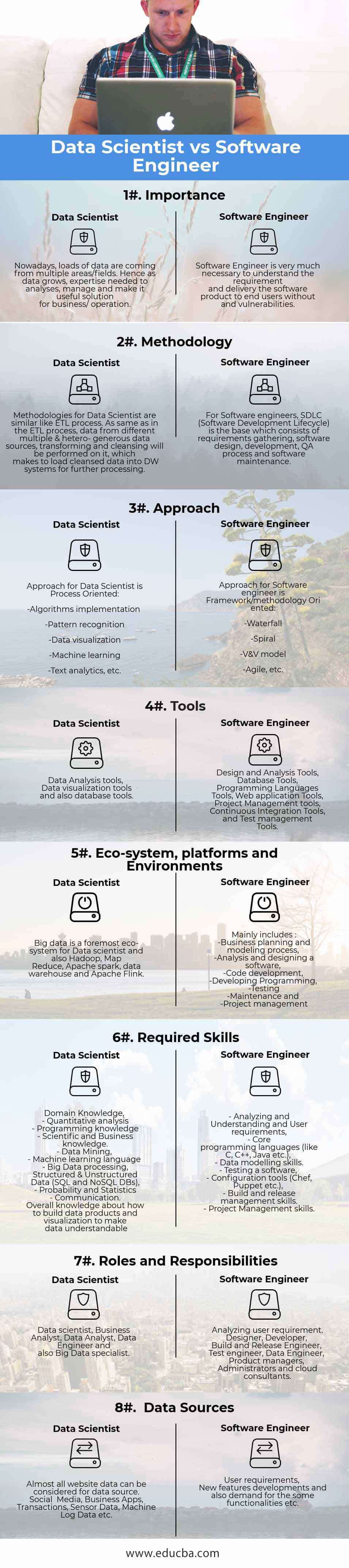
Key Differences Between Data Scientist vs Software Engineer
Below are the most important differences Between Data Scientist vs Software Engineer:
- Data Science consists of Data Architecture, Machine Learning algorithms, and Analytics processes, whereas software engineering is more of disciplined architecture to deliver a high-quality software product to end users.
- Data scientists are the ones who analyze the data and make that data into knowledge that helps in business; software engineers are the ones who are entirely responsible for building the software product for the end user.
- Growth in the field of Big Data is an input source for data science. In software engineering, demanding new features and functionalities in the market or clients are driving to design and develop new software(s).
- By analyzing and processing the data, Data scientist helps to make good business decisions, whereas software engineering makes life easy by developing required software products.
- Data drive data science; end-user requirements drive the software engineering process.
- The data extraction process is the essential & necessary step in data science; Requirement gathering and designing as per requirement is vital in software engineering.
- With an increase in data generation, it is observed that data engineers emerge as a subnet within the software engineering discipline. A data engineer builds systems that consolidate all data and store and retrieve data from the various systems and applications software engineers make.
- An example of Data Science: A suggestion about similar products on an E-commerce website (Flipkart, Amazon, etc.); the system automatically processes our search/products we browse and gives tips.
- For software engineering, let’s take an example of designing applications that help improve business and are collected by user feedback.
Data Scientist vs Software Engineer Comparison Table
Below are the lists of points that describe the comparisons between Data Scientist vs Software Engineer:
| Basis for Comparison | Data Scientist | Software Engineer |
| Importance | Nowadays, loads of data are coming from multiple areas/fields. Hence as data grows, expertise is needed to analyze, manage and make it a helpful solution for business/ operation. | Software Engineer is very much necessary to understand the requirement and delivery the software product to end users without vulnerabilities. |
| Methodology | Methodologies for Data Scientists are similar to the ETL process. As in the ETL process, data from different multiple & hetero- generous data sources, transforming, and cleansing will be performed on it, which makes it load cleansed data into DW systems for further processing. | For Software engineers, SDLC (Software Development Lifecycle) is the base that consists of requirements gathering, software design, development, QA process, and software maintenance. |
| Approach | Approach for Data Scientist is Process Oriented:
|
Approach for a Software engineer is Framework/methodology Oriented:
|
| Tools | Data Analysis tools, Data visualization tools, and also database tools. | Design and Analysis Tools, Database Tools, Programming Languages Tools, Web application Tools, Project Management tools, Continuous Integration Tools, and test management Tools. |
| Eco-system, Platforms, and Environments | Big data is a foremost ecosystem for Data scientists, including Hadoop, Map Reduce, Apache Spark, data warehouse, and Apache Flink. | Mainly includes Business planning and modeling processes, Analysis and designing software, Code development, Developing Programming, Testing, Maintenance, and Project management. |
| Required Skills |
|
|
| Roles and Responsibilities | Data scientist, Business Analyst, Data Analyst, Data Engineer, and Big Data specialist. | Analyzing user requirements. Designer, Developer, Build and Release Engineer, Test engineer, Data Engineer, Product managers, Administrators, and cloud consultants. |
| Data Sources | Almost all website data can be considered for data sources. Social Media, Business Apps, Transactions, Sensor Data, Machine Log Data, etc. |
User requirements, new features developments, and demand for some functionalities, etc. |
Conclusion
A Data Scientist is always more focused on data and hidden patterns; data scientist develop their analysis on top of data. Data Scientist work includes Data modeling, Machine learning, Algorithms, and Business Intelligence dashboards. But software engineer builds software applications. And they will be involved in all stages of the SDLC process, from design to review with clients. There is very important observation is that the software application built by a software engineer will be based on the requirements identified by the Data engineer or Data Scientist. So Data science and software engineering, in a way, go hand-in-hand. The conclusion on this is ‘Data science’ is a “Data-Driven Decision” to make good decisions in business. In contrast, software engineering is the disciplined and structured methodology for software development without deviating from user requirements.
Recommended Articles
This has been a guide to the top difference between Data Scientist vs Software Engineer. Here we have discussed Data Scientist vs Software Engineer head-to-head comparison, key differences, infographics, and comparison table. You may also have a look at the following articles to learn more –

