


Differences Between Python vs Groovy
Python is a general-purpose programming language that is interpreted and focuses on a “readable-code” like feature. It was first released in 1991 by Guido van Rossum.
Groovy is an object-oriented, static, and dynamic language with features similar to Python. It was first released in January 2007.
Python has support for various types of programming paradigms and provides the developer with enormous standardized libraries. Python is object-oriented, imperative, procedural, and functional.
Groovy is compatible with Java syntax, built for the Java platform. Groovy can function equally well as both a programming and scripting language. Like Java, it can be compiled to JVM bytecode and work efficiently with other Java code and its libraries. There is a process called AST, i.e. Abstract Syntax Tree, which allows the developer to hook into its compilation process and can alter to its requirement. To learn more about Groovy scripting, check out this informative article.
Python has a great deal of usage in the web development ecosystem. It’s docile; any naïve programmer can get along with its syntax. Also, its collection of massive libraries, which provide features to achieve complex tasks, makes it the most appreciable tool for software writing.
Just like Java, Groovy uses a bracket syntax. Its resemblance with the Java language makes it highly popular among Java users. Java users find Groovy highly compatible due to its ability to be converted to bytecode for JVM and being an object-oriented language. Most of the Java code is also syntactically valid Groovy code.
Python is practical for automating functionalities. Its usage has been enhanced in the last few years, from data analysis to infrastructure management. Since it’s docile, any naïve programmer needs to focus on business logic rather than too much time learning the language syntax feature.
From version 2 onwards, Groovy can be compiled statically, and performance is near Java. Although the Groovy code is syntactically valid with Java, it appears to be more compact than Java code because it does not require all the elements that Java needs. This one aspect of Groovy makes it possible for Java programmers to learn it gradually. It has native support for markup languages like HTML, using DOM syntax. Similar to Perl and Ruby, Groovy is parsed, compiled, and generated before execution, despite being an object-oriented language.
Python has built-in support for multi-thread and concurrency as a requirement. With Groovy’s support for GPars, developers can effectively include concurrency features rest in their programs. Python provides concurrency, but the developer must manage isolation and resource since it is resource-intensive. But an efficient programmer can cope with this constraint easily.
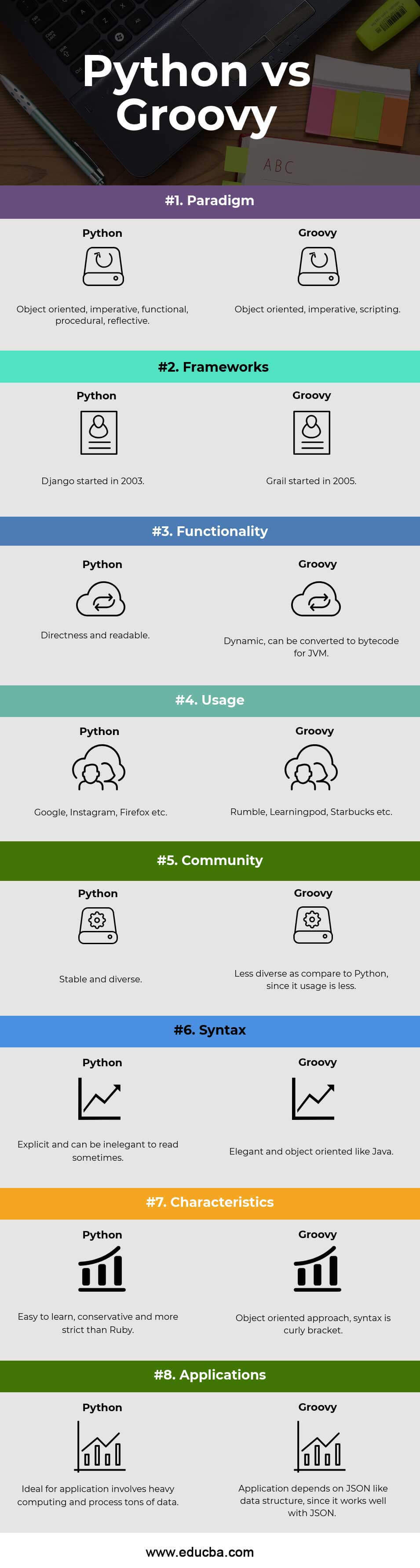
Head-to-Head Comparison Between Python vs Groovy (Infographics)
Below is the top 8 difference between Python vs Groovy:
Key Differences Between Python vs Groovy
Both Python vs Groovy performance are recommended options in the business. Let us examine some of the key differences between Python and Groovy:
- Python is scripting; this has to be interpreted, whereas Groovy, an object-oriented programming language for the Java platform, can be converted to bytecode for JVM.
- Python has readable code; hence, it is flexible and docile, whereas Groovy has more object orientation in nature, with a curly bracket-like syntax.
- Python does not provide a built-in concurrency mechanism, whereas Groovy with GPars gives several high-level.
- Python has better game-creation tools since its GUI kits are considerably stronger than Groovy.
- Python binding and application styling are better for creating applications than Groovy. However, Groovy is strong in object-oriented programming, allowing for efficiently meeting design-related complexity.
- Python and Groovy both offer powerful scripting capabilities, but Python’s extensive libraries and community support make it a popular choice for Generative AI Services.
- Python community is very stable and diverse, but when it comes to innovation, it’s slower than Groovy, whereas the Groovy community, although less in size, comes up with more features.
- Python still gains the upper hand when it comes to explicit syntax and thus is more readable, whereas Groovy is concise, fast, and easy to set up.
- Python is preferred among data scientists, especially for machine learning, whereas Groovy is ideal for object-oriented programming.
- A Python approach is more directly toward programming and thus makes everything obvious to programmers. Groovy code is readable and concise like Java but requires less code to achieve complex tasks.
- Python is easy to adapt to meet standard programming requirements but can be tricky for complex web development. W. With Groovy, a Grail-like web framework, one can achieve complex features with an efficient object-oriented design.
Python vs Groovy Comparison Table
As you can see, there are many comparisons between Python and Groovy. Let’s look at the top Comparison between Python vs Groovy:
| The basis of comparison Between Python vs Groovy |
Python |
Groovy |
| Paradigm | Object-oriented, imperative, functional, procedural, and reflective. | Object-oriented, imperative, scripting. |
| Frameworks | Django started in 2003. | Grail started in 2005. |
| Functionality | Directness and readable. | Dynamic can be converted to bytecode for JVM. |
| Usage | Google, Instagram, Firefox, etc. | Rumble, Learningpod, Starbucks, etc. |
| Community | Stable and diverse. | Less diverse as compared to Python since its usage is less. |
| Syntax | Explicit and can be inelegant to read sometimes. | Elegant and object-oriented, like Java. |
| Characteristics | Easy to learn, conservative, and more strict than Ruby. | Object-oriented approach, the syntax is a curly bracket. |
| Applications | Ideal for an application that involves heavy computing and processing tons of data. | The application depends on a JSON-like data structure since it works well with JSON. |
Conclusion
Developers use Groovy and Python languages in diverse technology areas, including Python Web Development, machine learning, and more. Groovy arriving from the Java-like streak makes it a capable contender for the future. On the other hand, Python has a streak of capabilities in multiple areas. One of them is Machine learning, the latest artificial intelligence forte. Besides these advantages, Groovy vs Python has a community setting supporting various use cases.
The developer can perceive language concepts and deal with the incredible complexity. Groovy can provide you with the speed and performance Python development services can deliver and vice-versa. Using a specific language depends on projected requirements and the developer’s comfort level with that language. Project requirements might suit Python, but if the developer has a more robust understanding of Groovy, that won’t be too good for the project. Thus, a language’s usage and performance lie on the aspects mentioned above, which need to balance out. The final choice of technology selection to build a complex application would eventually boil down to expertise and business need.
Recommended Articles
This has been a guide to Python vs Groovy. Here we have discussed Python vs Groovy head-to-head comparison, key differences, infographics, and comparison table. You may also have a look at the following articles to learn more –

