

Difference Between MS SQL vs MYSQL
MySQL is a relational database management system. A relational DB stores data in separate tables instead of putting all the data in a single docket. MySQL AB is a commercial company that builds businesses providing services around the MySQL database. The initials stand for Structured Query Language. SQL is a nonprocedural language, indifferent to the third-generation languages (3GLs) or procedural languages such as C and COBOL that were created up to that time. Developers use SQL statements to perform tasks such as retrieving data from a database or updating data in a database.
Let us study much more about MS SQL and MySQL in detail:
An RDBMS is a type of DBMS that organizes data into a chain of records held in correlated tables. Even though there are various types of database management approaches, the relational approach is the premier in most software applications. The association of linked tables aids in transformation and data access because linkages based on record values are very flexible. The rules for linkages are conventional, and the actual organization of records occurs based on values.
The fundamental definitions to keep in mind while thinking about RDBMS.
- Domain-specific attributes of specific relations draw their values from a puddle of values.
- Tuple – an organized list of values
- Primary key – a unique identifier for a table; a column or combination of columns with the property that no two rows of the table have the same value in that column or columns
Features of a Database System
- Variety of User Interfaces: It allows users of various levels and knowledge to use the database flexibly.
- Physical Data Independence: The data elements remain independent of the application programs executed on its top. This allows an easy layering where changes to application programs do not expect any change to the Data elements.
- Query Optimisation: All database systems hold an optimizer that considers the different execution strategies for querying the data. The chosen strategy is termed the execution plan.
- Data Integrity: Eliminates inconsistent data in a very effective manner. Additionally, most real-life trouble implemented using database systems has integrity constraints that must hold true for the data.
Let us study the detailed difference between MS SQL and MYSQL in this post
What is SQL?
SQL originated in the late 1970s at the IBM laboratory in San Jose, California. The initials “SQL” stand for Structured Query Language, and the language itself is commonly known as “sequel.” Initially, developers created SQL for IBM’s DB2 product platform.
SQL enables efficient communication with the database. As per ANSI (American National Standards Institute), RDBMS uses SQL as its standard language. Common RDBMS systems that use SQL are Oracle, Microsoft SQL Server Ingres, etc. Over the years, many changes have added a great deal of functionality to the standard SQL. These changes include triggers, support for XML, recursive queries, regular expression matching, standardized sequences, etc. Developers typically execute all necessary language commands corresponding to DBMS through SQL CLI. These commands can be grouped into the following areas:
- Clauses – the clauses are components of the statements and the queries;
- Expressions – the expressions can produce scalar values or tables, which consist of columns and rows of data;
- Predicates – Based on the specified conditions, which limit the effects of the statements and the queries or change the program flow;
- Queries – Allows retrieving data based on given criteria;
- Statements – Statements control transactions, manage connections, control program flow, handle sessions, and provide diagnostics. Server process statements distribute queries from the server, where the databases are stored, to a client program. These statements facilitate speedy data manipulation operations, ranging from simple data inputs to more complex queries.
What is MYSQL
MySQL was once intended to connect to our tables for fast ISAM routines, but the speediness and flexibility of MySQL were not up to needs, which was determined in further testing and on. This resulted in a new SQL interface connecting to the database area. This API facilitated the rapid integration of third-party code. MySQL, the well-liked Open Source SQL database, is developed by MySQL AB.
The DB system experiences increased speed and flexibility. Relations within these tables establish the availability of data for several other tables upon request. The SQL part of “MySQL” stands for “Structured Query Language,” the common standardized language for accessing relational databases.
The below list describes the essential properties of the MYSQL database,
Portability and Internals
- We carried out test executions on a wide range of compilers. These executions were programmed in C and C++ languages.
- Facilitates a wide variety of platforms.
- You can achieve portability by using GNU Autoconf (Version 2.52 or newer), Automake (1.4), and Libtool.
- Provides APIs for several key languages like C, C++, Eiffel, PHP, Python, and Tcl, Java, Perl.
- Works on a thread-based high-speed memory allocation system.
- Optimized one-sweep multi-join, which allows high-speed join executions.
- This act implements the highly optimized class library and SQL functions at a high-speed phase.
Column Types
- Includes a large variety of column types
1) signed/unsigned integers 1, 2, 3, and 8 bytes long,
2) FLOAT, DOUBLE,
3)CHAR, VARCHAR, TEXT,
4)BLOB, DATE, TIME, YEAR, SET, ENUM, DATETIME, TIMESTAMP
- Variable-length and fixed-length records.
Security
- The installation of a highly flexible and secure password system enables host-based verification for enhanced security. Password traffics are very much encrypted, which makes it much more secure.
Limits and Scalability
- You can mount large databases. some hold loads up to 5,000,000,000 rows.
- We can have up to 32 indexes per table. You can introduce a count of 1 to 16 column indexes. The maximum index width is 500 bytes. An index may use a prefix of a CHAR or VARCHAR field.
Connectivity
- You can connect to the MYSQL server using Unix Sockets (Unix), Named Pipes (NT), and TCP/IP sockets.
- Lingual support for error messages is available.
- The selected character set saves all data. All comparisons for normal string columns are case-insensitive.
- The sorting is done according to the selected character set. It is likely to change when the MySQL server is started. The collection of character sets supports mentioning different character sets at compile and runtime.
Clients and Tools
- Includes myisamchk, a utility used for table checking, repair, and optimization. All of the functionality of myisamchk is also available through the SQL interface.
- Online assistance is invoked with the –help or -? Options.
Head To Head Comparison Between MS SQL vs MYSQL
Below is the Top 8 difference between MS SQL vs MYSQL
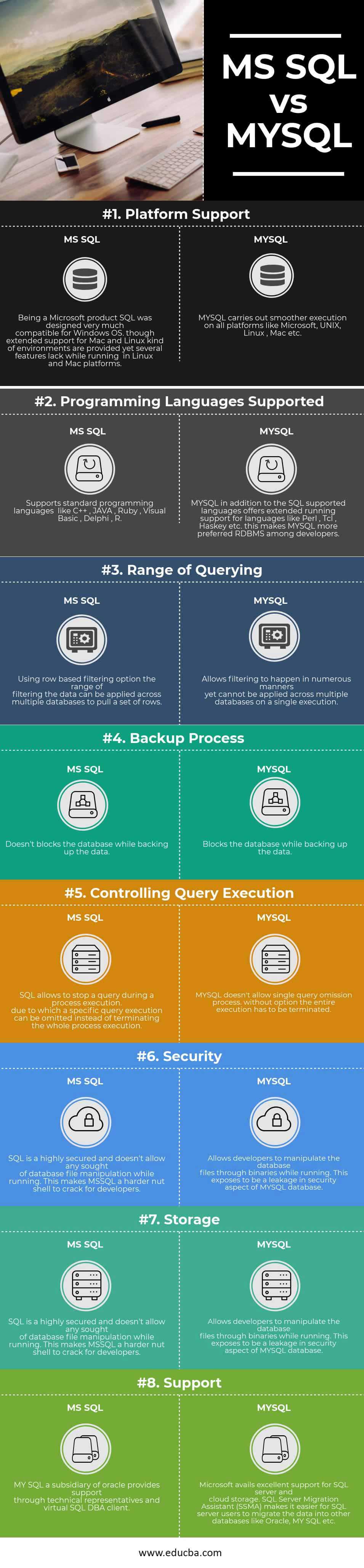
MS SQL vs MYSQL Comparison Table
Let us look into the detailed comparison between MS SQL vs MYSQL
| Basis of Comparison between MS SQL vs MYSQL | MS SQL | MYSQL |
| Platform support | As a Microsoft product, SQL was designed to be compatible with Windows OS. Though extended support for Mac and Linux environments is provided, several features are lacking while running on Linux and Mac platforms.
|
MYSQL carries out smoother execution on all platforms like Microsoft, UNIX, Linux, Mac, etc. |
| Programming Languages supported | Supports standard programming languages like C++, JAVA, Ruby, Visual Basic, Delphi, and R. | MYSQL, in addition to the SQL-supported languages, offers extended running support for languages like Perl, Tcl, Haskey, etc., making MYSQL more preferred RDBMS among developers.
|
| A range of Querying | Using the row-based filtering option, the range of filtering the data can be applied across multiple databases to pull a set of rows.
|
Allows filtering to happen in numerous manners yet cannot be applied across multiple databases on a single execution. |
| Backup process | It doesn’t block the database while backing up the data.
|
Blocks the database while backing up the data. |
| Controlling Query Execution | SQL allows stopping a query during process execution. Due to this, a specific query execution can be omitted instead of terminating the whole process execution.
|
MYSQL doesn’t allow a single query omission process. Without the option, the entire execution has to be terminated. |
| Security | SQL is highly secured and doesn’t allow any sought of database file manipulation while running. This makes MSSQL a harder nutshell to crack for developers.
|
Allows developers to manipulate the database files through binaries while running. This exposes a leakage in the security aspect of the MYSQL database. |
| Storage | Expects a large amount of operational storage space.
|
Expects less amount of operational storage space. |
| Support | MY SQL, a subsidiary of Oracle, provides support through technical representatives and virtual SQL DBA clients. | Microsoft avails excellent support for SQL servers and cloud storage. SQL Server Migration Assistant (SSMA) makes it easier for SQL server users to migrate the data to other databases like Oracle, MY SQL, etc.
|
Conclusion – MS SQL vs MYSQL
The choice of the database between MS SQL and MYSQL purely depends on the client’s needs; for a small-level enterprise system, it is advisable to stick with open-source MYSQL servers. If yours is a huge database with hundred-plus users, or if your system carries an intense transaction load, the performance of database operations will be an issue. In such cases, as the data increases, choosing MS SQL DBMS is expected to be better than opting for other alternatives due to its extended professional support and additional data handling features.
Recommended Article
We hope that this EDUCBA information on “MS SQL vs MYSQL” was beneficial to you. You can view EDUCBA’s recommended articles for more information.