

Updated May 18, 2023

Introduction to Redux Alternatives
Redux is a JavaScript library that is open-source. It is used for managing the application state. Redux is used most of the time with other javascript libraries like React and Angular to build user interfaces. Redux can be understood as a state management tool. Even though it is most commonly used with React, it is suitable for any JavaScript framework or library. It is very lightweight, measuring only 2KB. For any JavaScript-based application app, state management becomes messy when the app size increases or the app gets more complex, and thus, we need a state management tool such as Redux to maintain these states.
Redux is a great tool, and its importance is evident because it has completely changed the architecture of front-end apps. Redux could be a great tool to master for somebody looking for a new job because it provides some interesting offers with various versions of Angular and others. React & Redux combination is essential for job prospects.
What is Redux?
The working principle of Redux is quite simple. Redux can be considered a central store that holds the entire application state. Each component can access the given stored state without requiring sending down property from one component to another.
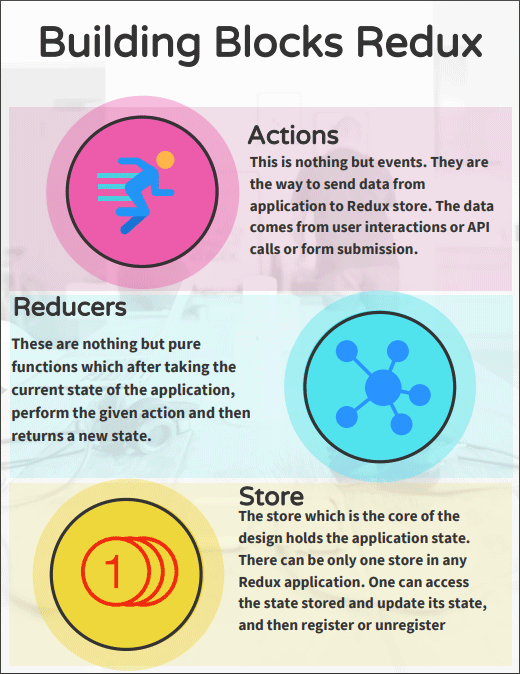
There are three building blocks of redux: actions, stores, and reducers.
1. Actions
This is nothing but events. They are the way to send data from the application to the Redux store. The data comes from user interactions or API calls, or form submissions.
2. Reducers
These are pure functions that perform the given action after taking the application’s current state and returning a new state. These states are later stored as objects, and they also specify how the state of the selected application changes with the response from an action sent to the store.
3. Store
The store, which is the core of the design, holds the application state. There can be only one store in any Redux application. One can access the state stored and update it, and then register or unregister listeners through the available helper methods.
Redux is great, but there are some problems with using Redux:
- Difficulty Switching to Work with Reducers: To work with redux, one must care about functional programming principles and always return a new value based on the previous app state. Sometimes this could be easy such as handling simple strings or objects or simple array operations. Still, as the complexity of the task increases, the better idea would probably be to use Immutable.json from a similar library.
- Don’t Repeat Yourself or DRY principle: Working with Redux requires keeping some conventions, such as creating action types, action creators, and reducers. For similar logic sake, such as CRUD operations, Redux code may look very similar. Adding small functionality in such cases will require a lot of redux logic and test cases. Thus, a better idea would be refactoring or following a DRY rule.
- Care about performances: In the end, performance matters. Developers usually prefer a single source of truth that is easy to maintain but debug and test; hence, redux does not suit that. In Redux, even a small change can trigger changes in the DOM structure.
List of Redux Alternatives
Following are the main alternatives for Redux which are as follows:

1. MobX
This is a new library which provides a lot of solutions for the problems mentioned above. It works on 3 points: state, derivations, and actions. With MobX, synchronization between models and UI can be done automatically. With MobX, one can use OOP and some methods directly on models’ items. Object normalization is also not required, but in the Redux store, it is needed.
2. GraphQL
Relay & GraphQL stack is comparatively old but not as popular as Redux. Facebook developed it, and when it came, it was described as the framework to build data-driven react applications. There are many unique benefits of using Relay with GraphQL. The biggest among them is that there is no need to remember from a frontend perspective how to fetch data to get the required response.
 3. Jumpsuit
 3. Jumpsuit
This is a solution usually for someone, who does not want to use MobX, but pure Redux is also not appealing to them. A jumpsuit is a framework that is based on Redux, and it makes the flow more automatic. For someone who does not like to build an application from scratch (which means adding and configuring many packages), then Jumpsuit is suitable for them. It gives a simplified API layer for both React and Redux.

4. Helpers/generators with conventional redux.js
One of the biggest problems that can be recognized with the Redux app is its many code duplications i.e., it does not follow the DRY principle. Conventional-redux.js is the approach to follow in this regard to simplify your workflow.
Jumpsuit, Conventional-redux.js, and many other tools focus on improving Redux workflow. These are preferred choices for those who are familiar with Redux and understand its ins and outs., These people probably have prepared a lot of data or state logic stuff and don’t want to rewrite this repeatedly or have put more effort into learning these skills.
On the other hand, MobX and Relay & GraphQL are outside of the Redux stack. MobX is very easy to learn. This is recommended if someone wants to write from scratch very quickly. GraphQL, on the contrary, needs a lot of time to build backend data flow logic. But once it is done, building-fronted implementation becomes much easier.
Comparison Table of Redux Alternatives
|
Features |
Redux | MobX | GraphQL |
Jumpsuit |
| DRY principle | No | Yes | Yes | Yes |
| Complication | High | Low | Medium | Medium |
| Learning curve | High | Low | Medium | Low |
| Application | Suitable for simple application | Suitable for complex application | Suitable for medium-sized application | Suitable for complex application |
Recommended Articles
This has been a guide to Redux Alternatives. Here we have discussed the top 4 Redux alternatives with their comparison table. You may also look at the following articles to learn more –

