



Introduction to Types of Computer Language
Computer language is a code or syntax for writing programs or specific applications. A computer language helps the user to tell the computer what to do and how to do it.
It comprises low-level, high-level, and specialized languages, further categorized by their functions and uses. To make the computer understand the code, we need a special program, called a compiler or an interpreter, that translates the code into a language the computer can understand. These types of computer language range from low-level machine language to modern ones like Python, C++, Java, SQL, and more. When choosing a programming language for a project, it is important to consider the project’s specific requirements and goals. Each programming language has advantages and disadvantages, and some languages may be better suited to certain tasks than others.
Different Types of Computer Languages
Below are the 3 types of computer languages with examples:
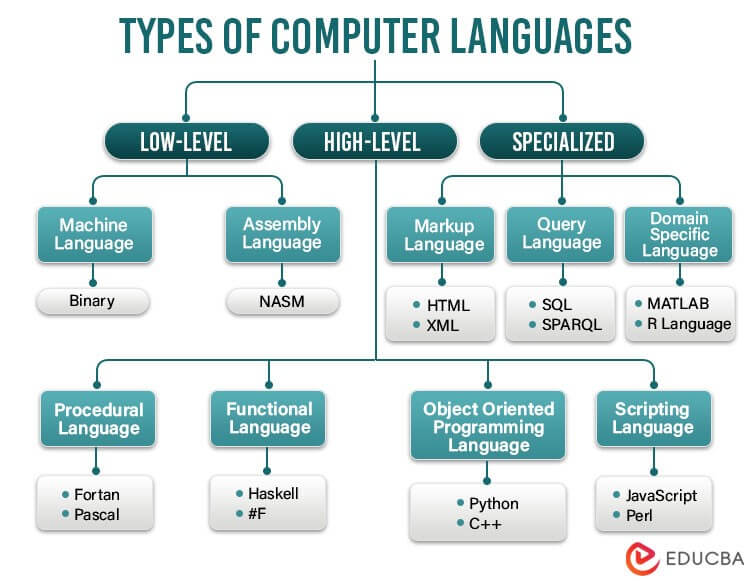
1. Low-Level Languages
A low-level programming language is closely related to a computer’s instruction set and directly interacts with its hardware components to convert the orders into action.
a) Machine Language
Machine language is a code or object code composed of binary digits (0s and 1s), which a computer system can easily interpret. It is a native language that the central processing unit (CPU) directly understands and processes. However, it can be difficult to understand machine language due to its binary commands, which can lead to differing interpretations and results.
One must note that computers can only understand and process machine language. A computer’s operating system identifies the specific machine language in that particular system. It cannot understand programs and scripts in C, C++, and Java. Hence, a compiler is needed to convert these computer scripts into machine language. The compiler’s output is a file that the computer can execute.
Example of machine language for the text “Hello World” using Binary Code:
Each group of eight ones and zeros is called a “byte.” In this case, each byte represents a specific letter or character in the text.
Here’s a breakdown of what each byte represents in the machine language example for the text “Hello World”:
- 01001000 -> ‘H’
- 0110101 -> ‘e’
- 01101100 -> ‘l’
- 01101100 -> ‘l’
- 01101111 -> ‘o’
- 00100000 -> ‘ ‘ (space)
- 01010111 -> ‘W’
- 01101111 -> ‘o’
- 01110010 -> ‘r’
- 01101100 -> ‘l’
- 01100100 -> ‘d’
So, when a computer reads this sequence of bytes in machine language, it understands that it should display the text “Hello World” on the screen.
b) Assembly Language
Assembly language is a low-level programming language used to write instructions for microprocessors and other programmable devices. It is often referred to as a second-generation language of computers, while machine language is the first-generation language. Assembly language is commonly used to write scripts for operating systems and desktop applications. It’s a low-level language for computers because it is closer to how computers actually work.
Assembly language is easier to understand than machine language. The compiler takes less time to translate the code, while the efficiency of the code’s execution is greater. However, a potential disadvantage is that the code cannot be reused across all projects and is difficult for beginners to understand. The code you write in assembly language is specific to a particular program or device, so it can’t be easily reused in other projects.
2. High-Level Languages
Earlier computer languages had portability issues, making it difficult to transfer code from one machine to another. To address this, high-level languages were introduced. Programmers began developing high-level languages to address the challenges of lower-level programming. These types of computer languages are designed to be user-friendly, allowing programmers to write code quickly and easily.
a) Procedural Language
A procedural language is a third-generation language easily created with simple procedures. These procedures are instructions in a sequence with a unique name. Hence, the execution of these instructions happens with a name or title assigned to that instruction.
Here are some examples of popular procedural languages:
- C Language: Developers widely use C to build system software, such as operating systems and device drivers. It manages hardware resources efficiently.
- Fortran: Fortran is commonly useful as a programming language for scientific computing and numerical analysis. It has found extensive applications in fields such as physics, engineering, and astronomy, and it remains relevant today.
- Pascal: Pascal is a procedural programming language designed to be easy to learn and use. Developers use it to create applications across various domains, including education, engineering, and business.
- BASIC: BASIC (Beginner’s All-purpose Symbolic Instruction Code) was designed with the goal of creating a procedural language that is beginner-friendly. It is commonly useful for developing basic applications and educational programs.
- COBOL: COBOL (Common Business Oriented Language) is a procedural language initially developed for business applications. It is still helpful today for developing banking, insurance, and government applications.
b) Functional Language
Functional language is a type of high-level language that revolves around mathematical functions as its fundamental concept. Functional languages give functions equal status by assigning them to variables, using them as arguments to other functions, and returning them as function values. This means that functions can be useful in flexible and powerful ways, making it easier to solve problems and create programs. Functional languages are particularly concise, clear, and easy to understand. They are common for the development of applications that involve extensive data manipulation, such as artificial intelligence and data analysis. Additionally, functional languages are best suited to web and game development.
Here are some examples of popular functional languages:
- Haskell: Haskell is a purely functional language famous for its strong safety features and its ability to handle complex mathematical operations. It finds applications in various fields, including artificial intelligence, data analysis, and finance.
- Lisp: Lisp is one of the oldest functional languages still in use today. It is famous for its flexibility and its capability to handle complex data structures. Developers use Lisp to build applications across domains such as artificial intelligence, robotics, and game development.
- Erlang: A functional language used by developers to build concurrent and distributed systems. The telecommunications industry widely uses it to develop messaging systems and other real-time applications.
- F#: F# is a functional language based on the .NET framework. It is notable in the development of applications for various domains, including web development, game development, and artificial intelligence.
- Clojure: Clojure, a functional programming language with roots in Lisp, offers exceptional expressiveness and finds application in diverse fields such as web development, data analysis, and machine learning.
c) Object-Oriented Programming Language
Object-oriented programming languages have become the predominant approach in developing new software. The development process in these languages revolves around creating and interacting with objects, which consist of pieces of code (modules) and data structures.
Here are some popular examples:
- Java: Java is a widely useful object-oriented language for developing a wide range of applications, including operating systems, mobile applications, enterprise platforms, and scalable websites. Each language offers unique strengths, and developers choose it based on project requirements and performance needs.
It aims to provide platform independence, allowing programs to run on different systems. Java handles memory management automatically, offers strong security features, and runs on multiple platforms. - Python: Python is a widespread object-oriented language for data analysis, machine learning, and artificial intelligence. It is popular for its user-friendly interface and capacity to process large amounts of data efficiently.
- C++: C++ is an object-oriented language suitable for developing applications that require high performance and low-level control, such as operating systems and game engines. It is famous for its speed and efficiency.
- Ruby: Ruby is an object-oriented language commonly helpful for web development and scripting. It is creative for its simplicity and straightforward design.
- Swift: Swift is an object-oriented language that developers primarily use to build applications for Apple devices, including iPhones and iPads. It prioritizes safety and handles complex applications efficiently.
d) Scripting Language
Scripting languages are high-level, user-friendly languages that are easy to learn and use to automate repetitive tasks and create dynamic web pages. Developers prefer interpreted scripting languages because they do not require compilation before execution, enabling quick prototyping and testing.
Here are some of the common scripting languages:
- JavaScript: JavaScript is a common scripting language for creating dynamic and interactive web pages. It is alongside HTML and CSS to build complex web applications. JavaScript is also used in server-side development through platforms such as Node.js. It is well known for its versatility and ability to run on various devices.
- Python: Python is a scripting language for various applications, such as web development, data analysis, and artificial intelligence. It is perfect for its user-friendly nature and ability to handle large datasets. Python has wide usage in scientific computing and machine learning domains.
- Perl: Developers widely use Perl as a scripting language for text processing, web development, and system administration.
- Bash: Bash is a scripting language used for shell scripting on Linux and Unix-based operating systems. It serves as the default shell and provides a powerful command-line interface, enabling users to perform various tasks with simple commands.
3. Specialized Languages
Specialized languages are programming languages that are for specific uses or industries. They have special features and rules that make them really good at solving certain kinds of problems. For example, there are languages for designing web pages, languages for working with databases, and even languages for doing scientific calculations. These specialized languages help programmers work more easily and effectively on tasks that require specific knowledge or skills.
a) Markup Language
Markup languages are computer languages to format text for display on the web or in documents. They use tags and other markers to define how text appears or is formatted. The objective of markup languages is to ensure both machine and human readability.
Here are some common examples of Markup languages:
- HTML: HTML (Hypertext Markup Language) is a primary markup language for designing web pages. It utilizes tags to structure and present information on a webpage, including headings, paragraphs, links, images, and other essential elements. HTML is widely supported by web browsers.
- XML: XML (Extensible Markup Language) is used to store and exchange data between different systems. It uses tags to define data structures and content, enabling the representation of complex data. Enterprise applications, data sharing, and web services commonly use XML format.
- Markdown: Markdown is just a lightweight markup language that allows for easy text formatting for the web. It uses plain text and simple tags to define headings, lists, links, and other elements. Developers widely use it to write documentation, blog posts, and web content because of its simplicity and readability.
b) Query Language
Query languages are simply computer languages that retrieve and manipulate data from databases. These types of computer languages allow users to issue commands or statements to edit or retrieve data based on specific criteria. Query languages find applications in various fields, including business intelligence, data analytics, and web development.
- SQL: Structured Query Language (SQL) is commonly used for managing relational databases. It provides functionality to create, modify, and delete databases, tables, and other objects, as well as to query data stored in these databases. SQL has usage in enterprise applications, web development, and data analytics.
- SPARQL: SPARQL (SPARQL Protocol and RDF Query Language) is a language for querying data stored in RDF (Resource Description Framework) format. RDF is a flexible data model that represents metadata, and SPARQL allows the manipulation and retrieval of data in RDF format. SPARQL is quite useful in applications involving large amounts of data, such as data analytics and scientific research.
c) Domain-Specific Language
Developers design Domain-Specific Languages (DSLs) for specific domains or problems to simplify programming tasks by providing a language tailored to the needs of a particular application. Multiple applications utilize domain-specific languages (DSLs), including scientific computing, financial modeling, and game development.
- MATLAB: MATLAB is a domain-specific language for scientific computing and data analysis. It provides a robust environment for numerical computation, visualization, and programming. Scientists in various fields, including engineering and physics, commonly use MATLAB.
- R Language: The R Language is primarily a domain-specific language for statistical computing and graphics. It is a widespread tool for data analysis and scientific research. R is open-source and has a large, active community of users and developers.
Differences Between the Low-Level and High-Level Languages
There are some distinguishing features of low-level and high-level types of computer language as follows:
| Parameters | Low-level language | High-level language |
| Definition | Closely tied to the computer’s instruction set and directly interacts with hardware components. | User-friendly and focuses on the problem-solving aspect of programming. |
| Examples | Machine language and Assembly language. | Python, Java, C++, Ruby, and JavaScript. |
| Abstraction level | Operates at a low level of abstraction, with direct hardware access and machine-level instructions. | More abstract, with straightforward and intuitive instructions for programmers. |
| Readability | Difficult to read and write due to machine-level instructions. | Easily readable and writable by humans. |
| Portability | Specific to a particular computer architecture, not portable without rewriting. | Portable and can run on any computer with the appropriate software. |
| Maintenance | Difficult to debug and maintain due to closeness to hardware and the requirement of a deep understanding of the architecture. | Easier to debug and maintain due to a higher level of abstraction and readability. |
| Speed | Faster due to direct access to hardware. | Slower because translation into machine-level code is necessary. |
Final Thoughts
In the future, the various types of computer languages will continue to serve important roles. Low-level languages control hardware, while high-level languages are popular for being easier to use. Object-oriented programming languages, scripting languages, and specialized languages will also be valuable tools for software development. Markup languages and query languages will help structure information on the web and manage data effectively. As technology advances, these languages will evolve to meet the needs of different fields and provide efficient solutions.
Frequently Asked Questions (FAQs)
Q1. Which is the easiest programming language?
Answer: Many beginners consider Python one of the easiest and most beginner-friendly programming languages.
Q2. Is HTML a programming language?
Answer: No, HTML is not a programming language. It comes under markup language. It’s more like a set of instructions to the web browser on how to display content on a webpage. It’s like giving your browser a blueprint of what to show and where to show it, but it can’t perform calculations or make decisions as a programming language can.
Q3. Give an example of low-level language in C.
Answer: A low-level language is like speaking directly to a computer in its own language at a very basic level. C programming uses binary code consisting of 0’s and 1’s. This binary code represents the instructions that the computer understands and executes. So, when we write programs in C, we can use the binary code “01101110 01101111” for the word “NO”.
Q4. Mention examples of high-level languages.
Answer: Some examples of high-level languages are C, C++, Java, Python, Ruby, Perl, PHP, etc. These high-level computer languages are user-friendly and make it easier for people to write code. They are simpler and more abstract, so you don’t have to worry about low-level details.
Q5. Do programming languages constantly evolve?
Answer: Yes, programming languages do constantly evolve. Just like technology and software, programming languages are regularly up-to-date to introduce new features, improve performance, and address shortcomings. These updates help programmers write code more efficiently, solve complex problems, and stay up to date with the latest trends in software development.
Recommended Articles
Understanding the different types of computer languages is the first step toward learning programming and software development. Browse the recommended articles below for more insights into computer concepts.