


Updated June 8, 2023
Workplace Toolkit
A workplace toolkit refers to a collection of resources, tools, and techniques employees use to enhance their productivity, efficiency, and effectiveness. It may include physical items such as software applications, computer hardware, stationery, and equipment, and non-physical things such as training programs, knowledge bases, and communication channels.
A workplace toolkit helps employees perform their duties effectively, streamline workflow processes, and achieve optimal results. It can meet the specific needs of different industries, job roles, and work environments.
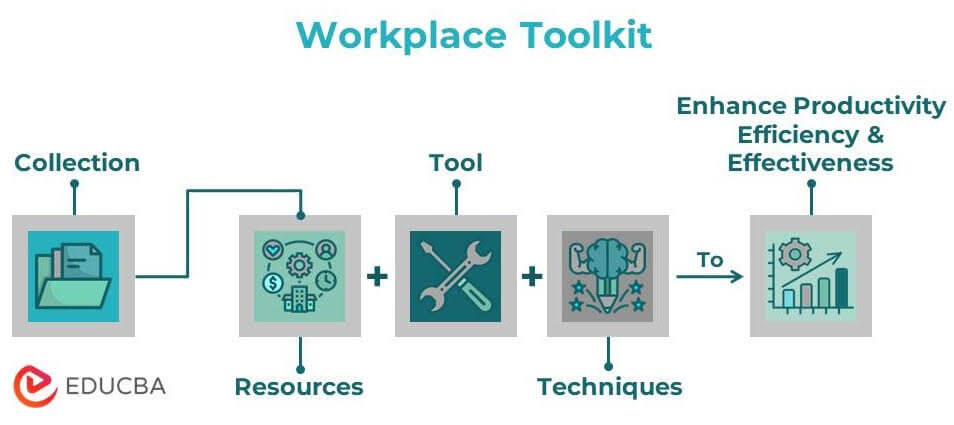
Following are the ten essentials you need to succeed, which are your effective workplace toolkit:
1. Self-Awareness as a Workplace Toolkit
You are employed and are working hard, that’s good, but if you don’t have any aim in life, your hard work will land you nowhere. As Louis Pasteur says, “Chance favors the perfect mind”. Chance only favors the person who knows what he is doing and where he wants to go, which means he is of the right mind. In the same way, if you know and are aware of your weaknesses, you can easily manage and rectify them, which can help build your productivity and increase your efficiency.
SWOT analysis is a most productive and useful workplace toolkit technique. It can help you uncover the opportunities you might not have been able to discover. Whether at the personal level or professional, SWOT would work for you. And once you know what your weaknesses are, you can easily manage and remove the threats and bottlenecks posing hindrances in your ultimate career goals.
And secondly, if you look at yourself through the SWOT framework, you can start thinking out of the box and find yourself different from your peers, learn new skills, and be innovative and creative.
2. Discipline as a Workplace Toolkit
To discipline yourself, adopt time management skills, be a strategic thinker, and devoid yourself of activities that might distract you from your goals. You can create an impressive Workplace Toolkit by showing your capability to maintain discipline. Ask yourself: Can you beat distractions and concentrate on the task before you? If yes, no one can beat you. You will see yourself above the crowd delivering their time less productive, like spending much of your office hours gossiping on social media sites and causing negative feelings in the environment.
- Maintain punctuality/time chart
- Organize your work schedule
- Keep your workstation clutter-free
- Make the optimum use of the resources available.
Maintaining discipline is the second best tool in your life incorporated in the complete persona for a successful and healthy life.
3. Technology as a Workplace Toolkit
Learn the new and latest technologies and make yourself comfortable with them. The more you are acquainted with the current technologies, the more your productivity doubles. Technologies can be in the form of software or machines. With the pace at which technologies stand invented, created, and used, the time is not far when we all see our whole personality reflects technology. However, it depends on you how you are utilizing the same. As an Automobile Trade Consultant suggests, “Today, a typical automotive design cycle is approximately 24 to 36 months, which is much faster than the 60-month life cycle from five years ago.” (Source Rita McGarth). Feel and live technology if you want to survive in the battle of your professional life.
Generally, adopting technology is a process that starts with getting acquainted with a particular technology and then moving toward making effective use of it. We would look at technology as a five-step process:
- Aware of yourself: Users get acquainted with the technology.
- Making an assessment – Users make the workplace toolkit assessment of the technology for its efficiency and efficacy.
- Acceptance: Users decide to incorporate the technology and how to use it.
- Learning: Users learn how to use the technology effectively by gaining the requisite skill.
- Using it: Users finally start using IT to increase efficiency and productivity.
4. Attitude as a Workplace Toolkit
Learn to control your attitude, effectively using it in your work and professional relationships. General people are not aware of how to handle it. And that’s the biggest mistake, as this attitude could make you stand apart. Attitude is a self-perception you generally consider ego, but it is self-love. It governs how you perceive the world and the way the world assumes about you. You know how good you are. It is self-encouragement and self-motivation. The main point is not what is happening to you but how you choose what matters. You can program or reprogram your mind well, which can become an effective tool for generating great ideas. Listen to your inner voice and think about it logically.
5. Visualization as a Workplace Toolkit
Studies have found that great athletes, surgeons, engineers, and even artisans consciously or subconsciously use visualization and affirmations. Nelson Mandela has written about how visualization has helped him retain a positive attitude even in prison for 27 years, “I thought continually of the day when I would walk free. I fantasized about what I would like to do,” he wrote in his autobiography. Visualizing the future keeps the fire of success burning in you.
Here are some tips on how to apply visualization to achieve your goals
- Focus on the positive side: If you are working on something, focus on the rewards you might get.
- Be very particular: Be very specific about what you want, don’t be vague.
- Think about your real aim: Think about what you want in your life and keep thinking as if what you want is already with you.
- Be very practical and consistent in your approach: Do not do any work which you feel is unachievable. Be realistic and goal-oriented.
Visualization is the best tool for people who carefully visualize the things around them and adopt a critical approach; they begin to analyze the things and gain the ability to form their perceptions and idea.
6. Soft Skills as a Workplace Toolkit
Hard skills are what employers see in you, but these are the soft skills that get you noticed. The following are skills that you should adopt:
- Be Flexible
- Confident
- Ability to handle stress and pressure
- Develop strong organizational skills
- Capability to work in a team
- Be Dependable
- Motivating
- Adopt great work ethics
- Attain a Positive attitude.
These soft skills are the best tools to acquire as they make the best attire of your personality and add to your productivity and efficiency. Besides, they:
- Increase your communication skills
- Help to display your leadership traits
- Develop Lateral Thinking
- Empower you to become a key influencer
- Built problem-solving capabilities
Judging the most important workplace toolkit soft skill isn’t easy, but this is what employers mean when they talk about the skills. These skills allow you to build co-worker relationships with others and be constructive and productive in your approach and work.
7. Adaptability as a Workplace Toolkit
All the skills apart, adaptability and flexibility are an endowment you need to adapt and add to your toolkit. With the market conditions changing, CEOs must be ready to learn fast. The idea is to form the capacity to adjust rather than stake out your goals and drive through them. As a CEO or an employee, the toughest part is understanding what should be changed and what things are left unaltered without negative consequences.
“Adaptability is a very complicated process. You’re making hard choices, including sometimes giving up values or beliefs, or ways of doing business that may even have been crucial to earlier success.” (Source: Carol Tice, Entrepreneur India).
Sometimes leaders have to redesign the complete concept of what the company stands for only to meet adaptability conditions. An environment where you can express your ideas and viewpoint, come up with tough issues, and emphasize learning from mistakes.
8. Action-Oriented as a Workplace Toolkit
Now the days of meetings are taken over by action-oriented policies, and that’s the need of the hour, and so are the decisions taken much faster than before. But action-oriented does not mean you should not think; it just means you should think quickly and make necessary decisions. You should be able to quickly analyze the pros and cons of the findings, as nobody has time to wait for your plan. The company wants a proactive, fast person with judgmental abilities.
Follow these ways to be action-oriented:
- Start your day by prioritizing everyday tasks, and write down your aim for the day and what you want to achieve. Once you have organized and planned everything, it will become easy for you to take action.
- Once you have taken action, you will find you have automatically entered into a flow. We have experienced it on one occasion when now, without much effort, we are automatically flowing in the stream.
- Be always alert, attentive, and aware of everything that is going around. Your alertness will automatically stimulate you to make a quick decision.
- You need to achieve the skill to gain a sense of urgency. Your urgency could motivate you to cut through the competition and reach your goal.
9. Social Networking as a Workplace Toolkit
Networking is not only needed for looking for jobs or clients, but it is a complete platform, or we can also call it a mini world of ideas and creations. It is a world where people are open to each other for the spontaneous float of new ideas. When articulately cultivated and used, a large network ties many like-minded people, build relationships, and opens up many avenues. It is the best tool utilized, if not every day, once or twice weekly.
Many social networking sites like Facebook, Google Plus, Twitter, Linkedin, and Pinterest, and many discussion forums and social comment sections exist. Linkedin has many tools to forge relationships and network with professionals. As you continue socializing, you will build social networks and learn much about an organization, its products, history, services, news, and culture. You can also analyze and follow today’s current topics and trends as you go. And sooner or later, you will surely get noticed and achieve in your life.

10. Research Tools as a Workplace Toolkit
Even though you are very intelligent and know everything, chances are there may be many things you are unaware of and do not know about. In this situation, research tools will come to your aid. The online world has many research tools to utilize and get information about anything or everything you want. You can use search engines, online libraries, social networking sites, ebooks, and many more resources. This means you should have the ability to utilize the research tools.
All ideas listed above are simple everyday use ideas, but we generally forget to use them in our hectic daily schedule. But by placing all these ideas and action-oriented plans in our workplace toolkit and using the same, we will see success will be at our fingertips.
Conclusion
In the economical parameters of our corporate endeavors, self-analysis makes us think, “are we standing where we want to be”? And this predicament is obvious as today we must keep moving despite bottlenecks and perplexing situations. Experts suggest we should change ourselves, articulately manage and maintain our workplace toolkit and overcome our predicaments.

