


Pivot Chart in Excel (Table of Contents)
- Pivot Chart in Excel
- What is a Pivot Chart in Excel?
- When Should You Use a Pivot Chart?
- Difference Between Pivot Table and Pivot Chart
- How to Create a Pivot Chart in Excel?
- Why Use a Pivot Chart Instead of a Normal Chart?
- Insert a Slicer Into the Table
- Use Timeline Filters
- Refresh a Pivot Chart
- Problems and Solutions
- Things to Remember About
Pivot Chart in Excel
Large datasets often contain valuable insights, but identifying trends from thousands of rows can be challenging. While Excel tables display the data, they do not always make patterns easy to understand. A Pivot Chart in Excel converts Pivot Table data into interactive charts, making it easier to analyze sales, revenue, expenses, inventory, survey results, and other business data. Unlike a standard chart, a Pivot Chart is directly connected to a Pivot Table, allowing users to filter, summarize, and visualize data dynamically. Any changes made to the Pivot Table are instantly reflected in the chart.
Whether you are preparing business reports, sales dashboards, or performance analyses, Pivot Charts help you present complex information in a clear and visually appealing format. In this guide, you will learn how to create, customize, and manage Pivot Charts in Excel 2016, Excel 2019, Excel 2021, Excel 2024, and Microsoft Excel 365.
What is a Pivot Chart in Excel?
A Pivot Chart is an interactive chart linked to a Pivot Table. It automatically summarizes and visualizes your data while allowing you to filter, sort, and analyze information without manually updating the chart. Instead of creating separate charts every time your data changes, a Pivot Chart updates automatically whenever the Pivot Table is refreshed.
For example, if you have monthly sales data for different regions, a Pivot Chart can instantly display:
- Total sales by region
- Monthly sales trends
- Product-wise revenue
- Year-over-year comparisons
- Department performance.
This makes Pivot Charts one of Excel’s most powerful data visualization tools.
When Should You Use a Pivot Chart?
Pivot Charts are useful whenever you need to analyze large datasets quickly and present them in an interactive format.
Common use cases include:
- Sales performance reports
- Monthly and yearly revenue analysis
- Budget vs. actual comparisons
- Marketing campaign performance
- Customer segmentation
- Employee performance dashboards
- Inventory and stock analysis
- Financial reporting
- Survey result visualization.
Instead of manually creating multiple charts, you can use filters and slicers to view different perspectives of the same dataset.
Difference Between Pivot Table and Pivot Chart
Although Pivot Tables and Pivot Charts work together, they serve different purposes.
| Feature | Pivot Table | Pivot Chart |
| Purpose | Summarizes data in rows and columns | Displays summarized data visually |
| Data Analysis | Excellent | Excellent |
| Visualization | No | Yes |
| Interactive Filters | Yes | Yes |
| Supports Slicers | Yes | Yes |
| Auto Updates | Yes | Yes |
| Best For | Detailed reports | Dashboards and presentations |
How to Create a Pivot Chart in Excel?
Suppose you have sales data containing Region, Month, and Sales Amount. You want to summarize the data and visualize regional sales performance using a Pivot Chart.
Follow these steps.
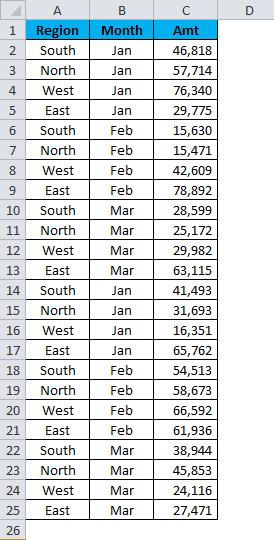
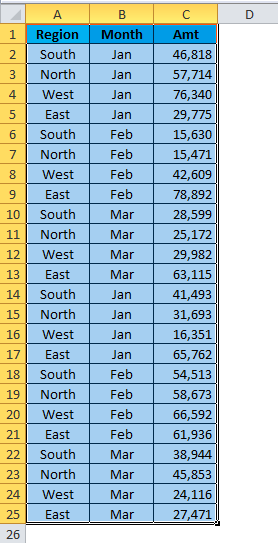
Step 1: Select Your Dataset
Select the complete data range, including column headers.
Ensure your dataset:
- Contains no blank rows or columns
- Has unique column names
- Is organized in a tabular format.
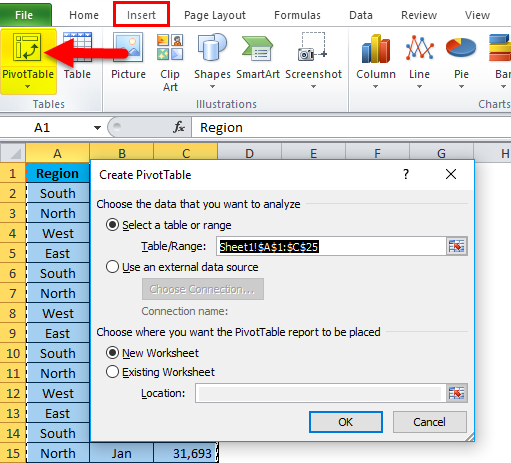
Step 2: Insert a Pivot Table
- Go to the Insert tab.
- Click PivotTable.
- Verify the selected data range.
- Choose New Worksheet (recommended).
- Click OK.
Excel creates an empty Pivot Table along with the PivotTable Fields pane.
Step 3: Build the Pivot Table
From the PivotTable Fields pane:
- Drag Region to the Rows area
- Drag Amount (Sales) to the Values area.
Excel automatically calculates the total sales for each region.
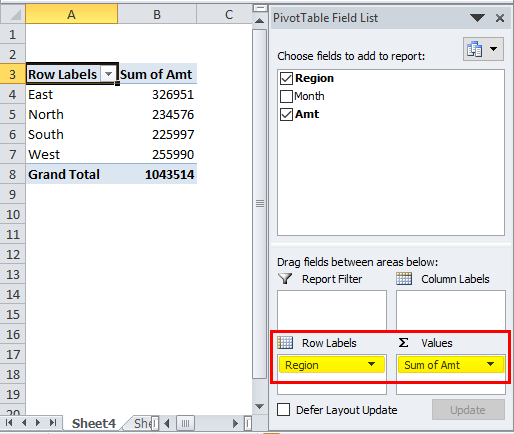
Your Pivot Table now displays a summarized sales report instead of thousands of individual records.
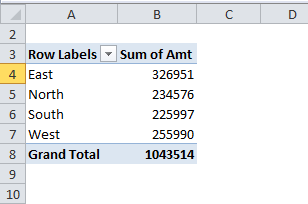
Step 4: Insert the Pivot Chart
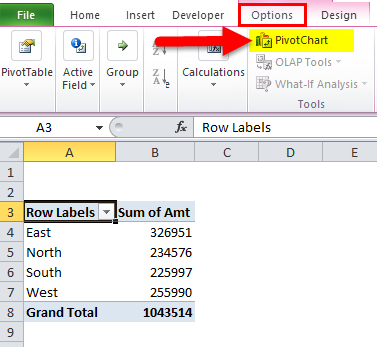
Click anywhere inside the Pivot Table.
Then:
- Go to the PivotTable Analyze tab (called Options in some Excel versions).
- Click PivotChart.
- The Insert Chart dialog box appears.
- Choose a chart type, such as:
- Clustered Column
- Bar
- Line
- Pie
- Area
- Click OK.
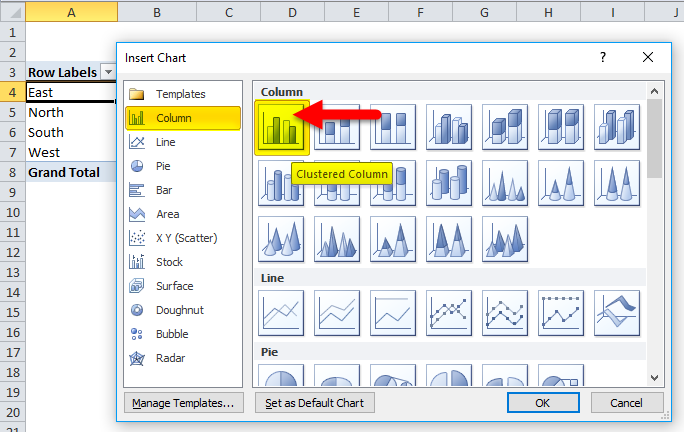
Excel creates a Pivot Chart that is directly linked to the Pivot Table.
Step 5: Understand the Pivot Chart
Your Pivot Chart now displays the total sales for each region.
Unlike a regular Excel chart, it includes interactive Field Buttons that allow you to:
- Filter categories
- Sort values
- Expand or collapse data
- Analyze different views without rebuilding the chart.
These controls make Pivot Charts much more flexible than standard charts.
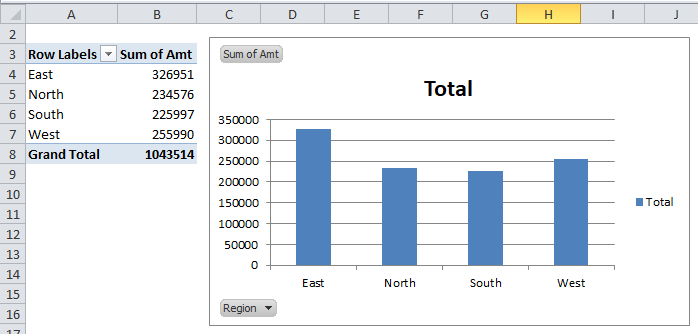
Step 6: Analyze Monthly Sales Trends
To make the chart more insightful:
- Drag Month into the Columns area of the Pivot Table.
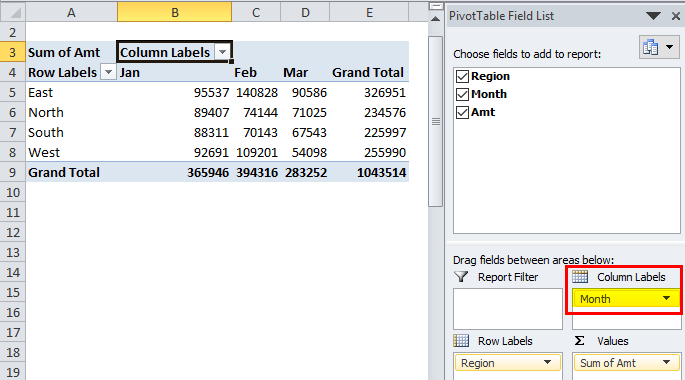
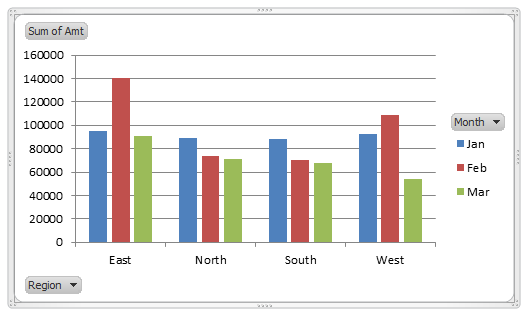
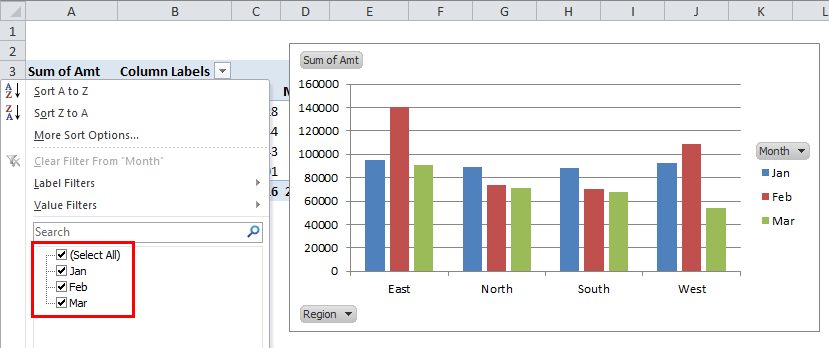
Excel immediately updates both the Pivot Table and the Pivot Chart. Instead of displaying only regional totals, the chart now breaks down sales by Region and Month, allowing you to identify seasonal patterns, compare regional performance, and spot high- and low-performing months at a glance.
Step 11: If you want to show the result only for Jan, you can select the Jan month from the drop-down list.
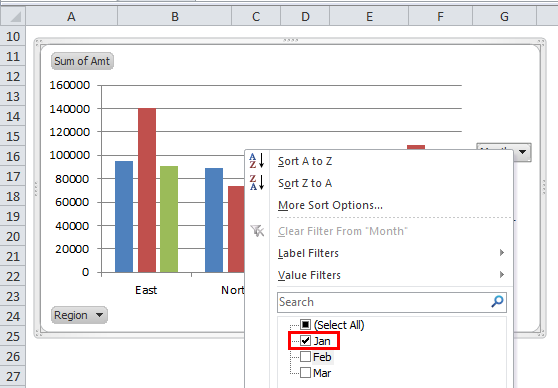
Step 12: It will show the results only for Jan. The important thing is not only in the chart section but also in the pivot region.
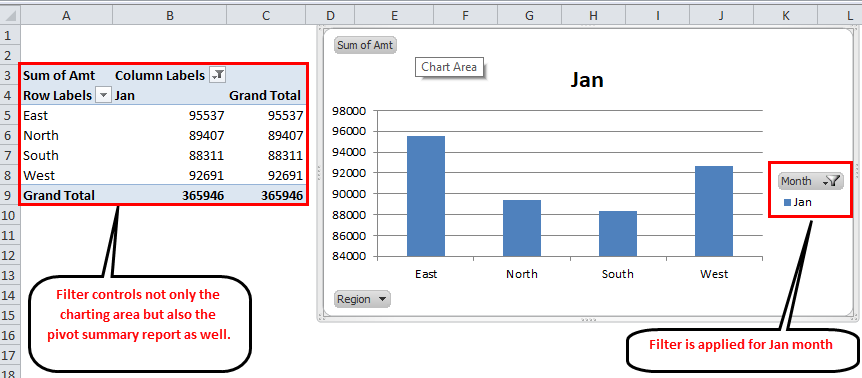
Step 13: A pivot chart controls the pivot, and a pivot table controls the pivot chart. Now the filter is applied in the pivot chart, but we can also release the filter in the pivot table.
Step 7: Customize the Pivot Chart
Click anywhere on the Pivot Chart to display the Chart Design and Format tabs.
From here, you can:
- Change the chart style and color.
- Add or remove chart elements.
- Modify the chart title.
- Display or hide the legend.
- Show data labels.
- Format the axes and gridlines.
These options help you create professional-looking reports and dashboards.
Why Use a Pivot Chart Instead of a Normal Chart?
A standard chart requires manual updates whenever the source data changes. In contrast, a it is dynamic and works directly with a Pivot Table.
Some key benefits include:
- Automatically updates after refreshing the Pivot Table
- Filters data without recreating the chart
- Works seamlessly with Slicers and Timelines
- Handles large datasets efficiently
- Simplifies dashboard creation
- Makes business reports more interactive
- Reduces manual chart formatting and maintenance.
Insert a Slicer Into the Table
While Field Buttons are useful, Slicers offer a more user-friendly, interactive way to filter Pivot Tables and Pivot Charts. A slicer serves as a visual filter, allowing users to filter data with a single click rather than using drop-down menus.
1: Place a cursor inside the pivot table.
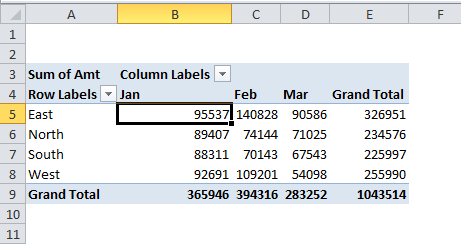
2: Go to Option and select Insert Slicer.
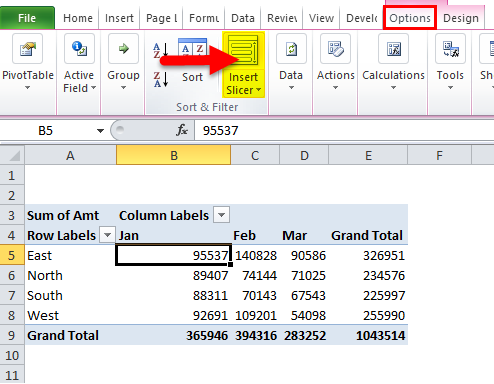
3: It will show you the options dialogue box. Select the field for which you need a slicer.
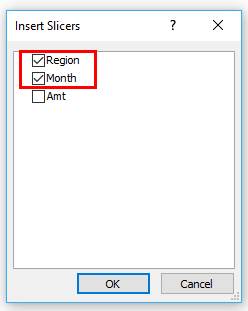
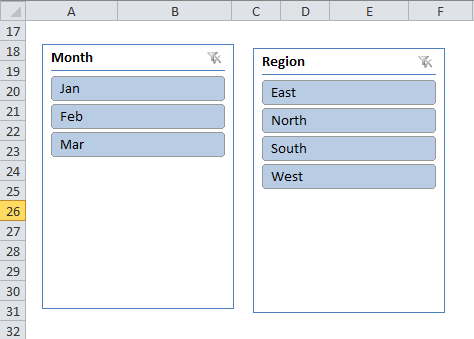
4: After selecting the option, you will see the actual slicer visual in your worksheet.
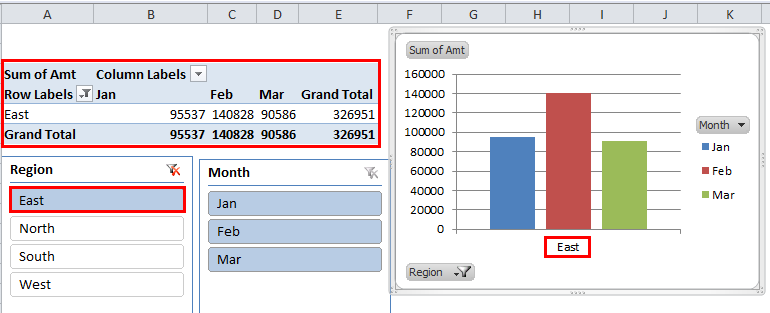
5: Now, you can control the table and chart from the SLICERS. As per your selection in the slicer, the table and chart will show their results accordingly.
To select multiple values:
- Hold Ctrl while clicking.
- Or enable Multi-Select from the slicer.
To clear the filter, click the Clear Filter button in the top-right corner of the slicer.
Why use Slicers?
- Easier than drop-down filters
- More visually appealing
- Excellent for dashboards
- Supports multiple selections
- Filters Pivot Tables and Pivot Charts simultaneously.
Use Timeline Filters (For Date Fields)
If your dataset contains dates, you can use a Timeline instead of a slicer.
A Timeline lets you filter data by:
- Year
- Quarter
- Month
- Day
Insert a Timeline
- Click inside the Pivot Table.
- Go to PivotTable Analyze.
- Click Insert Timeline.
- Select the Date field.
- Click OK.
Drag the Timeline slider to quickly analyze data for a specific period.
Timelines are especially useful for:
- Sales dashboards
- Financial reports
- Budget analysis
- Inventory tracking.
Refresh a Pivot Chart
If the source data changes, the Pivot Table and Pivot Chart do not update automatically until they are refreshed.
To refresh:
- Click anywhere inside the Pivot Table.
- Go to the PivotTable Analyze tab.
- Click Refresh.
Alternatively:
- Right-click the Pivot Table.
- Select Refresh.
The Chart updates immediately with the latest data.
Keyboard Shortcut:
Press Alt + F5 to refresh the selected Pivot Table.
If your workbook contains multiple Pivot Tables:
- Go to the Data tab.
- Click Refresh All.
Excel refreshes every Pivot Table and Pivot Chart in the workbook.
Common Pivot Chart Problems and Solutions
Below are some common issues users encounter while working with Pivot Charts.
| Problem | Possible Cause | Solution |
| Pivot Chart not updating | Pivot Table not refreshed | Click Refresh or press Alt + F5 |
| New data not appearing | Source range is fixed | Convert the source into an Excel Table or update the data source |
| Slicer not filtering the chart | Incorrect Pivot Table connection | Use Report Connections to connect the slicer |
| Missing categories | Filters applied | Clear filters from the Pivot Table or Slicer |
| Wrong totals displayed | Incorrect Value Field Settings | Check whether values are summarized by Sum, Count, Average, etc. |
| Chart looks cluttered | Too many categories | Apply filters or group similar data |
Things to Remember About Pivot Charts
- A Pivot Chart always works with a Pivot Table
- Refresh the Pivot Table whenever the source data changes
- Convert your data into an Excel Table to make expanding datasets easier to manage
- Use Slicers and Timelines for interactive filtering
- Choose the chart type that best represents your data
- Keep the source data clean and organized for accurate results
- Avoid overcrowding charts with too many categories
- Use meaningful titles and labels to improve readability
- Multiple Pivot Charts can be connected to the same Pivot Table for dashboard reporting.
Final Thoughts
Pivot Charts are one of Excel’s most effective tools for transforming large datasets into meaningful visual reports. By combining the analytical power of Pivot Tables with interactive charts, you can quickly identify trends, compare performance, and make data-driven decisions.
Whether you are creating sales reports, financial summaries, inventory dashboards, or business presentations, Pivot Charts help simplify complex information and make your reports more engaging. By using features such as Slicers, Timelines, and dynamic filtering, you can build interactive dashboards that update with just a few clicks, saving time while improving accuracy.
Frequently Asked Questions (FAQs)
Q1. What is a Pivot Chart in Excel?
Answer: A Pivot Chart is an interactive chart linked to a Pivot Table. It summarizes large datasets visually and updates automatically whenever the Pivot Table is refreshed.
Q2. What is the difference between a Pivot Table and a Pivot Chart?
Answer: A Pivot Table displays summarized data in rows and columns, while a Pivot Chart presents the same summarized data as a visual graph for easier analysis.
Q3. Can I create a Pivot Chart without a Pivot Table?
Answer: No. Every Pivot Chart is based on a Pivot Table. Excel automatically creates or links the chart to a Pivot Table.
Q4. Why is my Pivot Chart not updating?
Answer: The most common reason is that the Pivot Table has not been refreshed. Right-click the Pivot Table and select Refresh, or press Alt + F5.
Q5. Can I use multiple Pivot Charts with one Pivot Table?
Answer: Yes. You can create multiple Pivot Charts from the same Pivot Table, allowing you to visualize the data in different ways.
Q6. Can Slicers control multiple Pivot Charts?
Answer: Yes. If the Pivot Charts are connected to the same Pivot Table or data source, a single slicer can filter all of them simultaneously.
Q7. Which chart type is best for a Pivot Chart?
Answer: It depends on the data:
- Column charts for category comparisons
- Line charts for trends over time
- Bar charts for comparing many categories
- Pie charts for showing proportions with a limited number of categories.
Q8. Are Pivot Charts available in all Excel versions?
Answer: Yes. Pivot Charts are available in Excel 2016, Excel 2019, Excel 2021, Excel 2024, and Microsoft Excel 365, with minor interface differences.
Recommended Articles
We hope this guide on Pivot Charts in Excel helps you create dynamic, interactive reports and visualize your data more effectively. Explore these recommended articles to learn more about Pivot Tables, Excel charts, dashboards, data analysis, and advanced Excel techniques.

