

Updated May 4, 2023
Difference Between Predictive Analytics vs Statistics
Predictive Analytics vs Statistics is the comparison between two techniques that are used for data analysis. Predictive Analytics helps to predict the futuristic value or the outcomes based on past and present data sets. At the same time,s statistics is the mathematical computation of data for analyzing, interpreting, and identifying correlations. Predictive analytics depends upon advanced machine learning algorithms such as regression and classification for generating predictive data models. Statistics uses basic mathematical formulas and concepts such as identifying mean, median, mode, hypothesis testing, variance, and standard deviation calculation to identify data distributions. Predictive analytics are implemented based on statistical analysis.
Head-to-Head Comparison Between Predictive Analytics vs Statistics (Infographics)
Below are the top 6 comparisons between Predictive Analytics vs Statistics:
Key Differences Between Predictive Analytics vs Statistics
Below is the list of items that explain the differences between Predictive Analytics vs Statistics:
- Predictive Analytics is used to make predictions about unknown future events. Whereas statistics is the science used primarily in ‘Research.’ Statistics help in concluding the data by collecting, analyzing, and presenting.
- For a business to bloom, it must collect and generate facts that reflect its current status. Statistics help change these facts or data into information to support rational management decision-making.
How Does it Work?
In Predictive Analytics, predictive models use known results to develop or train a model that can be used to predict values for different or new data. This modeling provides results in the form of predictions that represent a probability of the target variable based on estimated importance from a set of input variables.
Statistics summarizes the data for public use.
There are two main statistical methods: Descriptive Statistics and Inferential Statistics.
- Descriptive Statistics: It summarizes the data from a sample using indexes such as mean or standard deviation.
- Inferential Statistics: It concludes the data subject to random variation, such as observation errors and sample variation.
Predictive Analytics includes Data Collection, Data Modeling, and Statistics. Predictive models play a vital role in predictive analytics.
There are two types of predictive models.
- Classification models
- Regression models
A popular method in statistics and works for predictive analytics too.
- Predictive Analytics is not single; it includes and depends on algorithms and methodologies. Examples are Regression models, Time series analysis, etc.
- Statistics help analysts build a predictive model to foresee business results, so it typically comes under data science, statistical analysis, and other skilled data analysis.
- In Predictive Analytics and Statistics, data engineers help gather relevant data and prepare it for analysis. In a way, statics acts as an input data source for predictive analytics.
- Once the data is collected, a statistical model is formulated, trained, and modified to produce accurate results. The model is then run against the selected data to generate predictions.
- Let’s take real-life examples or scenarios to understand them better. Some famous examples are Weather forecast, Trading, Healthcare, and retail.
- In reality, it’s all about finding patterns in vast data. Applying suitable statistical models allows you to gain insights from the information available. The hidden designs unveiled by the process make it possible to make predictions.
- Let’s examine one scenario to understand how statistics and predictive analytics guess future events.
- Big companies are using predictive analytics. For example, open your Amazon site and take a look around the site. A considerable percentage of the screen is devoted to “recommended” products, and each recommendation area is a slightly different predictive algorithm based on other data.
Predictive Analytics vs Statistics Comparison Table
Below is the Comparison Table, which explains the differences between Predictive Analytics vs Statistics:
| Predictive Analytics | Statistics | |
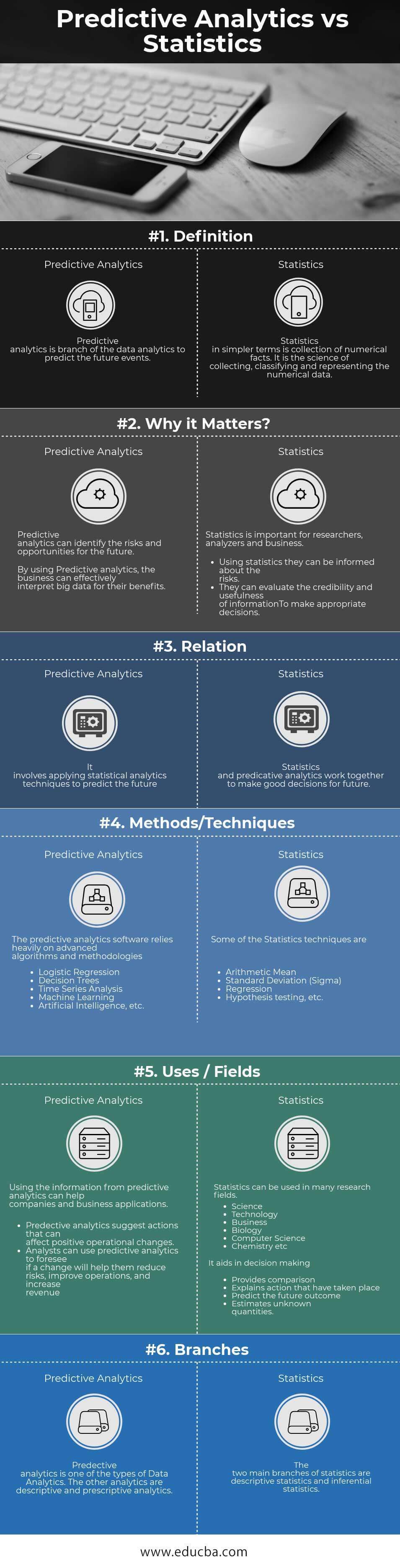
| Definition | Predictive analytics is a branch of data analytics to predict future events. | Statistics, in simpler terms, is a collection of numerical facts. It is the science of collecting, classifying, and representing numerical data. |
| Why it Matters? | Predictive analytics can identify the risks and opportunities for the future. By using Predictive analytics, the business can effectively interpret big data for their benefit.
|
Statistics are essential for researchers, analyzers, and businesses.
|
|
Relation |
It involves applying statistical analytics techniques to predict the future. | Statistics and predictive analytics work together to make good decisions for the future. |
| Methods/ Techniques | Predictive analytics software relies heavily on advanced algorithms and methodologies.
|
Some of the Statistics techniques are:
|
| Uses / Fields | Using the information from predictive analytics can help companies and business applications.
|
Statistics can be used in many research fields.
|
| Branches | Predictive analytics is one of the types of Data Analytics. The other analytics are descriptive and prescriptive. | The two main branches of statistics are descriptive statistics and inferential statistics. |
Conclusion
Predictive Analytics and Statistics are used to analyze current and historical data to predict future events. Predictive analytics uses many techniques, from data mining, statistics, modeling, machine learning, and artificial intelligence. Predictive analytics requires a high level of expertise with statistical methods and the ability to build predictive data models. So we can conclude that both work together to draw conclusions and predictions from the data.
Recommended Articles
This has been a guide to Predictive Analytics vs Statistics. Here we have discussed Predictive Analytics vs Statistics head-to-head comparison, key differences, infographics, and comparison table. You may also look at the following articles to learn more –

