


Updated May 22, 2023
How to Evaluate an Employer – When opportunities keep coming your way, it becomes tough to decide which one to pick and which to drop. No matter what decision you make, it will directly affect your career and then life. Moreover, there’s the opportunity cost of the offers you decide to let go of because of one offer you choose to accept.
If you have been working for some time, you would know that the employer who chooses you is an equal partner in the recruitment process. You’re not the only one seeking the job; they’re also trying to sell the companies to prospective employees like you. So, the way they evaluate you and your performance via a telephonic round of interviews, the pattern of resume and cover letter, face-to-face interviews, psychometric tests, and various other big and small evaluation techniques, why don’t you evaluate the employer?
It would be best to evaluate the employers before accepting any offer because it would be a long-term commitment for you, and you will be giving part of your life away because you choose to work for them. If it’s not the best one, won’t you regret it?
In this article, we will show you how to evaluate your employer simply by observation. As a smart professional, you already know that you’re a reasonable observer. We will tell you what to look for. And you would be equipped to understand which employer will serve you the best in achieving your long-term goal.
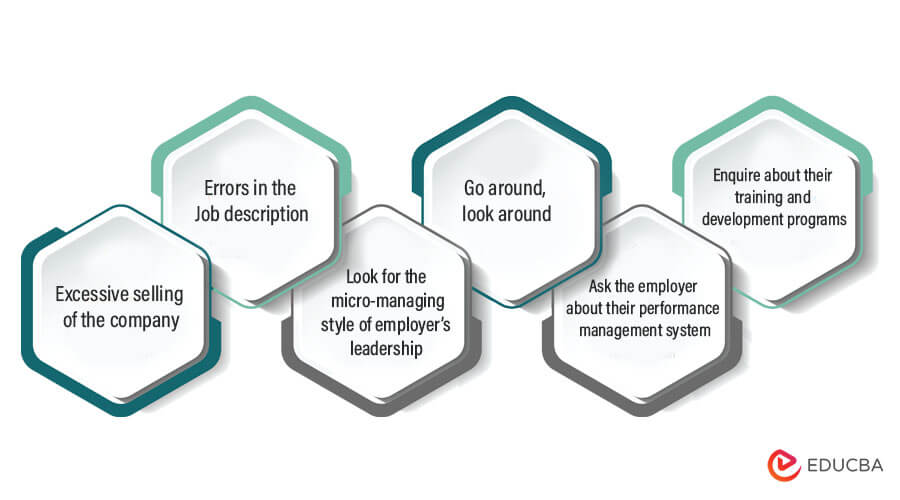
Parameters to Evaluate an Employer
Let’s dive in.
-
Excessive selling of the company
Do you think there is a difference between looking confident and being confident? If you pay heed, many recruiters who take your interviews look very confident but don’t feel very confident. How do you understand that? Just look at their behaviors closely. Notice their tone of voice, extra emphasis on a few words, trying to be more stylish than usual, and being unable to look into your eyes constantly. They do that because they inherently don’t feel confident about themselves or the company. So, they camouflage themselves under the false shadow of confidence. But you’re so absorbed in convincing the recruiter you don’t notice. If you’re confident about your ability, don’t worry about convincing the employer; try to be confident about the company’s merit.
The recruiters are the faces of the company, and they convey what you should look for to evaluate your employers. Other than looking confident (not being confident), they show a few things that you should look for if you want to consider your potential employer about their worth as a company.
Look for signs when they sell you excessively about the company. If they mention a few lines about the company, it’s a natural protocol; every recruiter should do that. But if they take time to talk about all the achievements, awards, past successes, and the founder members of the company, it’s a red flag. You should ask yourself – “Why they’re overselling the company?” Then do your part to look for more signs and symbols.
Other than interviews, look at the email they sent you. How they introduce you makes a huge difference. The recruiters who send you long emails depicting their company in detail should be wary of them. They talk more about the company than about the job. Most people don’t notice it, but not you. You need to evaluate the company and question why they oversell the company and its successes! Are they not confident about the company? Or are they simply more about the company than about themselves?
-
Errors in the Job description
If the company is a start-up, how would you possibly know about them or evaluate them? They don’t have any past records. If you search in Google, very little information you will get. How would you judge them or, better to say, evaluate them as a company?
Here’s the simple thing you need to follow.
Once the recruiter calls you from the company, ask for the job description. First, notice how the recruiter is talking over the phone! Is s/he fluent in communication or gulping words in between? If ‘s/ he is good at communication, you can ask him/her for the job description. Please note that evaluating doesn’t mean humiliating. Be polite in your conversation; observe and see for yourself.
Once s/he sends the job description, read it through and through. Firstly, you don’t need to browse it to read the key responsibilities; instead, look for typos, structure, and communication style. A great company pays great attention to communication and how communication conveys its brand image because it does. How would you judge a company if the job description of the said position speaks like “importent” rather than “important”?
Read it through, and if you feel intrigued, go to the company website and then check for yourself the way the image of the company is being presented. You will get enough idea about what the company is all about and how they treat their employees.
-
Look for the micro-managing style of employers’ leadership
To every company, leadership matters. Without the guidance of able leader/s, the company would not be able to perform as it desires in the long run. And if the company doesn’t perform well, as an employee, you won’t. So, you need to look for signs that will prove what sort of leadership the company currently has.
You may not always ask directly about what kind of leadership they’re having during the interview session because it’s too direct. Instead, look for the symbols. If a panel of interviewers is interviewing you, give the interview with confidence; but while giving the interview, look for occasional clues about how they behave and how they look. Few of them can say that their company is not micro-managing anything. If they say that, it means they’re the micromanagers; if they’re, there’re some issues.
If HR people interview you, you can get an opportunity to look for people who’re sitting in their private cabins and working (the CEOs). Try to have an occasional glimpse. You will understand whether they’re cheerful or very reserved. You can also closely watch the employees and how they behave. Are they fearful? Are they joyous? Are they serious? Are they funny? Look for clues, and you will understand how their seniors treat them in the working environment. And then you can know whether this is suitable for you to grow or not.
-
Go around, look around.
The company where you got the offer or gave an interview should be evaluated before you give your nod to the prospective employer. You need to check whether the employer is as accurate in its core as the faces of the company are depicting. How would you know? Go around, look around.
First, you do what’s easy. Go online and check for stats. Don’t forget when you’re hired, the recruiters and the employers ask you to present stats, the proof which can be treated as evidence of your success or paycheck. So, if they can evaluate you and second guess you while thinking about their return on investment (ROI), shouldn’t you do the same with your potential employer?
Yes, you must.
Go to Google and then type in their name. Search for any leads that you get. Search on Linked In, Facebook, and Twitter. Check out blogs of people who talk about them. Do research on your own before you say ‘yes’ to the prospective employer.
Once the easiest step is taken, go for another route. Find out people who used to work in the organization and then try to connect with them. They may say good or bad about the company. But make sure you either call them or meet face to face. Mere chat is not always enough to judge them. Talk to a few ex-employees and then make your judgment.
-
Ask the employer about their performance management system
The company you’re about to join may be new or a start-up. But the thing is, you need to know the employer’s approach to the performance of its employees. How would you know that? Ask them how they judge the performance of the employees and how they get rewarded for excellent performance.
When you’re facing a recruiter or the employer, it’s/he may tell you that the salary is negotiable. If you ask for any benefits, they may say to you that the performance benefits depend on your performance. Don’t stop there. Most of the people stop there and don’t ask anything else.
Instead, tell them it’s not enough for you to know it’s negotiable. You need to know at least the salary range they would be offered per annum. You can use this script once they’re optimistic about hiring you. Once the employer tells you the range, ask about the performance management system. They may not tell you in detail, but you will have a fair idea of how the employee’s performance is rewarded.
Anyone looking for better opportunities looks for opportunities with better reward systems, not only in terms of compensation and benefits but also in terms of recognition and promotion. If the performance management system is not sound for a company, the employer may probably not treat you well.
Do a calculation of opportunity cost. If you decide to join the company and stay there for two years at least, how would you suffice the cost of not joining any other company? Does the opportunity cost more or benefit? If you don’t see the benefit, don’t join the company.
-
Enquire about their training and development programs.
Most companies that focus on cutting costs than improving profits don’t perceive training and development as an investment. They put it in a cost structure and prevent the human resource department from campaigning about T&D. Think about how many courses, books, articles, audios, podcasts, and videos you’ve gone through to reach this place. How about not being encouraged to learn more and attend more training to hone your skills as a professional? Not good!
There’s an equation called “E versus E.” The first E stands for Education, and the last stands for Entertainment. You can join a company with about 70% education and 30% entertainment. Most of companies, you should avoid putting more emphasis on throwing parties than building an inherent knowledge management system.
This is the age of being a learning organization. If you’ve heard about Peter Senge, you would know the learning organization concept. As employees, everyone should be treated as knowledge workers. And without training and development, no company can encourage implementing a knowledge management system within the company. So how can you serve employers without the encouragement of continuous learning? You won’t.
Whenever the employer interviews you during the interview where you would like to see yourself after five years, respond promptly – You mean to say in your company or general. Most of the time, employers would ask you the question generally! If it’s a general question, answer that and then ask – “I have a question! What if I join your company and would like to serve the company using my highest potential? Do you have any system or ongoing process to nurture the human capital?” Wait for the employer’s answer, and you can make out from his/her answer what sort of company it is – a training-oriented company or a cutting-cost company!
When an employer tends to evaluate you on the basis of whether you’re capable or not and would be beneficial for the ROI of the company, they don’t think about how you would feel! Because employers know that it’s their job to check on candidates. Then why won’t you judge or evaluate the employers on your scorecard? Use the above six significant parameters to assess whether the employers are worthy of your service for a few years. No matter what you choose, make sure you don’t compromise on your growth by any means.

