


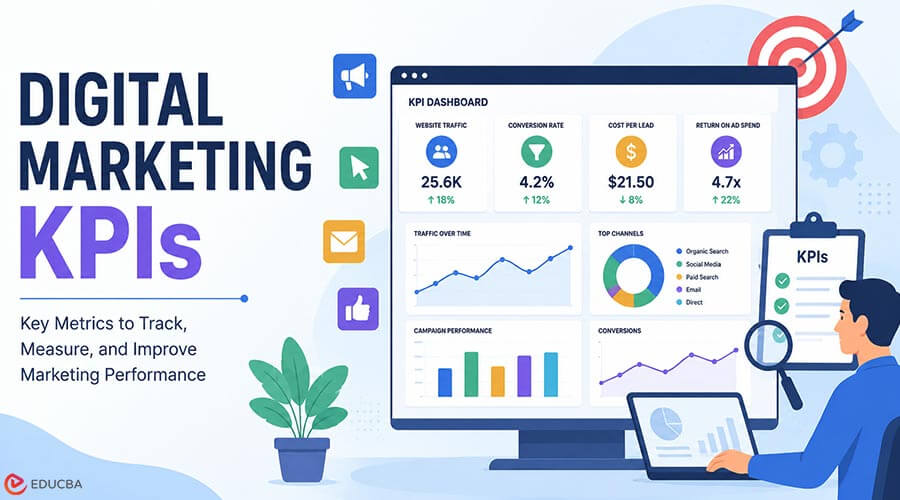
Digital marketing helps businesses reach customers through search engines, social media, email, websites, paid advertising, and other online channels. However, simply running digital marketing campaigns does not guarantee success. Businesses need to measure whether their efforts generate traffic, engagement, leads, sales, and revenue.
This is where Digital Marketing KPIs become important. Key Performance Indicators (KPIs) provide measurable values that help marketers understand campaign performance and make informed decisions.
For example, an e-commerce business may track conversion rate to understand how many website visitors purchase products. A B2B company may focus on lead generation, cost per lead, and customer acquisition cost. Similarly, a content-focused website may monitor organic traffic, engagement, and returning visitors.
The right KPIs depend on the business goal, marketing channel, target audience, and campaign type. Tracking too many metrics can also create confusion. Therefore, marketers should select KPIs that directly connect marketing activities with business objectives.
Table of Contents
- Meaning
- Importance
- Types
- Real-World Examples
- How to Select?
- Common Mistakes
- Dashboard
- Best Practices
Key Takeaways
- Digital Marketing KPIs help businesses measure the effectiveness of their online marketing activities.
- The right KPIs depend on specific business goals, marketing objectives, and digital channels.
- Website and SEO KPIs such as organic traffic, keyword rankings, CTR, and conversions help evaluate search performance.
- Social media KPIs such as reach, engagement rate, clicks, and conversions help measure audience interaction and campaign results.
- Email marketing KPIs include open rate, CTR, conversion rate, and unsubscribe rate.
- Paid advertising KPIs such as CPC, CPL, CPA, and ROAS help businesses evaluate advertising efficiency.
- Conversion and revenue KPIs connect marketing activities with leads, customers, sales, and business growth.
- Businesses should avoid relying only on vanity metrics such as followers, impressions, or likes.
- Marketers should regularly review KPI data, compare performance over time, and use insights to optimize campaigns and allocate budgets effectively.
- A focused KPI dashboard can help marketing teams monitor performance and make data-driven decisions.
What Are Digital Marketing KPIs?
Digital Marketing KPIs are measurable values that businesses use to evaluate the performance and effectiveness of their digital marketing activities.
These KPIs help marketers answer questions such as:
- How many people visit the website?
- Where does the traffic come from?
- How many visitors become leads or customers?
- How much does the business spend to acquire a customer?
- Which marketing channel generates the highest return?
- How effectively do customers interact with content?
- How much revenue does a campaign generate?
For example, suppose an online clothing store spends ₹50,000 on digital advertising and generates ₹2,00,000 in sales. The business can use metrics such as Return on Ad Spend (ROAS) to evaluate whether the advertising campaign was profitable.
KPIs transform marketing performance from assumptions into measurable results.
Why Are Digital Marketing KPIs Important?
Digital Marketing KPIs help businesses understand what works and what needs improvement. Instead of relying only on impressions or follower counts, marketers can connect their activities to meaningful business outcomes.
1. Measure Marketing Performance
KPIs show whether a campaign achieves its intended objective.
For example, if a company launches a lead-generation campaign, it can track the number of leads, conversion rate, and cost per lead.
2. Support Data-Driven Decisions
Marketers can use KPI data to decide where to increase, reduce, or redirect their marketing budget.
If Google Search Ads consistently generate customers at a lower acquisition cost than display advertising, the company may allocate more budget to search campaigns.
3. Identify Problems
KPIs can reveal problems within the customer journey.
For example, a website may receive thousands of visitors but generate very few purchases. This situation may indicate problems with the landing page, product information, pricing, checkout process, or overall user experience.
4. Improve Return on Investment
Businesses can compare marketing costs with results to understand whether campaigns generate sufficient returns.
5. Set Clear Goals
KPIs turn broad marketing goals into measurable targets.
Instead of saying, “We want more website traffic,” a business can set a goal such as, “Boost organic website visits by 25% within the next six months.”
Types of Digital Marketing KPIs
Different marketing channels require different KPIs. A useful approach is to group them by customer-journey stage and marketing objective.
1. Website Traffic KPIs
These KPIs help marketers understand how many people visit their websites and where those visitors come from.
Website Traffic
Website traffic represents the number of visits or sessions a website receives.
For example, an educational website may publish SEO-focused articles to attract users from search engines. If monthly organic traffic increases from 100,000 to 130,000 sessions, the business can use this information to evaluate its SEO and content strategy.
However, high traffic does not automatically mean high revenue. Marketers should combine traffic data with engagement and conversion metrics.
Users
Users represent the number of unique visitors who access a website during a selected period.
For example, if a website receives 50,000 sessions from 30,000 users, the business can see that some visitors returned multiple times.
Traffic Sources
Traffic source data shows where visitors come from. Common sources include:
- Organic search
- Paid search
- Social media
- Referral websites
- Direct traffic
This KPI helps marketers identify the channels that attract visitors.
New vs. Returning Visitors
This metric helps businesses understand whether they attract new audiences and retain existing visitors.
A content website may use returning visitors as an indicator of audience loyalty, while an e-commerce company may analyze returning users to understand repeat purchase behavior.
2. SEO KPIs
Search engine optimization is essential for building an effective digital marketing strategy. SEO KPIs help marketers measure visibility and organic performance.
Organic Traffic
Organic traffic measures visitors who reach a website through unpaid search results.
For example, a software company may create articles around software-related keywords. If organic traffic increases after publishing and optimizing these articles, the company can evaluate the effectiveness of its SEO strategy.
Keyword Rankings
Keyword rankings show where a website appears in search engine results for specific search queries.
A business may track whether an important keyword moves from position 15 to position 5.
However, rankings alone do not indicate business success. Marketers should also evaluate traffic, conversions, and revenue generated from organic search.
Click-Through Rate
Organic CTR indicates the percentage of searchers who click on a website’s listing after viewing it in search results.
The basic formula is:
For example, if a page receives 1,000 impressions and 80 clicks, its CTR is 8%.
A low CTR may encourage marketers to improve the page title and meta description.
Backlinks
Backlinks are hyperlinks from external websites that direct users to a business’s website. Marketers can monitor the number and quality of backlinks as part of their SEO strategy.
For example, an industry publication linking to a company’s research report can help strengthen the site’s authority and potentially generate referral traffic.
3. Content Marketing KPIs
Content marketing KPIs help businesses evaluate how effectively their content attracts and engages audiences.
Page Views
Page views show how many times users view a webpage.
For example, a company publishing a guide to digital marketing may compare page views across articles to identify the topics that attract the most interest.
Average Engagement Time
This metric indicates how long users actively engage with a page or website.
Higher engagement can suggest that visitors find the content useful, although marketers should interpret the metric alongside other indicators.
Content Conversion Rate
Content conversion rate measures how effectively content encourages users to complete a desired action.
For example, a blog post can encourage readers to access an e-book or enroll in an upcoming webinar.
Downloads
Businesses can track downloads for resources such as:
- E-books
- Whitepapers
- Templates
- Guides
- Reports
- Product brochures
These actions can be particularly useful for B2B businesses that use content to generate leads.
4. Social Media KPIs
Social media platforms provide several metrics for measuring audience engagement and business results.
Followers
Follower count shows the size of a social media audience. However, marketers should not treat follower growth as the only measure of success.
A brand with 10,000 highly engaged followers may generate more value than a brand with 100,000 inactive followers.
Engagement Rate
Engagement rate measures interactions such as likes, comments, shares, and saves relative to audience size or reach.
For example, a fitness brand may publish an educational workout video. If users actively comment, save, and share the content, the brand can identify strong audience interest.
Reach
Reach refers to the total number of individual users who view a piece of content.
A business can compare reach across posts to identify content that attracts broader audiences.
Social Media Click-Through Rate
Social CTR measures the percentage of users who click a link after seeing social media content.
This KPI becomes particularly important when a business uses social media to drive website traffic.
Social Conversions
Social conversions show how many users complete a desired action after interacting with social media content or advertising.
For example, an online retailer may track purchases generated from Instagram campaigns.
5. Email Marketing KPIs
Email marketing remains useful for customer communication, retention, promotions, and lead nurturing.
Open Rate
Email open rate shows the proportion of successfully delivered emails that recipients open.
Marketers can use this metric to evaluate subject lines and audience engagement, but modern email measurement can be affected by privacy features and should not be interpreted in isolation.
Click-Through Rate
Email CTR shows the share of email recipients who click on at least one link in the message.
For example, an online retailer may send an email promoting a seasonal sale. A high CTR can indicate that the message and offer encouraged recipients to visit the website.
Conversion Rate
Email conversion rate indicates the share of recipients who take the intended action after interacting with an email.
The action may include:
- Purchasing a product
- Registering for an event
- Downloading a resource
- Booking a consultation
- Starting a free trial
Unsubscribe Rate
The unsubscribe rate shows how many recipients opt out of an email list.
A sudden increase may indicate that a business sends emails too frequently or delivers content that does not match subscriber expectations.
6. Paid Advertising KPIs
Paid advertising requires marketers to monitor both campaign performance and financial efficiency.
Impressions
Impressions show the total number of times users are exposed to an advertisement.
This metric helps measure exposure but does not necessarily indicate engagement or conversions.
Cost Per Click
Cost Per Click (CPC) measures how much an advertiser pays for each click.
For example, if a business spends ₹20,000 and receives 4,000 clicks, its CPC is ₹5.
Click-Through Rate
Paid advertising CTR measures the percentage of impressions that result in clicks.
A low CTR may suggest that the advertisement does not match the audience’s interests or that the creative needs improvement.
Cost Per Lead
Cost Per Lead (CPL) is the amount a business spends to generate each lead.
For example, if a company spends ₹30,000 and generates 300 leads, its CPL is ₹100.
Cost Per Acquisition
Cost Per Acquisition (CPA) measures the average cost of acquiring a customer or completing a defined conversion.
A business can compare CPA across advertising channels to determine which channels most efficiently acquire customers.
7. Conversion and Lead Generation KPIs
These KPIs help marketers understand whether visitors and prospects take valuable actions.
Conversion rate reflects the share of visitors who complete a specific target action, such as placing an order or submitting their details.
Suppose an e-commerce website receives 20,000 visitors and generates 600 purchases.
The conversion rate is:
600 ÷ 20,000 × 100 = 3%
The business can then test product pages, offers, checkout processes, and landing pages to improve this percentage.
Lead-to-Customer Rate
This KPI shows how many generated leads eventually become customers.
For example, if a business generates 1,000 leads and 100 become customers, the lead-to-customer rate is 10%.
This metric helps marketing and sales teams evaluate lead quality.
Landing Page Conversion Rate
Landing page conversion rate measures how effectively a specific landing page generates conversions.
A company may test two landing pages with different headlines, forms, images, or calls to action and compare their conversion rates.
8. Customer Acquisition and Revenue KPIs
Marketing should ultimately contribute to business growth. Revenue-related KPIs help connect marketing activities with financial outcomes.
Customer Acquisition Cost
Customer Acquisition Cost (CAC) measures the average cost of acquiring a new customer.
For example, if a company spends ₹5,00,000 on sales and marketing and acquires 500 new customers, its CAC is ₹1,000.
Customer Lifetime Value
Customer Lifetime Value (CLV or LTV) estimates the revenue a business can generate from a customer over the lifetime of the relationship.
For example, if a customer typically spends ₹2,000 per purchase, makes 5 purchases, and remains active for several years, the company can estimate the customer’s long-term value.
Businesses can compare LTV with CAC to understand the sustainability of customer acquisition.
Return on Investment
Marketing ROI measures the financial return generated from marketing investment.
A basic formula is:
For example, if a campaign generates ₹3,00,000 in revenue from a ₹1,00,000 investment:
ROI = [(₹3,00,000 − ₹1,00,000) ÷ ₹1,00,000] × 100 = 200%
This indicates that the campaign generated a 200% return based on this calculation.
Return on Ad Spend
ROAS focuses specifically on advertising revenue.
If a company spends ₹50,000 on advertising and generates ₹2,00,000 in attributed revenue, its ROAS is 4 or 400%.
9. Customer Retention KPIs
Digital marketing does not stop after acquiring a customer. Businesses also need to measure retention.
Customer Retention Rate
Customer retention rate is the proportion of customers a business retains over a defined period.
A high retention rate can indicate strong customer satisfaction and effective retention strategies.
Repeat Purchase Rate
E-commerce businesses can track how many customers make repeat purchases.
For instance, a skincare company can use email promotions, tailored deals, and loyalty rewards to motivate existing customers to make repeat purchases.
Churn Rate
Churn rate reflects the share of customers who discontinue a service or stop engaging with a business during a defined period.
Subscription-based businesses closely monitor churn because losing customers can reduce recurring revenue.
Real-World Examples of Digital Marketing KPIs
Real-world campaigns show how businesses use digital marketing KPIs to measure performance, understand consumer behavior, and improve marketing strategies.
Example 1: Spotify – User Engagement
Spotify’s Wrapped campaign provides a strong example of using engagement-focused KPIs. The personalized campaign encourages users to view and share their listening summaries across social media.
Spotify can measure:
- Social media engagement
- Content shares
- App interactions
- Website visits
- New user sign-ups
- Returning users
These KPIs help Spotify understand how effectively the campaign encourages users to interact with and share its content.
Example 2: Nike – Social Media and Conversion KPIs
Nike uses social media, email marketing, websites, and mobile apps to promote its products and connect with customers.
For a product campaign, Nike can track:
- Social media engagement rate
- Website traffic
- Product-page views
- Click-through rate
- Add-to-cart rate
- Conversion rate
- Online sales
If a campaign generates strong social engagement but few purchases, Nike can review its messaging, product pages, pricing, or calls to action to improve conversions.
Example 3: HubSpot – Content Marketing KPIs
HubSpot uses educational content to attract audiences through search engines and other digital channels. Its blog covers topics related to marketing, sales, customer service, and business.
For this content strategy, marketers can monitor:
- Organic traffic
- Keyword rankings
- Organic CTR
- Page views
- Engagement
- Lead generation
- Conversion rate
An article may attract thousands of visitors but generate only a small number of leads. This shows why marketers should evaluate traffic alongside lead generation and conversion metrics.
Example 4: Coca-Cola – Brand Awareness KPIs
Coca-Cola’s Share a Coke campaign encouraged customers to find bottles with their names on them and share their experiences. Digital channels helped the campaign generate conversations and user participation.
For similar brand-awareness campaigns, marketers can track:
- Reach
- Impressions
- Social mentions
- Engagement rate
- Video views
- Content shares
- Brand searches
- Website traffic
These KPIs help determine whether a campaign increases brand visibility and encourages audience interaction.
Example 5: Amazon – E-Commerce Conversion KPIs
Amazon provides an example of how e-commerce businesses can connect digital marketing activity with purchasing behavior.
An e-commerce campaign can measure:
- Website traffic
- Product-page views
- Click-through rate
- Add-to-cart rate
- Cart abandonment rate
- Conversion rate
- Average order value
- Customer acquisition cost
- Return on ad spend
For example, high product-page traffic combined with a low conversion rate may indicate issues with pricing, product information, reviews, or the checkout process. Marketers can use these insights to improve the customer journey and increase sales.
These examples show that the right KPI depends on the campaign objective. Brand-awareness campaigns may focus on reach and engagement, while e-commerce campaigns may prioritize conversions, revenue, and ROAS.
How to Select the Most Relevant Digital Marketing KPIs?
Businesses should not track every available metric. Instead, marketers should select KPIs that support specific objectives.
Step 1: Define the Business Goal
Start with the desired business outcome.
Examples include:
- Increase sales
- Generate leads
- Improve brand awareness
- Increase website traffic
- Reduce customer acquisition cost
- Improve retention
Step 2: Identify the Marketing Objective
Connect the business goal with a marketing objective.
For example, a company that wants to increase sales may focus on conversion rate, CPA, ROAS, and revenue.
Step 3: Select Relevant KPIs
Choose a small group of KPIs that directly measure progress.
For an SEO campaign, relevant KPIs may include organic traffic, keyword rankings, CTR, conversions, and organic revenue.
Step 4: Set Benchmarks
Evaluate present results against past performance, industry standards, and outcomes from earlier campaigns.
Step 5: Review Performance Regularly
Marketers should monitor KPIs at appropriate intervals. Daily monitoring may work for paid advertising campaigns, while SEO performance often requires a longer evaluation period.
Step 6: Take Action
Data becomes useful only when marketers act on it.
If a landing page has strong traffic but low conversion rates, the marketing team can test a new headline, form, offer, or call to action.
Common Mistakes When Measuring Digital Marketing KPIs
Tracking Too Many Metrics
A dashboard containing dozens of metrics can make decision-making difficult. Marketers should focus on KPIs that directly support business goals.
Focusing Only on Vanity Metrics
Likes, followers, impressions, and views can provide useful context, but they do not always demonstrate business impact.
Ignoring Conversion Data
Traffic without conversions may not produce meaningful business value. Marketers should connect acquisition metrics with conversion and revenue metrics.
Using the Same KPIs for Every Channel
SEO, email, social media, paid advertising, and content marketing have different objectives. Each channel requires relevant performance indicators.
Looking at Data Without Context
A KPI can change because of seasonality, promotions, market conditions, website changes, or external events. Marketers should investigate the reasons behind changes rather than react to individual numbers.
Digital Marketing KPI Dashboard
A KPI dashboard brings important marketing data together in one place.
A business can create separate sections for:
| Marketing Area | Important KPIs |
| Website | Users, sessions, traffic sources, conversions |
| SEO | Organic traffic, rankings, CTR, conversions |
| Content | Page views, engagement, downloads, conversions |
| Social Media | Reach, engagement, clicks, conversions |
| Open rate, CTR, conversions, unsubscribe rate | |
| Paid Ads | CPC, CTR, CPL, CPA, ROAS |
| Sales | Leads, customers, CAC, revenue |
| Retention | Repeat purchases, retention rate, churn |
Best Practices for Measuring Digital Marketing KPIs
- Align KPIs with business goals: Choose metrics that demonstrate progress toward actual business outcomes.
- Use consistent measurement: Apply the same definitions and reporting periods when comparing campaigns.
- Segment your data: Analyze KPIs by audience, location, device, campaign, channel, or customer type when relevant.
- Compare trends: Look at performance over time rather than relying on a single day’s results.
- Connect marketing with revenue: Whenever possible, connect leads and campaigns with actual sales and revenue.
- Test and optimize: Use KPI data to identify opportunities for improvement and conduct controlled tests where appropriate.
- Avoid vanity metrics: Treat surface-level engagement metrics as supporting indicators rather than the sole measure of success.
Frequently Asked Questions (FAQ’s)
Q1. How do you set realistic targets for digital marketing KPIs?
Answer: Set targets using historical performance, industry benchmarks, campaign objectives, available resources, and business goals. Start with realistic targets and adjust them as you collect more performance data.
Q2. How can businesses track KPIs across multiple digital marketing channels?
Answer: Businesses can use analytics platforms, advertising dashboards, CRM systems, and marketing reporting tools to collect data from different channels. Combining these sources into one dashboard makes cross-channel performance easier to compare.
Q3. What is the role of attribution in measuring digital marketing KPIs?
Answer: Attribution helps businesses understand which marketing touchpoints contribute to conversions. It can show whether a customer discovered a brand through search, interacted with it on social media, clicked a link in an email, or converted after seeing an advertisement.
Q4. How can businesses identify which digital marketing channel performs best?
Answer: Businesses can compare channels using KPIs such as conversion rate, CAC, CPA, revenue, and ROAS. They should also consider the quality and lifetime value of customers generated by each channel.
Q5. Why should businesses review their digital marketing KPIs regularly?
Answer: Regular reviews help marketers identify changes in customer behavior, campaign performance, and market conditions. This allows them to adjust budgets, content, targeting, and strategies before performance declines.
Final Thoughts
Digital Marketing KPIs help businesses measure whether their online marketing activities produce meaningful results. From website traffic and SEO performance to conversion rate, customer acquisition cost, ROAS, and customer lifetime value, each KPI provides a different view of marketing performance.
The most effective approach is not to track every available metric. Instead, businesses should identify their goals, select relevant KPIs, monitor trends, and use the results to improve their marketing strategies.
For example, an e-commerce company may prioritize conversion rate, CPA, and ROAS, while a B2B company may focus on leads, CPL, lead-to-customer rate, and CAC. A content website may prioritize organic traffic, engagement, and content conversions.
When marketers align the right KPIs with clear business objectives, they can make better decisions, optimize marketing budgets, and build campaigns that directly contribute to sustainable business growth.
Recommended Articles
We hope this guide on Digital Marketing KPIs helps you evaluate marketing performance and make informed, data-driven decisions. Explore these recommended articles for additional insights and strategies to strengthen your digital marketing performance.


