


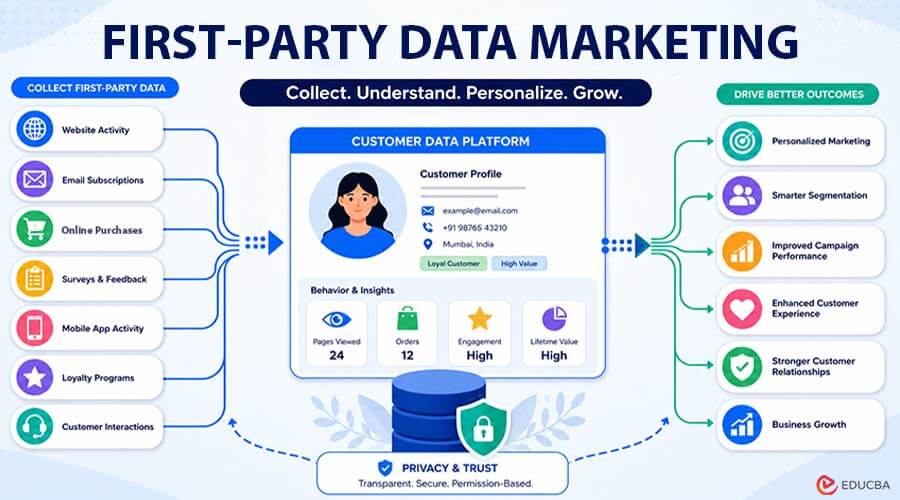
Businesses collect enormous amounts of customer information through websites, mobile apps, email campaigns, social media, loyalty programs, and other digital channels. This information helps marketers understand customer behavior, personalize experiences, and improve marketing campaigns.
However, marketers now face stricter privacy regulations, changing consumer expectations, and reduced access to third-party tracking. These changes have increased the importance of first-party data marketing.
First-party data gives businesses information that customers share directly through their interactions with a brand. For instance, businesses can gather first-party data when users register on a website, sign up for emails, place orders, respond to surveys, or interact with a mobile app. Each interaction can provide valuable information that the business can use, subject to appropriate consent and privacy controls.
First-party data marketing uses this directly collected information to create personalized campaigns, improve customer experiences, strengthen relationships, and make better marketing decisions.
Unlike third-party data, which businesses obtain from external providers, first-party data comes directly from the people who interact with the business. This direct relationship makes the data highly relevant to the company’s customers and marketing activities.
As privacy-focused technologies continue to reshape digital advertising, businesses can use first-party data to build more sustainable and customer-focused marketing strategies.
Table of Contents
- Meaning of First-Party Data
- Meaning of First-Party Data Marketing
- Importance
- First-Party vs. Second-Party vs. Third-Party Data
- How Do Businesses Collect First-Party Data?
- Benefits
- Challenges
- Best Practices
- Real- World Examples
- First-Party Data and Personalization
- First-Party Data and Customer Segmentation
- Role of Technology
- Future Trends
Key Takeaways
- First-party data comes directly from a company’s audience.
- Businesses can collect it through websites, purchases, apps, surveys, email, and loyalty programs.
- First-party data provides relevant insights into customer behavior.
- It can improve personalization and audience segmentation.
- Businesses can use it to reduce dependence on external data sources.
- Data quality and integration remain important challenges.
- Companies should collect information transparently and responsibly.
- Strong privacy and governance practices support sustainable data strategies.
- AI and marketing automation will increase the potential of first-party data.
What Is First-Party Data?
First-party data is customer or audience information that a business gathers directly through its own websites, platforms, and other communication channels.
Businesses can collect this information when users:
- Visit a website.
- Create an account.
- Purchase a product.
- Subscribe to an email list.
- Download a resource.
- Complete a survey.
- Use a mobile application.
- Contact customer support.
- Participate in a loyalty program.
- Interact with digital content.
For example, an online retailer may collect a customer’s purchase history, product preferences, email address, and interactions with its website. The retailer can analyze this information to recommend relevant products or create personalized email campaigns.
First-party data can include both customer-provided information and behavioral information collected through direct interactions.
Examples of First-Party Data
Common examples include:
- Name and contact information
- Purchase history
- Website behavior
- Email engagement
- Product preferences
- Customer service interactions
- Survey responses
- Loyalty program activity
- Account information
- App usage patterns
- Content preferences
Businesses should collect and use this information transparently and follow applicable privacy requirements.
What Is First-Party Data Marketing?
First-party data marketing involves using information that a business collects directly from its audience to plan, personalize, execute, and measure marketing activities.
Marketers can use first-party data to understand customer interests and deliver more relevant messages. For example, an online clothing store can analyze previous purchases and browsing activity to recommend products that match a customer’s preferences.
Companies can also use first-party data to divide their audiences into meaningful groups. A business might create segments for first-time buyers, repeat customers, inactive customers, high-value customers, or users who frequently interact with specific product categories.
This approach allows marketers to replace broad assumptions with information based on actual customer interactions.
Why Does First-Party Data Matter?
First-party data has become an important part of modern digital marketing because businesses face growing restrictions around tracking and data privacy.
Several factors make first-party data valuable.
1. It Supports Privacy-Focused Marketing
Customers increasingly expect businesses to handle their information responsibly. First-party data gives companies a clearer understanding of where their data comes from and how customers interact with their brand.
Businesses can establish transparent data collection practices and obtain the necessary permissions before using customer information for marketing purposes.
2. It Provides Relevant Customer Insights
First-party data comes from actual interactions with a business. Therefore, it can provide useful insights into customer interests, preferences, and behaviors.
For example, a customer’s purchase history can help a retailer understand which product categories interest that customer.
3. It Improves Personalization
Marketers can use first-party data to create personalized experiences.
For example, an online learning platform can recommend courses based on a student’s previous course activity. Similarly, an e-commerce company can recommend products based on previous purchases or browsing behavior.
4. It Helps Build Customer Relationships
First-party data can help companies understand customers throughout their journey. Businesses can use these insights to communicate with customers at the right stages rather than sending generic messages.
5. It Reduces Dependence on External Data
Companies that rely heavily on external audience data may face disruptions when platforms change their policies or tracking technologies.
A strong first-party data strategy gives businesses greater control over their customer information.
First-Party vs. Second-Party vs. Third-Party Data
Marketers commonly divide customer information into three categories: first-party, second-party, and third-party data.
| Data Type | Source | Example | Level of Control |
| First-party data | Collected directly by the company | Purchase history | High |
| Second-party data | Obtained directly from another organization | Partner’s audience data | Medium |
| Third-party data | Collected and aggregated by external providers | Audience segments | Low |
First-Party Data
The company collects first-party data directly from its own audience.
For example, a travel website can collect information about the destinations customers search for and the bookings they make.
Second-Party Data
Second-party data refers to another organization’s first-party data that a company obtains through a direct partnership or agreement.
For example, an airline and a travel platform might collaborate and share specific customer insights under appropriate agreements and privacy requirements.
Third-Party Data
Third-party data comes from external organizations that collect information from multiple sources and sell or provide audience segments to other businesses.
Historically, marketers used third-party data extensively for audience targeting. However, privacy changes and restrictions on third-party tracking have increased the need for businesses to develop stronger first-party data strategies.
How Do Businesses Collect First-Party Data?
Businesses can collect first-party data through multiple customer touchpoints.
1. Websites
Websites are among the most important sources of first-party data.
Businesses can collect information from account registrations, purchases, content interactions, forms, and other permitted activities.
For example, a software company can track which product pages users visit and which resources they download.
2. Email Marketing
Email subscriptions can provide valuable information about customer interests.
Marketers can analyze metrics such as email opens, clicks, preferences, and conversions to understand audience engagement.
Companies should provide clear subscription and privacy choices and respect customer preferences.
3. Customer Purchases
Transaction data provides direct insights into customer behavior.
A retailer can analyze:
- Products purchased
- Purchase frequency
- Order value
- Product categories
- Repeat purchases
These insights help marketers design more relevant campaigns and group customers based on shared characteristics or behaviors.
4. Surveys and Feedback Forms
Surveys allow customers to provide information directly.
Companies can ask customers about:
- Product preferences
- Satisfaction levels
- Purchasing intentions
- Content interests
- Product feedback
This data allows marketers to gain deeper insights into customer needs rather than relying only on observed behaviors.
5. Loyalty Programs
Loyalty programs motivate customers to engage with a brand more frequently.
Businesses can collect information about purchases, preferences, rewards activity, and engagement. Marketers can then use these insights to create relevant offers and experiences.
6. Mobile Applications
Mobile apps can generate first-party data through customer interactions.
For example, an app can provide information about features customers use, products they view, or content they consume, subject to appropriate permissions and privacy practices.
7. Customer Service
Customer support interactions can reveal common customer problems, preferences, and needs.
Marketing and product teams can use aggregated insights from these interactions to improve communication and customer experiences.
Benefits of First-Party Data Marketing
A well-designed first-party data strategy can provide several benefits.
Better Audience Segmentation
Marketers can categorize customers into distinct groups according to their actual interactions with the brand.
For example, an e-commerce company can create segments such as:
- New customers
- Repeat customers
- High-value customers
- Cart abandoners
- Inactive customers
- Category-specific shoppers
These segments allow marketers to create more relevant campaigns.
More Personalized Marketing
First-party data allows businesses to personalize communication based on customer behavior.
Instead of sending the same email to every customer, a business can recommend products or content based on individual interests.
Improved Customer Experience
Businesses can use customer information to make interactions more relevant.
For example, a streaming service can recommend content based on viewing history, while an online education platform can suggest courses based on previous learning activity.
Better Marketing Measurement
First-party data can help businesses connect customer interactions with marketing outcomes.
Marketers can analyze how customers move from initial engagement to conversion and identify which campaigns generate meaningful results.
Greater Data Control
Businesses have more direct control over first-party data because they collect it through their own channels.
This control can help organizations develop long-term marketing strategies that depend less on external data providers.
Stronger Customer Relationships
When companies use customer information responsibly, they can create more relevant experiences and communications.
This can improve engagement and encourage customers to maintain long-term relationships with the brand.
Challenges of First-Party Data Marketing
Despite its benefits, first-party data marketing also creates several challenges.
1. Data Collection Requires Customer Trust
Customers may hesitate to provide information if they do not understand why a business needs it.
Companies should explain how they collect and use data and provide clear privacy choices.
2. Data Quality Can Vary
Incomplete, outdated, or inaccurate information can reduce the value of first-party data.
For example, customers may change their email addresses, preferences, or purchasing habits.
Businesses should regularly review and maintain their databases.
3. Data Exists Across Multiple Systems
Customer information often exists across different platforms, including CRM systems, email platforms, websites, mobile applications, and customer support systems.
Companies may struggle to create a consistent customer view when these systems do not communicate effectively.
4. Integration Can Become Complex
Marketers need suitable technology to collect, organize, analyze, and activate first-party data.
Depending on the organization’s size, this process may require CRM systems, customer data platforms, analytics tools, marketing automation platforms, and data warehouses.
5. Privacy Requirements Require Attention
Businesses must handle customer information responsibly and comply with applicable privacy laws and regulations.
Marketers should work with relevant legal, privacy, security, and compliance teams when designing data collection strategies.
6. Building a First-Party Data Strategy Takes Time
Businesses cannot build a valuable first-party data ecosystem overnight.
They need to create useful customer touchpoints, encourage voluntary engagement, establish appropriate consent practices, and continuously improve data quality.
Best Practices for First-Party Data Marketing
Businesses can follow several practices to create a stronger first-party data strategy.
1. Provide Clear Value for Data Sharing
People are more willing to provide their information when they see a clear benefit from doing so.
Businesses can offer useful experiences such as personalized recommendations, relevant content, loyalty benefits, or improved services.
2. Be Transparent
Clearly explain what information the company collects and how it uses that information.
Avoid confusing language and make privacy choices easy to understand.
3. Collect Only Useful Information
Businesses do not need to collect every possible piece of customer information.
Instead, marketers should identify which information directly supports their business and customer experience goals.
4. Maintain Data Quality
Regularly remove duplicate, outdated, and inaccurate records.
Clean data improves segmentation, personalization, reporting, and campaign performance.
5. Connect Customer Touchpoints
Businesses should connect relevant customer information across their marketing ecosystem.
For example, integrating website, CRM, email, and purchase data can help marketers create a more complete view of customer interactions.
6. Segment Customers Carefully
Avoid treating every customer the same.
Use meaningful characteristics such as purchase behavior, engagement, interests, lifecycle stage, and customer value to create relevant segments.
7. Use Data Responsibly
Privacy should remain central to every first-party data strategy.
Businesses should establish appropriate access controls, security practices, consent management, retention policies, and governance processes.
8. Test and Improve Campaigns
Marketers should continuously test different messages, offers, content, and customer experiences.
They can use first-party data to understand what works and improve future campaigns.
Real-World Examples of First-Party Data Marketing
Example 1: Netflix
Netflix collects first-party data from users’ viewing activity, including the shows and movies they watch, search for, rate, and stop watching. The platform uses these insights to personalize content recommendations for individual users.
For example, if a user frequently watches crime dramas, Netflix can recommend similar movies and series on the user’s homepage. This approach helps Netflix create a more personalized viewing experience based on direct customer interactions.
Example 2: Amazon
Amazon uses first-party data from customer searches, product views, purchases, reviews, and shopping activity. The company analyzes these interactions to personalize product recommendations and marketing communications.
For example, after a customer purchases a laptop, Amazon may recommend compatible accessories such as a laptop bag, mouse, or keyboard. These recommendations use the customer’s direct shopping activity to make the experience more relevant.
Example 3: Starbucks
Starbucks collects first-party data through its loyalty program and mobile app. Customers can share information through purchases, rewards activity, order history, and app interactions.
Starbucks can use these insights to personalize offers and recommendations. For example, a customer who frequently purchases a particular beverage may receive a relevant promotional offer or personalized recommendation through the app.
Example 4: Sephora
Sephora collects first-party data through its loyalty program, website, mobile app, and in-store interactions. Customers provide information through purchases, product preferences, reviews, and engagement with the company’s digital platforms.
Sephora can use these insights to recommend relevant beauty products, personalize communications, and provide customers with offers based on their interests and previous purchases.
First-Party Data and Personalization
Personalization represents one of the strongest applications of first-party data.
Marketers can use customer information to personalize:
- Emails
- Product recommendations
- Website content
- Offers
- Notifications
- Advertising audiences
- Customer journeys
For instance, a customer who regularly buys sports-related products might receive personalized content about athletic gear, fitness products, or the latest offerings.
However, personalization should remain relevant and proportionate. Businesses should avoid creating experiences that make customers uncomfortable or appear overly intrusive.
The goal should not simply involve collecting more information. The goal should involve using appropriate information to create better customer experiences.
First-Party Data and Customer Segmentation
Customer segmentation allows marketers to organize audiences into groups with similar characteristics or behaviors.
First-party data can support segmentation based on:
- Behavior: Customers who frequently visit a particular product category.
- Purchase history: Customers who regularly purchase products.
- Engagement: Customers who frequently interact with emails or content.
- Lifecycle stage: New, active, or inactive customers.
- Customer value: Customers who generate higher long-term revenue.
Effective segmentation helps marketers deliver more relevant campaigns while reducing unnecessary communication.
Role of Technology in First-Party Data Marketing
Businesses rely on technology to efficiently gather, organize, and leverage first-party data.
Businesses can use different systems to manage customer information.
Customer Relationship Management Systems
CRM systems help businesses organize customer profiles, interactions, sales information, and communication history.
Customer Data Platforms
Customer data platforms can bring information from multiple sources into a unified customer profile.
Marketing Automation Platforms
Marketing automation tools can use customer information to trigger personalized emails, messages, and campaigns.
Analytics Platforms
Analytics systems help marketers understand consumer behavior, campaign performance, conversions, and other important metrics.
Businesses should select technology based on their specific requirements instead of collecting unnecessary tools.
Future Trends in First-Party Data Marketing
First-party data marketing will continue to evolve as businesses adapt to privacy-focused digital environments.
Greater Focus on Customer Consent
Businesses will increasingly focus on transparent consent and clear customer choices.
More Personalized Customer Experiences
Companies will use their direct customer insights to create more relevant experiences across websites, applications, email, and other channels.
Increased Use of AI
Artificial intelligence can help marketers analyze large amounts of first-party data, identify patterns, predict customer behavior, and automate personalization.
However, companies should maintain appropriate human oversight and privacy controls when using AI with customer information.
Stronger Data Governance
As businesses collect more customer information, they will need stronger processes for data quality, security, access, retention, and compliance.
Greater Integration Across Channels
Businesses will increasingly connect customer information across websites, CRM systems, mobile applications, email platforms, and other customer touchpoints.
This integration can help marketers create consistent customer experiences across channels.
Frequently Asked Questions (FAQs)
Q1. What is first-party data marketing?
Answer: First-party data marketing involves using customer information that a business collects directly through its own channels, such as websites, apps, purchases, email subscriptions, surveys, and loyalty programs.
Q2. Why is first-party data important for marketers?
Answer: First-party data helps marketers understand customer behavior, personalize campaigns, improve audience segmentation, and reduce dependence on external data sources.
Q3. What are some examples of first-party data?
Answer: Examples include purchase history, website interactions, email engagement, survey responses, customer preferences, loyalty program activity, account information, and mobile app usage.
Q4. How can businesses collect first-party data?
Answer: Businesses can collect first-party data through websites, mobile apps, email marketing, customer purchases, surveys, loyalty programs, content downloads, and customer service interactions.
Q5. What is the difference between first-party and third-party data?
Answer: First-party data comes directly from a company’s customers or audience, while third-party data comes from external organizations that collect and aggregate information from multiple sources.
Final Thoughts
First-party data marketing helps businesses understand their customers through direct interactions and build stronger, more meaningful relationships. By collecting data through websites, purchases, surveys, apps, email, and other owned channels, businesses can gain valuable insights without relying heavily on external data sources.
Companies can apply these insights to create personalized marketing strategies, segment audiences more effectively, analyze customer journeys, and improve the overall user experience. However, they should always balance marketing goals with customer expectations around privacy, transparency, and responsible data use.
A successful first-party data strategy focuses on collecting relevant information, offering value to customers, maintaining data quality, and using data responsibly. As privacy expectations and digital technologies continue to evolve, businesses that invest in strong first-party data practices can create more sustainable marketing strategies and stronger customer relationships.
Recommended Articles
We hope this guide to First-Party Data Marketing helps you strengthen customer connections and develop more impactful marketing strategies. Explore these recommended articles for additional insights and strategies to strengthen your digital marketing efforts.

