


Every successful business starts by creating interest before making a sale. Customers rarely purchase a product or service on their first exposure to it. Instead, they research their options, compare solutions, read reviews, and learn about brands before making a decision. Businesses that educate and engage potential customers throughout this journey are more likely to build trust and increase conversions.
Demand generation is a marketing strategy that builds brand awareness, educates potential customers, and nurtures their interest until they are ready to make a purchasing decision. Rather than focusing solely on lead collection, demand generation builds meaningful relationships through valuable content, personalized communication, and consistent engagement.
Modern organizations use blogs, videos, webinars, social media, search engine optimization (SEO), email marketing, and paid advertising to generate demand across multiple channels. Whether a company serves businesses (B2B) or consumers (B2C), a well-planned demand generation strategy helps attract qualified prospects, improve brand visibility, and drive sustainable business growth.
In this guide, you will learn what demand generation is, why it matters, how it works, and the strategies businesses use to build long-term customer demand.
Key Takeaways
- Demand generation focuses on creating awareness before selling products or services.
- It helps businesses educate potential customers throughout their buying journey.
- Valuable content plays a central role in attracting and engaging audiences.
- Demand generation supports both B2B and B2C marketing strategies.
- Businesses use SEO, social media, webinars, email marketing, and paid advertising to generate demand.
- Measuring performance with marketing metrics helps improve campaign effectiveness.
- Strong demand-generation strategies create qualified leads and drive long-term business growth.
Table of Contents
- Meaning
- Importance
- How Does it Work?
- Funnel
- Demand Generation vs Lead Generation
- Top Strategies
- Best Channels
- Metrics and KPIs
- Best Practices
- Common Challenges
- Popular Tools
- Real-World Examples
What is Demand Generation?
Demand generation focuses on increasing brand visibility and engaging potential customers with products or services before they enter the buying stage. It focuses on educating audiences, solving their problems, and building trust through valuable content and meaningful interactions.
Unlike traditional marketing campaigns that concentrate on immediate sales, demand generation supports the entire customer journey. Businesses engage potential customers throughout the buying journey by using educational blogs, videos, webinars, email campaigns, social media, SEO, and targeted advertising. As customers become more informed and confident, they move closer to making a purchase decision.
A successful demand generation strategy helps organizations attract qualified audiences, strengthen brand credibility, increase customer engagement, and generate a steady pipeline of future sales opportunities.
Why is Demand Generation Important?
Customers have more choices than ever before. Before making a purchase, they compare products, read reviews, watch videos, and seek expert advice. Businesses that provide useful information during this research phase earn greater trust and remain top of mind when customers are ready to buy.
Demand generation helps organizations connect with potential customers long before the sales process begins. Instead of relying only on promotional campaigns, businesses create educational experiences that encourage long-term engagement.
Below are some of the major benefits of demand generation.
1. Builds Brand Awareness
Customers cannot purchase products they are not aware of. Demand generation introduces your brand to new audiences through blogs, social media, search engines, webinars, podcasts, and online communities. Consistent visibility increases brand recognition and expands your market reach.
2. Educates Potential Customers
Many buyers need information before making purchasing decisions. Educational content helps customers understand their challenges, explore possible solutions, and evaluate different options. As a result, they become more confident when choosing a product or service.
3. Creates Trust and Credibility
People prefer buying from businesses they trust. Publishing accurate, helpful, and informative content positions your organization as an industry expert. Over time, consistent value strengthens customer confidence and brand credibility.
4. Attracts High-Quality Prospects
Demand generation targets audiences that genuinely need your products or services. Instead of trying to reach everyone, businesses focus on attracting people more likely to become customers. This approach improves marketing efficiency and increases conversion opportunities.
5. Supports Long-Term Business Growth
Unlike short-term promotional campaigns, demand generation builds lasting customer relationships. As brand awareness and trust increase, businesses generate a steady stream of qualified prospects, driving sustainable revenue growth.
6. Improves Marketing Return on Investment (ROI)
Educational content often continues attracting visitors long after publication. Blog articles, videos, guides, and webinars generate ongoing traffic, making demand generation a cost-effective marketing strategy that delivers long-term value.
7. Aligns Marketing and Sales Teams
Demand generation encourages collaboration between marketing and sales departments. Marketing teams educate and nurture potential customers, while sales teams engage prospects when they are ready to purchase. This alignment improves lead quality and increases conversion rates.
How Does Demand Generation Work?
Demand generation follows a structured process that guides potential customers from discovering a brand to becoming loyal customers. Each stage focuses on delivering value, building trust, and encouraging meaningful engagement.
Step 1: Identify Your Target Audience
Every successful campaign begins with understanding the target audience. Businesses create buyer personas by researching customer demographics, interests, behaviors, goals, and pain points. Understanding your target audience helps you design personalized marketing campaigns that effectively meet their unique needs and preferences.
For example, a cybersecurity company may target IT managers, while an online learning platform may focus on college students and working professionals.
Step 2: Create Valuable Content
Content forms the foundation of every demand generation strategy. Businesses produce educational resources that answer customer questions and solve common problems.
Popular content formats include:
- Blog articles
- eBooks
- White papers
- Videos
- Webinars
- Podcasts
- Case studies
- Infographics
- Industry reports
- Email newsletters
High-quality content demonstrates expertise while helping customers make informed decisions.
Step 3: Promote Content Across Multiple Channels
Creating valuable content is only the beginning. Businesses must distribute it through multiple marketing channels to reach the right audience.
Common distribution channels include:
- Search engine optimization (SEO)
- Social media marketing
- Email marketing
- Paid advertising
- Influencer marketing
- Online communities
- Industry forums
- Video platforms
Using multiple channels increases visibility and expands audience reach.
Step 4: Engage and Nurture Prospects
Once potential customers discover your content, businesses continue engaging them through personalized communication. Email campaigns, webinars, newsletters, remarketing ads, and educational resources help nurture relationships over time.
Rather than pushing immediate sales, marketers focus on answering questions, providing value, and maintaining consistent communication.
Step 5: Encourage Buying Decisions
As potential customers approach the decision-making stage, businesses offer more in-depth resources, including:
- Product demonstrations
- Free trials
- Product comparisons
- Customer success stories
- Testimonials
- Personalized consultations
These resources reduce uncertainty and help prospects make informed purchasing decisions.
Step 6: Measure and Optimize Campaign Performance
Demand generation requires continuous improvement. Marketing teams monitor campaign performance using analytics tools and key performance indicators (KPIs). They identify successful strategies, optimize underperforming campaigns, and improve customer engagement over time.
Common performance metrics include website traffic, conversion rates, engagement rates, cost per lead, and marketing ROI.
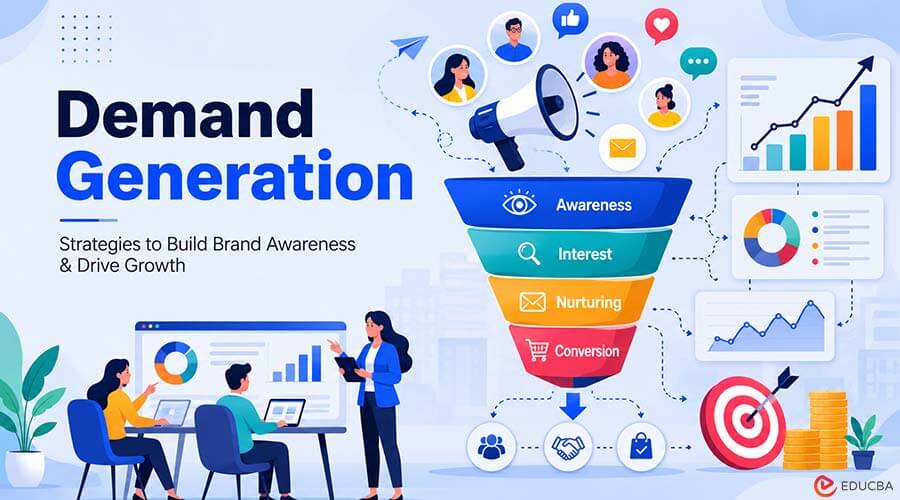
Demand Generation Funnel
The demand generation funnel illustrates how businesses guide potential customers from discovering a brand to becoming loyal customers. Each phase has its own objective and involves specific marketing efforts to guide customers through the journey.
| Funnel Stage | Objective | Common Marketing Activities |
| Awareness | Introduce the brand and attract new audiences. | SEO, blogs, social media posts, videos, podcasts, display ads |
| Interest | Educate prospects and encourage engagement. | eBooks, guides, newsletters, webinars, infographics |
| Consideration | Build trust and help prospects evaluate solutions. | Case studies, comparison guides, product videos, email nurturing |
| Intent | Encourage buying signals and product exploration. | Free trials, product demos, consultations, pricing pages |
| Conversion | Turn qualified prospects into paying customers. | Sales meetings, proposals, limited-time offers, onboarding support |
| Loyalty & Advocacy | Retain customers and encourage referrals. | Customer newsletters, loyalty programs, training resources, referral programs |
Understanding the Funnel
Awareness
At the awareness stage of the funnel, businesses aim to reach audiences unfamiliar with their brand or offerings. Educational blog posts, search engine optimization, social media campaigns, and videos help attract visitors and introduce them to relevant solutions.
Interest
Once prospects discover the brand, businesses provide valuable content that addresses their challenges. Downloadable guides, webinars, and newsletters encourage visitors to engage further and learn more.
Consideration
At this stage, potential customers compare different solutions. Businesses strengthen trust by sharing case studies, customer testimonials, comparison articles, and detailed product information.
Intent
Prospects begin showing strong purchase intent by requesting demos, signing up for free trials, or exploring pricing information. Marketing and sales teams work together to answer questions and address concerns.
Conversion
Businesses convert qualified prospects into customers by providing personalized support, clear pricing, and a smooth purchasing experience.
Loyalty and Advocacy
Demand generation does not end after the sale. Businesses continue engaging customers through educational resources, product updates, and loyalty programs. When customers have positive experiences, they are more likely to promote the brand among their networks, generating new opportunities through referrals and organic recommendations.
Demand Generation vs Lead Generation
Many people use demand generation and lead generation interchangeably, but they serve different purposes. Demand generation builds interest in a brand and its offerings, while lead generation converts engaged audiences into qualified contacts for further sales efforts. Businesses often use both strategies together to guide customers through the entire buying journey.
The table below highlights the key differences.
| Feature | Demand Generation | Lead Generation |
| Primary Goal | Build awareness and interest | Capture leads for sales |
| Focus | Educate and engage audiences | Convert prospects into leads |
| Funnel Stage | Top and middle of the funnel | Middle and bottom of the funnel |
| Content Type | Blogs, videos, webinars, podcasts, social media | Landing pages, forms, free trials, product demos |
| Success Metrics | Website traffic, engagement, brand awareness | Number of leads, conversion rate, cost per lead |
| Sales Focus | Indirect | Direct |
| Time Horizon | Long-term | Short-term and medium-term |
How Do Demand Generation and Lead Generation Support the Customer Journey?
Demand generation creates interest by providing valuable information and building trust. When prospects interact with your content and demonstrate interest in purchasing, lead generation collects their details through forms, resource downloads, webinars, or free trial sign-ups.
For example, a cloud software company may publish SEO-optimized blog posts and educational videos to attract visitors. After readers gain confidence in the company’s expertise, they may download an eBook or register for a webinar by submitting their email address. This action converts an anonymous visitor into a qualified lead, allowing the sales team to continue the conversation.
Instead of choosing one strategy over the other, businesses achieve better results by integrating demand generation and lead generation into a unified marketing plan.
Top Demand Generation Strategies
An effective demand generation strategy combines multiple marketing techniques to attract, educate, and nurture potential customers. The following strategies help businesses increase brand awareness, build trust, and generate long-term demand.
1. Content Marketing
Content marketing serves as the foundation of demand generation. It helps businesses educate their audience while demonstrating expertise and credibility.
Useful content formats include:
- Blog articles
- eBooks
- White papers
- Case studies
- Research reports
- Infographics
- Videos
- Podcasts
Businesses should focus on solving customer problems instead of promoting products. High-quality educational content naturally attracts qualified prospects and encourages them to return for more information.
2. Search Engine Optimization (SEO)
SEO helps businesses attract potential customers who actively search for information online. Using relevant keywords strategically in website content helps businesses rank higher in search results and bring more unpaid traffic to their websites.
Effective SEO practices include:
- Conducting keyword research
- Creating helpful content
- Optimizing page titles and meta descriptions
- Improving page speed
- Building high-quality backlinks
- Enhancing user experience
Unlike paid advertising, SEO continues generating traffic long after content is published, making it a valuable long-term investment.
3. Social Media Marketing
Social media platforms help businesses connect with wider audiences, distribute valuable content, and strengthen relationships with customers.
Companies use social media to:
- Share educational posts
- Publish videos
- Host live sessions
- Answer customer questions
- Promote webinars
- Showcase customer success stories
Different platforms serve different purposes. For example:
- LinkedIn works well for B2B marketing.
- Instagram supports visual storytelling and brand awareness.
- Facebook encourages community engagement.
- YouTube helps educate audiences through long-form videos.
Consistent engagement increases brand visibility and encourages conversations with potential customers.
4. Email Marketing
Email marketing keeps businesses connected with prospects throughout the buying journey. Instead of sending frequent promotional messages, marketers should provide useful information that helps subscribers solve problems and make informed decisions.
Successful email campaigns often include:
- Educational newsletters
- Industry insights
- Product updates
- Event invitations
- Personalized recommendations
- Customer success stories
Marketing automation platforms allow businesses to send customized emails based on customer behavior, helping increase engagement and improve conversion rates.
5. Webinar Marketing
Webinars allow businesses to educate audiences while interacting with them in real time. They provide an excellent opportunity to explain complex topics, answer questions, and demonstrate expertise.
Businesses commonly use webinars to:
- Explain industry trends
- Launch new products
- Conduct live demonstrations
- Train customers
- Share research findings
Interactive webinars often generate higher engagement because participants can ask questions and receive immediate answers.
6. Video Marketing
Video content captures attention quickly and simplifies complex topics. Many customers prefer watching short videos instead of reading lengthy articles.
Popular video formats include:
- Product demonstrations
- Tutorials
- Customer testimonials
- Expert interviews
- Animated explainers
- Educational series
Businesses can publish videos on YouTube, LinkedIn, Instagram, Facebook, and their own websites to reach broader audiences.
7. Paid Advertising
Paid advertising helps businesses increase visibility among targeted audiences within a short period. Unlike organic marketing, paid campaigns generate immediate traffic.
Common advertising platforms include:
- Google Search Ads
- Display Advertising
- LinkedIn Ads
- Facebook Ads
- Instagram Ads
- YouTube Ads
- Retargeting Campaigns
Businesses should continuously monitor campaign performance and optimize ad copy, audience targeting, and budgets to maximize return on investment.
8. Influencer and Thought Leadership Marketing
People trust recommendations from industry experts and respected professionals. Businesses collaborate with influencers, consultants, and subject matter experts to increase credibility and reach wider audiences.
Organizations can build thought leadership by:
- Publishing research reports
- Speaking at conferences
- Participating in podcasts
- Writing guest articles
- Hosting expert interviews
Sharing valuable knowledge helps position a business as an industry leader.
9. Account-Based Marketing (ABM)
Account-Based Marketing focuses on targeting specific high-value companies instead of broad audiences. Organizations bring marketing and sales teams together to develop account-specific campaigns that address the needs of valuable prospects.
ABM strategies include:
- Personalized email campaigns
- Custom landing pages
- Industry-specific case studies
- Executive webinars
- Personalized product demonstrations
This strategy is especially effective for B2B organizations that handle lengthy sales cycles and large enterprise clients.
10. Customer Advocacy and Referral Programs
Satisfied customers often become a company’s strongest marketing asset. Businesses encourage loyal customers to recommend products or services to colleagues, friends, and professional networks.
Effective advocacy strategies include:
- Customer testimonials
- Online reviews
- Referral rewards
- Case studies
- User-generated content
- Customer communities
Positive customer experiences increase credibility and generate new demand through word-of-mouth marketing.
Best Demand Generation Channels
Choosing the right marketing channels significantly influences the success of a demand generation campaign. Businesses should select channels based on their target audience, goals, and available resources.
The following channels consistently deliver strong demand generation results.
| Marketing Channel | Primary Purpose | Best For |
| Search Engine Optimization (SEO) | Increase organic visibility | Long-term traffic generation |
| Content Marketing | Educate audiences | Building trust and authority |
| Email Marketing | Nurture prospects | Customer engagement |
| Social Media Marketing | Expand brand awareness | Community building |
| Paid Advertising | Drive targeted traffic | Immediate visibility |
| Webinars | Educate and interact | Lead nurturing |
| Video Marketing | Increase engagement | Product education |
| Podcasts | Share industry expertise | Thought leadership |
| Online Communities | Encourage discussions | Customer relationships |
| Referral Marketing | Generate recommendations | Customer acquisition |
Businesses use a combination of digital marketing channels to execute successful demand generation strategies. SEO helps attract users through organic search, while content marketing provides valuable information that builds trust and encourages engagement. Email marketing enables businesses to nurture prospects with personalized communication, and social media marketing improves brand visibility through direct audience interactions. Paid advertising allows companies to target specific audiences and increase product awareness, while video platforms, webinars, and podcasts help educate customers through engaging formats. Online communities create opportunities for meaningful discussions, and referral programs leverage customer recommendations to generate new interest. By combining these channels, businesses can effectively attract prospects, build relationships, and create consistent demand for their products and services.
Choosing the Right Channel Mix
No single marketing channel guarantees success. The most effective demand generation campaigns combine multiple channels to create a consistent customer experience.
For example:
- SEO attracts organic visitors.
- Content marketing educates potential customers.
- Social media expands brand reach.
- Email marketing nurtures prospects.
- Webinars build trust.
- Paid advertising accelerates visibility.
- Referral programs encourage customer advocacy.
Businesses should regularly analyze channel performance, identify the highest-performing strategies, and adjust their marketing mix to meet changing customer needs and business objectives.
Demand Generation Metrics and KPIs
Evaluating the performance of your demand generation campaigns helps identify effective strategies and areas that require optimization. By monitoring relevant key performance indicators (KPIs), businesses can improve campaign performance, manage budgets efficiently, and drive stronger marketing results.
Below are some of the most important demand generation metrics.
1. Website Traffic
Website traffic refers to the total number of users who visit a website within a defined time frame. An increase in traffic often indicates that your content, SEO, and promotional campaigns are successfully attracting potential customers.
2. Organic Traffic
Organic traffic consists of users who visit your website through unpaid search engine listings rather than paid ads. This metric measures how effectively your SEO and content marketing efforts drive organic visibility and traffic.
3. Engagement Rate
Engagement rate measures how actively users interact with your content through likes, comments, shares, clicks, downloads, or time spent on a page.
4. Click-Through Rate (CTR)
Click-Through Rate (CTR) is the proportion of viewers who click a link, advertisement, or email when it appears on their screen.
Formula:
CTR = (Number of Clicks ÷ Number of Impressions) × 100
5. Conversion Rate
This metric measures how many visitors take the intended action, such as downloading valuable resources, signing up for webinars, or scheduling a product demo.
Formula:
Conversion Rate = (Conversions ÷ Total Visitors) × 100
6. Marketing Qualified Leads (MQLs)
Marketing Qualified Leads (MQLs) are potential customers who demonstrate strong interest in a company’s content, products, or services and show a higher likelihood of becoming paying customers.
Examples include users who:
- Download multiple resources
- Attend webinars
- Subscribe to newsletters
- Visit key product pages repeatedly
7. Sales Qualified Leads (SQLs)
Sales Qualified Leads (SQLs) are prospects who have shown clear purchase intent and are ready to communicate directly with the sales team.
Examples include prospects who:
- Request a product demonstration
- Schedule a consultation
- Ask for pricing information
- Start a free trial
8. Cost Per Lead (CPL)
Cost Per Lead measures how much a business spends to acquire each qualified lead.
Formula:
CPL = Total Marketing Spend ÷ Number of Leads
9. Customer Acquisition Cost (CAC)
Customer Acquisition Cost (CAC) represents the total investment required to convert a prospect into a new customer.
Formula:
CAC = Total Sales and Marketing Expenses ÷ Number of New Customers
10. Customer Lifetime Value (CLV)
Customer Lifetime Value (CLV) predicts the total income a business is likely to generate from a customer over the duration of their relationship.
11. Marketing Return on Investment (ROI)
Marketing ROI evaluates how effectively marketing campaigns generate profit compared to the amount invested.
Formula:
ROI = [(Revenue – Marketing Cost) ÷ Marketing Cost] × 100
12. Sales Pipeline Growth
Pipeline growth measures the increase in qualified sales opportunities generated by demand-generation campaigns.
Best Practices for Demand Generation
Successful demand generation requires more than publishing content or running advertisements. Businesses should follow proven practices that improve audience engagement and maximize marketing performance.
Understand Your Audience
Research your target audience thoroughly before launching campaigns. Analyze customer demographics, interests, challenges, and buying behaviors to create personalized marketing messages.
Create High-Quality Content
Develop educational content that answers customer questions and solves real problems. Focus on delivering value rather than excessively promoting products.
Optimize Content for Search Engines
Use relevant keywords, descriptive headings, internal links, and optimized meta tags to improve your search engine rankings and increase organic traffic.
Maintain Consistent Branding
Use consistent messaging, visuals, and tone across your website, social media platforms, emails, and advertisements. Consistency strengthens brand recognition and builds trust.
Personalize Customer Experiences
Group your audience according to their interests, online behavior, or industry, and deliver tailored emails, content, and recommendations that align with their preferences.
Align Marketing and Sales Teams
Encourage collaboration between marketing and sales departments. Share lead qualification criteria, campaign insights, and customer feedback to improve conversion rates.
Use Marketing Automation
Use automation tools to handle repetitive activities such as email campaigns, lead scoring, follow-up communications, and campaign reporting.
Analyze and Improve Performance
Monitor campaign metrics regularly. Test different headlines, content formats, landing pages, and advertisements to identify the most effective strategies.
Build Long-Term Relationships
Continue engaging customers after they purchase by sharing educational content, product updates, and exclusive resources. Loyal customers often become brand advocates.
Common Demand Generation Challenges
Even well-planned campaigns face obstacles. Understanding these challenges helps businesses prepare effective solutions.
| Challenge | Solution |
| Low brand awareness | Invest in SEO, content marketing, and social media campaigns. |
| Poor audience targeting | Develop detailed buyer personas and use audience segmentation. |
| Low-quality content | Create original, research-backed, and customer-focused content. |
| Long buying cycles | Use email nurturing, webinars, and educational resources to maintain engagement. |
| Difficulty measuring ROI | Track KPIs using analytics and marketing automation tools. |
| Marketing and sales misalignment | Establish shared goals and regular communication between teams. |
| Limited marketing budget | Prioritize high-ROI channels such as SEO and email marketing. |
| Increasing competition | Differentiate your brand through valuable content and exceptional customer experiences. |
Popular Demand Generation Tools
Businesses use various tools to plan, execute, and measure demand generation campaigns. The table below highlights some widely used platforms.
| Tool | Primary Purpose |
| HubSpot | Marketing automation, CRM, and email marketing |
| Google Analytics | Website analytics and traffic insights |
| Semrush | SEO research and keyword analysis |
| Ahrefs | Backlink analysis and competitor research |
| Salesforce | Customer relationship management (CRM) |
| Mailchimp | Email marketing and automation |
| Google Ads | Search and display advertising |
| LinkedIn Campaign Manager | B2B advertising campaigns |
| Canva | Creating marketing visuals and social media graphics |
| Buffer | Social media scheduling and management |
Choose tools based on your marketing objectives, budget, and business size. Many organizations combine several platforms to manage campaigns more effectively.
Real-World Examples of Demand Generation
Example 1: HubSpot
HubSpot attracts potential customers by offering free blogs, templates, marketing guides, certifications, and online courses. These educational resources establish trust before introducing its marketing and CRM software.
Example 2: Adobe
Adobe publishes tutorials, webinars, creative inspiration, and product demonstrations that help users improve their design skills. This content showcases product capabilities while educating potential customers.
Example 3: Shopify
Shopify supports entrepreneurs with business guides, e-commerce tutorials, success stories, and free business tools. These resources help new business owners learn about online selling while introducing Shopify’s platform.
Frequently Asked Questions (FAQs)
Q1. What is the difference between demand creation and demand generation?
Answer: Demand creation focuses on introducing a product or service to new audiences and sparking initial interest. Demand generation is a broad marketing strategy designed to build brand awareness, educate prospects, develop customer relationships, and support potential buyers as they progress through the purchasing journey.
Q2. How can businesses align sales and marketing for successful demand generation?
Answer: Businesses can align sales and marketing by defining a shared target audience, agreeing on lead qualification criteria, setting common goals, and regularly sharing campaign insights and customer feedback. Strong collaboration improves lead quality and increases conversion rates.
Q3. Which content formats generate the most demand?
Answer: The most effective content formats depend on your audience and industry. However, blog posts, eBooks, webinars, case studies, videos, white papers, podcasts, and interactive tools consistently help businesses educate prospects and build trust.
Q4. What are the common mistakes to avoid in demand generation?
Answer: Some common mistakes include targeting the wrong audience, publishing overly promotional content, neglecting SEO, failing to nurture prospects, relying on a single marketing channel, and ignoring campaign performance data. Avoiding these mistakes helps improve engagement and campaign effectiveness.
Q5. How often should businesses evaluate their demand generation strategy?
Answer: Businesses should monitor campaign performance continuously and conduct a detailed review at least once every quarter. Regular evaluations help identify successful tactics, address performance issues, and adapt strategies to changing customer behavior and market trends.
Final Thoughts
Demand generation is more than a marketing tactic; it is a long-term strategy for building meaningful relationships with potential customers. Instead of focusing solely on immediate sales, businesses create awareness, educate audiences, and provide valuable experiences that guide prospects through every stage of the buying journey.
An effective demand generation strategy combines valuable content creation, SEO, social media marketing, email campaigns, webinars, and data-based insights to attract and engage potential customers. By monitoring key performance metrics and continually improving campaigns, businesses can attract high-quality prospects, build stronger customer relationships, and achieve long-term growth.
As customer needs and preferences change, businesses that focus on educating their audience, delivering personalized experiences, and maintaining regular engagement can gain a competitive advantage and create long-term demand for their products and services.
Recommended Articles
We hope this guide on Demand Generation helps you build brand awareness, engage potential customers, and create sustainable business growth. Explore these recommended articles for additional insights and strategies to strengthen your marketing efforts, improve lead quality, and drive better business results.

