


AI and Automation in Digital Marketing: Overview
Digital marketing in 2026 looks vastly different from what businesses practiced just a few years ago. AI and automation in digital marketing have moved beyond experimental tools and are now deeply embedded in every successful marketing strategy. From campaign planning to customer engagement and performance optimization, AI-driven systems are reshaping how brands connect with audiences at scale while maintaining personalization. As competition intensifies across digital channels, businesses that fail to adopt intelligent automation risk falling behind in an increasingly data-driven landscape.
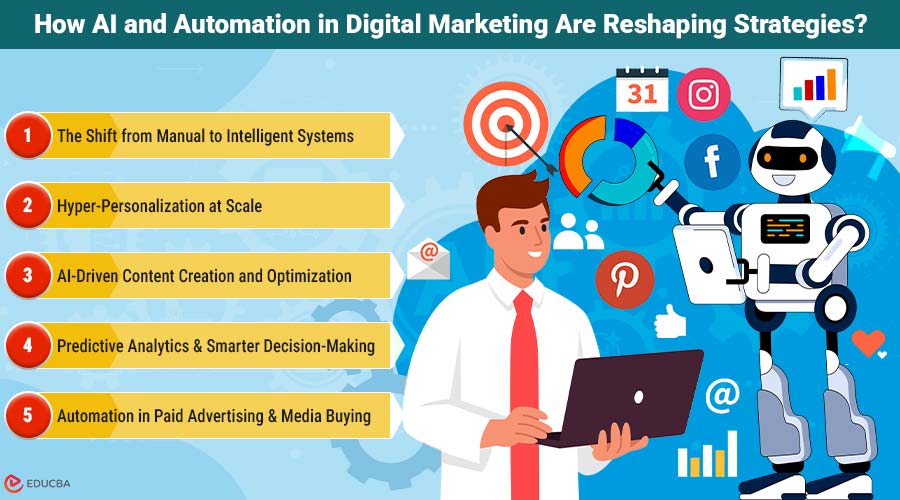
How AI and Automation in Digital Marketing Are Reshaping Strategies?
The integration of AI and automation in digital marketing has transformed every stage of the marketing funnel.
1. The Shift from Manual to Intelligent Systems
Traditional digital marketing relied heavily on manual processes such as keyword research, ad bidding, audience segmentation, and content scheduling. While these methods worked, they required significant time and human effort. In 2026, AI-powered platforms automate these tasks with precision and speed, allowing marketers to focus on strategic thinking rather than repetitive execution.
Machine learning algorithms now analyze massive datasets in real time, identifying patterns that humans would struggle to detect. These systems continuously learn from user behavior, adapting campaigns automatically to maximize engagement and conversions. Automation has transformed marketing from a reactive practice into a predictive one, allowing brands to anticipate customer needs before customers explicitly express them.
2. Hyper-Personalization at Scale
One of the most significant transformations AI has brought to digital marketing is hyper-personalization. In 2026, consumers expect content, offers, and messaging tailored specifically to their preferences, behaviors, and intent. AI enables marketers to deliver this level of personalization at scale without sacrificing efficiency.
Advanced recommendation engines analyze browsing history, purchase behavior, location, and real-time interactions to generate personalized experiences across websites, social media, emails, and paid ads. Even visual elements like color schemes, messaging tone, and brand logo placement adjust dynamically based on audience segments. This level of customization improves engagement rates and builds stronger emotional connections between brands and consumers.
3. AI-Driven Content Creation and Optimization
Content remains central to digital marketing, but AI has transformed how it is created and optimized. In 2026, marketers use AI tools to generate blog drafts, social captions, ad copy, video scripts, and product descriptions with remarkable accuracy. These tools analyze top-performing content across industries and tailor outputs to match brand voice and audience intent.
AI does not replace human creativity but enhances it. Marketers refine AI-generated content to ensure authenticity and strategic alignment. Automation also plays a crucial role in content optimization by testing headlines, adjusting messaging, and improving readability based on performance data. As a result, content cycles are faster, more efficient, and far more effective than in previous years.
4. Predictive Analytics and Smarter Decision-Making
Data has always been valuable in digital marketing, but AI has unlocked its true potential through predictive analytics. In 2026, marketers no longer rely solely on historical data to guide decisions. AI models forecast future trends, customer behavior, and campaign outcomes with impressive accuracy.
These predictive capabilities help businesses allocate budgets more efficiently, identify high-value audiences, and time campaigns for maximum impact. Marketers can now predict churn, identify upsell opportunities, and optimize customer journeys before problems arise. This shift from descriptive to predictive marketing has significantly improved ROI and reduced wasted ad spend.
5. Automation in Paid Advertising and Media Buying
Paid advertising has become increasingly complex, with multiple platforms, formats, and bidding strategies to manage. Automation powered by AI has simplified this complexity in 2026. Smart bidding systems automatically adjust bids in real time based on conversion probability, audience intent, and competitive landscape.
AI-driven ad platforms continuously test creatives, placements, and targeting options without manual intervention. Marketers define objectives, and automation handles execution at scale. Even visual consistency, including the correct use of brand logo across ad variations, is managed by intelligent systems to maintain brand integrity while maximizing performance.
6. Conversational Marketing and AI Assistants
Customer communication has evolved dramatically with the rise of conversational AI. In 2026, chatbots and virtual assistants will no longer be basic support tools but sophisticated marketing assets. These AI assistants engage users in natural conversations, answer complex queries, recommend products, and guide customers through the sales funnel.
Integrated across websites, messaging apps, and social platforms, conversational AI provides instant responses around the clock. Automation ensures that leads are qualified, nurtured, and routed to sales teams without delays. This seamless interaction improves user experience while reducing operational costs for businesses.
7. Voice Search and Visual AI Optimization
As voice-enabled devices and visual search tools become more popular, AI is redefining how brands optimize for discovery. In 2026, digital marketing strategies account for conversational search queries and image-based searches powered by AI recognition technology.
Marketers use AI tools to analyze how users speak and search, and to optimize content for natural language queries. Visual AI helps brands ensure that images, videos, and digital assets are discoverable and contextually relevant across platforms. Automation continuously refines these optimizations as user behavior evolves, keeping brands visible in an increasingly diverse search ecosystem.
Ethical AI and Data Privacy Considerations
With greater reliance on AI comes increased responsibility. In 2026, ethical AI practices and data privacy compliance are central to digital marketing success. Consumers now monitor how companies use their data, and regulations evolve constantly worldwide.
Modern AI marketing platforms prioritize transparency, consent management, and data security. Automation helps businesses comply with regulations by managing data responsibly and ensuring ethical targeting practices. Brands that demonstrate respect for user privacy build trust, a powerful differentiator in crowded digital markets.
The Future Role of Digital Marketers
AI and automation have not replaced digital marketers; instead, they have redefined their roles. In 2026, marketers act as strategists, analysts, and creative directors rather than manual operators. They guide AI systems, interpret insights, and make high-level decisions that shape brand growth.
The ability to understand AI outputs, refine automation rules, and align technology with business goals has become a core skill. Marketers who embrace continuous learning and adaptability are thriving in this AI-driven environment, leveraging technology to amplify human creativity and strategic thinking.
Final Thoughts
AI and automation in digital marketing have fundamentally reshaped the way brands engage with audiences in 2026. From predictive analytics and automated advertising to conversational AI and ethical data practices, intelligent systems now power every stage of the marketing funnel. Businesses that successfully integrate AI into their strategies are achieving higher efficiency, deeper customer connections, and sustainable growth. As technology evolves, human expertise and AI will work together to define the next era of digital marketing.
Recommended Articles
We hope this guide on AI and automation in digital marketing helps you enhance your marketing strategies. Check out these recommended articles for more insights and practical tips.


