
Updated May 14, 2026
What is AI Automation?
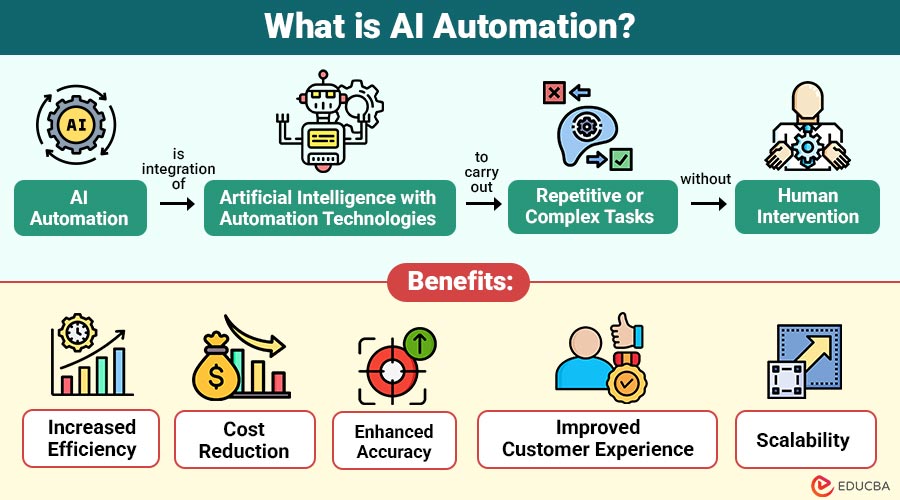
AI automation is integration of artificial intelligence with automation technologies to carry out repetitive or complex tasks without human intervention. Unlike traditional automation, which follows fixed rules and predefined scripts, AI automation can learn, adapt, and improve over time.
Key characteristics of AI automation include:
- Self-learning capabilities: AI algorithms can analyze patterns, learn from historical data, and dynamically adjust processes.
- Decision-making ability: AI systems can make informed decisions, often outperforming humans in speed and accuracy.
- Scalability: AI automation can be implemented across multiple operations, from small tasks to enterprise-level workflows.
Table of Contents:
Key Takeaways:
- AI automation enhances operational efficiency by learning from data and making intelligent, adaptive decisions autonomously.
- Combining AI with automation enables businesses to scale processes rapidly while reducing human errors and costs.
- Organizations adopting AI-driven workflows gain a competitive advantage through faster insights, predictive actions, and optimized performance.
- Despite the benefits, successful AI automation requires careful planning, data management, and workforce reskilling to ensure a smooth integration.
How AI Automation Work?
AI automation integrates several technologies to replicate human intelligence in operational tasks. The process typically involves:
1. Data Collection
AI automation collects both structured and unstructured data from sources such as databases, IoT devices, emails, and social media platforms.
2. Data Processing and Analysis
Machine learning algorithms look at the collected data to find useful patterns, connections, trends, or unusual things, and then turn them into helpful information for making decisions
3. Decision-Making
Based on data insights, AI models predict outcomes, make recommendations, or choose optimal actions, reducing human intervention in repetitive operational tasks.
4. Task Execution
Automated systems perform tasks such as sending emails, updating records, generating reports, and modifying production schedules without requiring manual input.
5. Continuous Improvement
AI systems constantly learn from feedback and performance metrics, refining algorithms over time to increase operational efficiency, accuracy, and decision reliability.
Types of AI Automation
It can be categorized based on its application and complexity:
1. Robotic Process Automation
Payroll, invoicing, and data entry are examples of repetitive operations that RPA uses software robots to complete, increasing productivity and lowering errors.
2. Cognitive Automation
Cognitive automation leverages AI technologies like NLP, machine learning, and computer vision to interpret unstructured data and make intelligent, human-like decisions.
3. Autonomous Systems
Cognitive automation leverages AI technologies like NLP, machine learning, and computer vision to interpret unstructured data and make intelligent, human-like decisions.
4. Predictive Analytics Automation
AI is used in predictive analytics automation to analyze historical and present data, forecast potential outcomes, and assist companies in making informed decisions in advance.
5. Intelligent Process Automation
IPA combines RPA with AI capabilities, such as machine learning and NLP, to automate complex, decision-intensive processes, enhancing efficiency across entire workflows.
Benefits of AI Automation
AI automation offers several benefits for businesses across industries:
1. Increased Efficiency
Automating boring, time-consuming tasks lets employees focus on more important work, which improves productivity, efficiency, and business results
2. Cost Reduction
AI minimizes manual labor, reduces errors, and streamlines processes, resulting in significant operational cost savings and more efficient resource allocation.
3. Enhanced Accuracy
AI and machine learning systems analyze large datasets, perform complex calculations, and detect anomalies with far greater accuracy than humans.
4. Improved Customer Experience
AI-powered chatbots and virtual assistants provide personalized, real-time support, faster issue resolution, and 24/7 customer service, resulting in higher satisfaction.
5. Scalability
It allows businesses to expand operations efficiently without proportional increases in staff, supporting growth, flexibility, and faster adaptation to demand.
Challenges of AI Automation
Despite its benefits, AI automation presents several challenges:
1. High Initial Investment
AI system implementation necessitates a large investment in infrastructure, technology, and qualified staff.
2. Data Privacy Concerns
AI relies heavily on data, raising concerns about privacy, security, and regulatory compliance.
3. Workforce Displacement
Automation may lead to job displacement in certain sectors, requiring reskilling and upskilling programs for affected employees.
4. Complex Implementation
Data silos, corporate opposition to change, and compatibility problems might make integrating AI into current systems difficult.
5. Algorithmic Bias
AI systems can inherit biases from training data, leading to unfair or inaccurate decisions, requiring careful monitoring and mitigation.
Real-World Applications of AI Automation
Applications for AI automation are numerous and span several industries:
1. Finance
AI automates fraud detection, evaluates risks, drives intelligent trading, manages investments efficiently, and enhances customer support through predictive algorithms and insights.
2. Healthcare
AI helps doctors give accurate diagnoses, look at medical images, predict how patients will do, schedule appointments automatically, and handle paperwork, making healthcare better overall.
3. Manufacturing
AI predicts machinery maintenance, monitors production quality using computer vision, optimizes supply chains, and increases operational efficiency while reducing downtime and errors.
4. Retail
AI recommends products to customers, forecasts demand, manages inventory, automates supply chain operations, and provides personalized support via chatbots to enhance shopping experiences.
5. Marketing
AI creates content, optimizes campaigns, monitors social media sentiment, automates lead generation, scores prospects, and improves customer engagement and marketing effectiveness. These use cases sit at the core of what AI marketing automation makes possible for modern marketing teams.
Future Trends in AI Automation
The future of AI automation looks promising, with trends shaping the next decade:
1. Hyperautomation
AI integrates multiple tools and systems to fully automate complex business processes, increasing efficiency, reducing errors, and enabling seamless operational workflows.
2. Human-AI Collaboration
AI works alongside humans, enhancing creativity, productivity, and decision-making while supporting rather than replacing employees across various professional tasks.
3. Explainable AI
Transparent AI models explain how they make decisions, helping people trust them, stay accountable, and follow rules in industries that use AI.
4. AI in Cybersecurity
AI automates detection and response to cyber threats by analyzing patterns, predicting attacks, and safeguarding systems against increasingly sophisticated threats.
Final Thoughts
AI automation is no longer just futuristic concept; it is an important tool for businesses aiming to enhance effectiveness, reduce costs, and improve customer experiences. Organizations may strategically implement AI automation to obtain a competitive edge in rapidly changing digital ecosystem by being aware of its applications, advantages, and difficulties. Adopting AI automation changes how we work and engage with technology by freeing up firms to concentrate on strategic growth, innovation, and creativity.
Frequently Asked Questions (FAQs)
Q1. Is AI automation only suitable for large companies?
Answer: No, AI automation can benefit businesses of all sizes, from startups to big businesses, by improving efficiency and reducing manual tasks.
Q2. Will AI automation replace human jobs?
Answer: AI may automate certain tasks, but it will also create new opportunities requiring advanced skills, making workforce reskilling essential.
Q3. How is AI automation different from traditional automation?
Answer: Traditional automation follows fixed rules, while AI automation uses machine learning and cognitive abilities to make adaptive decisions.
Recommended Articles
We hope that this EDUCBA information on “AI Automation” was beneficial to you. You can view EDUCBA’s recommended articles for more information.


