

Updated April 12, 2024
Introduction to IoT Technologies
The internet of things IoT is a set of physical devices that are embedded with software applications, smart sensors and other technologies that are interconnected with each other over the internet and provide real-time data exchange and analysis with each other. IoT enabled systems to consist of more than 7 billion interconnected IoT devices worldwide. IoT has become one of the most important technologies, interconnecting cars, home appliances, home climate control systems, smart wearable’s, through the internet via embedded devices. It uses big data analytics and machine learning algorithms to share, monitor and collect data and provide analysis with minimal human interaction using AI-based systems.
Top new IoT Technologies
Given below are some new IoT Technologies:
1. Driverless Cars
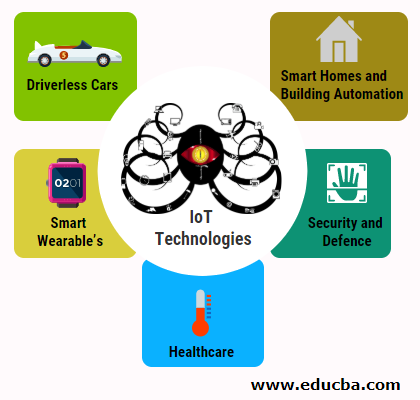
IoT is the future of autonomous vehicles. Driverless autonomous vehicles seamlessly drive traffic across highways. The passengers can input their destination and the software will seamlessly coordinate with the traffic grid to drive passengers to the destination at very high speeds.
These cars will be fitted with sensors, cloud architecture, gyroscopes, proximity sensors, and other technologies which co-ordinate with the IoT software to get real-time data on pedestrian movement, traffic conditions, and road condition such as speed breakers, signals, stop signs. These cars will be fitted with AI and machine learning software which will adapt to road conditions instantaneously (Huh, Cho, & Kim, 2017, February).
2. Smart Wearable’s
Smart wearable technologies can be integrated into the IoT ecosystem to provide real-time data to users. The Google Glass project has possibilities that enable the user to get information and entertainment on the go. Another smart wearable device is the Fit bit which enables activity tracking, heart rate monitoring, several sleep steps climbed, and other personal metrics to its users (Chen et al., 2014). These devices use the IoT ecosystem to connect to AI-based monitoring systems to provide real-time data analysis to smartphones through mobile applications like IOS and Android-based apps.
3. IoT in Healthcare
One of the major applications includes real-time patient monitoring by doctors in different geographical locations. Devices such as Fit bit monitor real-time patient health indicators through connected monitoring systems. The Kinect HoloLens Assisted Rehabilitation Experience (KHARE) platform, allows healthcare professionals to advise personalized therapy to patients in different locations, it connects to the Microsoft Azure IoT Suite.
Smart fridges for vaccine storage made by Viveka, which allows remote monitoring of field vaccines through automated inventory management. These devices are connected to IoT data analysis platforms such as the mind sphere (Siemens) and Kaa(KaaIoT Technologies). Healthcare through IoT can also be extended to care for the elderly and people with disabilities through voice-assisted technology and alert systems directly connected to implants to monitor emergencies such as seizures.
Some hospitals have implemented smart beds that can provide real-time data for patient occupancy and provide information related to patient health to nurses. IoT enabled sensors can also be used to monitor pacemakers. IoT enabled platforms have also use IoMT sensors along with RFID electronics which can be fabricated on e-textiles to be wirelessly connected to patient monitoring and diagnostic systems (Jia, Feng, Fan, & Lei, 2012, April).
4. Smart Homes and Building Automation
IoT enabled technologies such as electronic sensors, smart home appliances, and electrical and mechanical systems, can be used to automate homes and connect them in a single network. Different systems such as smart lighting can be adjusted by the user’s mobile phones or home climate control systems that can adjust according to the outside climate through metrological data and the users’ requirements.
Smart homes also include home appliances such as smart refrigerators microwaves etc., which can be connected to the user’s mobile phones and provide alerts to the refrigerator’s contents and microwave settings. IoT also seamlessly connects home entertainment systems such as smart televisions, music, and entertainment systems and provides a single user platform, where the user can effectively control all of these devices through a single platform (Kelly, Suryadevara, & Mukhopadhyay, 2013).
All of the IoT enabled home automation systems can be connected to an AI platform that can control all of these devices and provide a seamless user experience. Cloud Computing based systems can store user data seamlessly in a virtual platform and use it anywhere through IoT-enabled devices. Smart energy grids connect IoT-based technology to improve energy efficiency for homes (Dorri, Kanhere, Jurdak, & Gauravaram, 2017, March).
5. IoT in Security and Defence
IoT provides a single user interface to control home privacy and security systems. CCTV cameras can be linked via IoT to police departments which can effectively monitor home and building security. IoT also provides security establishments with a database that can be shared nationally and internationally.
IoT provides real-time tracking systems such as restraint bands which provide real-time data on criminals such as their geographical locations. The internet of military things is IoT systems usage for combat operations and warfare (Lee & Lee, 2015). Applications of these systems are limitless with the potential for cyber warfare and battles dominated by machine intelligence. Real-time data and coordination can be made with soldiers on the field and they can interact with their Central command irrespective of geographical location.
IoT also enables autonomous drones and smart combat platforms which can be used to put humans out of harm’s way. Internet of Battlefield things has enabled the use of technology for reconnaissance, unmanned warfare, and battlefield surveillance to be entirely handed over to AI-based systems which can be monitored remotely. The ocean of things is a DARPA Enabled program designed for collecting and analyzing environmental and marine data that contract military and Commercial Ocean going vessels.
Military-based applications for IoT include ambient intelligence and autonomous devices such as robots and drones which can take over from human control. Deep reinforcement learning uses IoT systems where IoT devices adapt to an environment where conventional machine learning algorithms cannot be used. Cyberwarfare and espionage also find applications in IoT.
Conclusion
IoT has come a long way since its inception, IoT will become ingrained into all aspects of life from smart home automation and entertainment, personal devices, revolutionize modern warfare and improve healthcare. Overall, IoT has the potential to simplify every aspect of human life and make the world a more connected place.
Recommended Articles
This has been a guide to IoT Technologies. Here we discuss the introduction and Top new IoT Technologies in detail. You may also have a look at the following articles to learn more –

