


Growth Strategies for Small Businesses: Overview
Running a small or midsize business in modern days is challenging. With tighter budgets, higher customer expectations, and constant changes in the digital world, success requires more than just hard work. It requires working smarter. Currently, one of the most effective growth strategies for small businesses is leveraging AI tools to streamline operations and enhance efficiency. But this is not about replacing people—it is about freeing them to focus on what matters most.
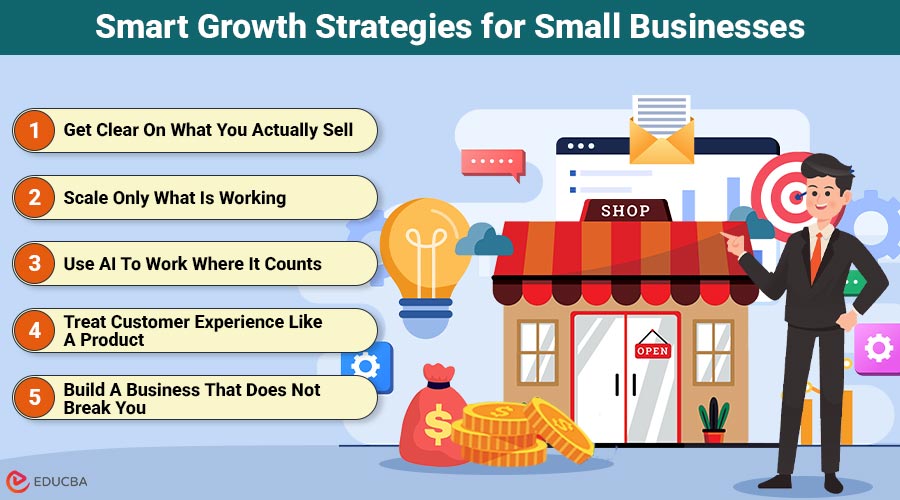
Smart Growth Strategies for Small Businesses
Here are five practical growth strategies for small businesses that focus on clarity, smart scaling, customer experience, and leveraging AI tools effectively.
1. Get Clear On What You Actually Sell
One of the fastest ways a small business can get lost in the weeds is forgetting what it is truly offering. And no, it is not just products or services. You are selling relief. Or control. Or speed. Maybe it is identity. Maybe it is trust. But it is rarely just “landscaping” or “consulting.” The best-performing SMEs lean hard into clarity. Their messaging, pricing, and packaging—it all reflects a single, compelling value proposition that real people want. That kind of clarity makes marketing easier, closes deals faster, and aligns your team without endless meetings.
It is also the first thing to get muddled when you are juggling operations, customer service, and three million tiny fires. If you have not re-evaluated your core offering in the last six months, you are probably overdue. A well-defined focus does not limit your growth—it accelerates it.
2. Scale Only What Is Working
There is a weird pressure these days to always be expanding. More products, content, and platforms, but more does not equal better, and it certainly does not equal sustainability. The smartest growth moves come from doubling down on what is already driving results. That could mean your email list instead of social. Your in-person sales over digital ads. Or your subscription model instead of a la carte chaos.
When you scale strategically, it is less about jumping on trends and more about understanding where your leverage lives. This is also where having the right software for small businesses matters. Tools that show you where conversions are happening, what your margins really look like, and which customers keep coming back make all the difference when you are deciding what deserves more investment and what needs to be cut loose.
3. Use AI To Work Where It Counts
Here is where things get interesting. AI is not a buzzword anymore; it is a practical, everyday tool. And for SMEs, it is no longer a matter of if you should use it—it is where you start. Marketing’s an easy entry point. Automated email tools that write (and rewrite) subject lines until they hit. Social caption assistants that sound like a human wrote them. Chatbots that handle 80% of the questions you are tired of repeating. These save time, sure, but they also improve quality and consistency in ways that used to require a full-time hire.
But it does not stop there. One of the more underrated upgrades? The AI video generator. You no longer need to outsource video production or rely on your team to know how to edit. These tools turn a few lines of text into polished video content you can use in ads, emails, landing pages—you name it. They are fast, surprisingly affordable, and genuinely useful if you are trying to punch above your weight without stretching your team thin. The trick is picking tools that integrate into your workflow instead of becoming yet another subscription you forget about. AI should feel like a helping hand, not homework.
4. Treat Customer Experience Like A Product
When you are growing, it is easy to treat customer service like something that will get better “when we hire more people.” But great service is not just about being responsive—it is about building repeatable systems that scale with you. Think about how your business handles onboarding, support, returns, and follow-ups. Are there clear touchpoints? Do customers know what to expect? Is there a consistent tone, or does it depend on who is answering that day?
Your product might be great, but if your customer journey feels like a hot mess, they will not stick around. Consistency matters. So does tone. So does solving issues before they turn into complaints. When you treat the experience itself like an asset, it starts to generate its momentum—referrals, reviews, long-term loyalty. And no, this does not mean turning your service team into robots. It means removing friction, adding thoughtful automation, and training your people to lead with ownership.
5. Build A Business That Does Not Break You
The hard truth about most small businesses is that they are quietly running on burnout. The founder is answering emails at midnight. The team’s wearing three hats each. Everyone is hoping the next launch or sale will give them enough breathing room to keep going. That is not sustainable. And it is not necessary either.
A healthy SME runs on clarity, not chaos. It has systems and tools that rely on data-driven insights rather than intuition or external influence. It does not chase every shiny thing, and it does not overwork its people just to keep up appearances. AI can help. So can smart hires. So you can get real about your actual goals because growth for the sake of growth is exhausting. But building something that supports your life—not the other way around—that is worth it.
Final Thoughts
Success is not just about hustle anymore. It is about using the right growth strategies for small businesses, letting go of what does not work, and building something that supports everyone in your company. Thanks to accessible AI tools and a clear focus, you do not need a big tech team or budget to grow smarter. It is time for working smarter, not harder.
Recommended Articles
We hope this guide on growth strategies for small businesses gives you practical steps to scale smartly and sustainably. Explore these recommended articles to discover more ways to boost your business.

