
What is a Strategic Alliance?
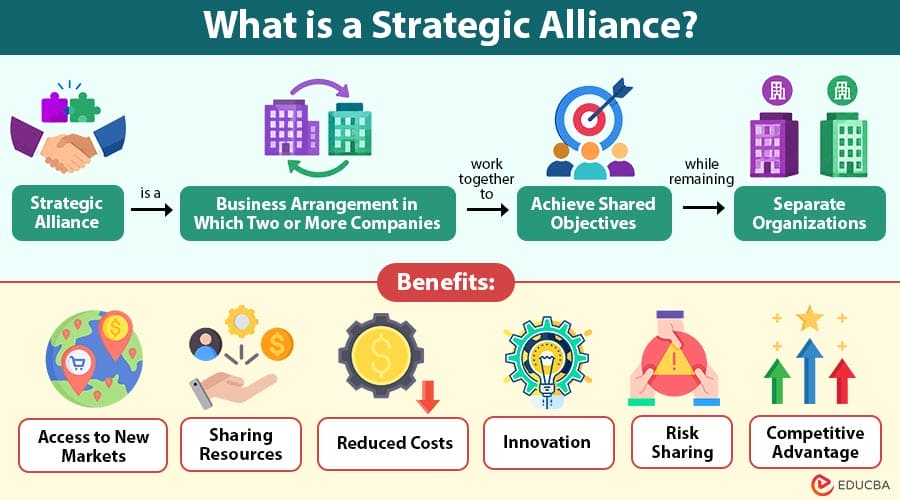
A strategic alliance is a business arrangement in which two or more companies work together to achieve shared objectives while remaining separate organizations. Partners may share resources, technology, expertise, distribution networks, knowledge, or market access without merging.
Companies often form strategic alliances to enter new markets, develop products, reduce costs, improve capabilities, or reach new customers. Each company contributes something valuable and benefits from the partnership.
For example, a software company may form a strategic alliance with a consulting firm. The software company provides its technology, while the consulting firm provides industry expertise and customer relationships. Together, they can offer a stronger solution than either company could alone.
Table of Contents:
- Meaning
- Importance
- Working
- Types
- Benefits
- Challenges
- Examples
- How to Build a Successful Strategic Alliance?
Key Takeaways:
- Strategic alliances help companies expand markets, share resources, reduce risks, and strengthen competitive advantages.
- Successful alliances require clear objectives, suitable partners, defined responsibilities, effective communication, and mutual trust.
- Companies can collaborate through joint ventures, equity alliances, licensing agreements, marketing partnerships, or contracts.
- Strong strategic alliances combine complementary capabilities to support innovation, growth, efficiency, and long-term business success.
Importance of Strategic Alliances
Below are the key reasons why strategic alliances are important for business growth and success:
1. Expands Market Reach
Strategic alliances help companies enter new markets by using a partner’s existing customers, distribution networks, local knowledge, and business relationships.
2. Encourages Innovation
Working with another organization brings together different skills, technologies, ideas, and expertise. This collaboration can help companies develop innovative products and improve existing solutions.
3. Optimizes Resources
Companies can combine technology, employees, infrastructure, knowledge, and other resources. This allows partners to achieve common objectives without building every capability independently.
4. Reduces Business Risks
Strategic alliances allow companies to share certain financial, operational, and market risks. This can make large projects and expansion plans more manageable for each partner.
5. Improves Competitive Position
Businesses can improve their market position and react to rivals more skillfully by gaining access to new capabilities, technology, clients, and knowledge.
6. Supports Business Growth
Strategic alliances create opportunities for increased sales, new products, customer acquisition, geographic expansion, and long-term business development.
How Does a Strategic Alliance Work?
A strategic alliance begins when companies identify a common business opportunity or objective. The organizations then determine what each partner can contribute and what benefits they expect.
Partners usually establish an agreement that defines responsibilities, resources, financial arrangements, intellectual property rights, performance expectations, and the relationship’s duration.
Depending on the arrangement, companies may share:
1. Technology and Research
Partners share technologies, research capabilities, innovations, and technical knowledge to develop better products, improve processes, and accelerate innovation.
2. Employees and Expertise
Companies contribute skilled employees, professional expertise, and specialized knowledge to support projects, solve challenges, and achieve shared objectives.
3. Manufacturing Capabilities
Partners combine manufacturing facilities, production capacity, equipment, and operational expertise to increase efficiency, reduce costs, and meet demand.
4. Distribution Networks
Companies share distribution channels, logistics infrastructure, and market access to expand product availability and reach customers across regions efficiently.
5. Marketing Resources
Partners combine marketing teams, promotional campaigns, branding capabilities, and communication channels to increase visibility and attract potential customers.
6. Customer Bases
Companies leverage each partner’s existing customers to introduce products, expand market reach, strengthen relationships, and create new opportunities.
7. Data and Business Knowledge
Partners exchange valuable data, market insights, industry knowledge, and business intelligence to make informed decisions and improve performance.
8. Financial Resources
Companies contribute funding, investment, or financial support to jointly develop projects, expand operations, manage risks, and achieve strategic goals.
Types of Strategic Alliances
Strategic alliances can take different types depending on the goals and level of cooperation between the partners.
1. Joint Venture
A joint venture involves companies creating a separate business entity, combining resources, and sharing ownership, profits, responsibilities, and risks.
2. Equity Strategic Alliance
An equity alliance occurs when one company buys a minority stake in another, strengthening cooperation while both businesses remain independent.
3. Non-Equity Strategic Alliance
A non-equity alliance involves companies cooperating through contracts without exchanging ownership, allowing them to share resources, capabilities, or distribution.
4. Licensing Agreement
Under certain restrictions, a license agreement permits one business to use another’s technology, intellectual property, brand, or goods.
5. Marketing Alliance
A marketing alliance occurs when companies collaborate on promotional activities, combining audiences, marketing resources, customer insights, and communication channels.
Benefits of Strategic Alliances
Below are the key benefits of strategic alliances that help businesses grow, innovate, reduce costs, and strengthen their competitive position:
1. Access to New Markets
Strategic alliances help companies enter new markets by using partners’ customer networks, local knowledge, distribution channels, and market experience.
2. Sharing Resources
Partners combine technology, expertise, employees, infrastructure, and other resources to achieve shared objectives efficiently while creating greater business value.
3. Reduced Costs
Strategic alliances allow companies to share research, development, marketing, production, and expansion costs, reducing financial pressure on individual businesses.
4. Innovation
Collaboration combines different ideas, skills, technologies, and expertise, helping companies develop innovative products, improve processes, and create better solutions.
5. Risk Sharing
Strategic alliances allow partners to share financial, operational, and market risks, making major projects and expansion plans more manageable.
6. Competitive Advantage
Strategic alliances provide access to technology, expertise, customers, and distribution networks, helping companies strengthen their market position and outperform competitors.
Challenges of Strategic Alliances
Although strategic alliances offer many benefits, they also involve challenges.
1. Different Business Objectives
Partners may have different goals, priorities, or expectations, creating disagreements and making it difficult to maintain a successful alliance.
2. Cultural Differences
Differences in communication styles, management practices, workplace cultures, and decision-making approaches can create misunderstandings between strategic alliance partners.
3. Lack of Trust
Strategic alliances require sharing information, resources, and knowledge, but limited trust can reduce cooperation and create conflicts between partners.
4. Unequal Contributions
Partners may disagree when one company believes it contributes more resources, expertise, technology, or financial support than the other.
5. Intellectual Property Risks
Sharing technology, designs, data, and intellectual property can create ownership concerns, confidentiality issues, and risks of unauthorized use.
6. Management Complexity
Coordinating multiple organizations can create management challenges, making clear responsibilities, effective communication, decision-making processes, and regular monitoring essential.
Examples of Strategic Alliances
Below are some common examples of strategic alliances across different industries:
1. Technology Companies
Technology companies form strategic alliances to combine hardware and software expertise, improve products, reach customers, and develop integrated technology solutions.
2. Airlines
Airlines collaborate through strategic alliances to expand route networks, coordinate services, share resources, and provide passengers access to destinations worldwide.
3. Automotive Industry
Automotive companies partner with technology firms to develop electric vehicles, connected-car systems, advanced software, and driver-assistance technologies.
4. Retail Partnerships
Retailers collaborate with financial services companies to offer payment cards, financing options, and customer benefits, increasing engagement and business opportunities.
How to Build a Successful Strategic Alliance?
Creating an alliance is only the first step. Businesses must manage the relationship carefully to achieve meaningful results.
1. Define Clear Objectives
Partners should establish exactly what they want to achieve. Objectives may include increasing sales, entering a new market, reducing costs, or developing technology.
2. Select the Right Partner
The ideal partner should have complementary capabilities, a strong reputation, compatible objectives, and sufficient resources. Choosing a partner only because of its size or market position may not produce a successful alliance.
3. Establish Clear Responsibilities
Each organization should understand its responsibilities from the beginning. The agreement should clearly explain who will provide resources, make decisions, manage activities, and handle costs.
4. Protect Intellectual Property
Contracts should clearly define how the parties will handle intellectual property, confidential information, customer data, and newly developed technology.
5. Maintain Communication
Regular communication helps partners identify problems before they become serious. Meetings, performance reviews, and shared reporting systems can improve coordination.
6. Measure Performance
Businesses should establish measurable indicators to evaluate the alliance. These may include revenue growth, customer acquisition, cost savings, product development milestones, or market share.
7. Build Trust
Long-term alliances depend heavily on trust. Partners should communicate honestly, meet their commitments, and address disagreements constructively.
Final Thoughts
Strategic alliances enable businesses to combine strengths, access new markets, share resources, encourage innovation, and manage risks. However, successful partnerships require clear objectives, suitable partners, defined responsibilities, trust, communication, and performance measurement. When managed effectively, strategic alliances can create lasting value, strengthen competitiveness, and support sustainable business growth.
Frequently Asked Questions (FAQs)
Q1. How are decisions made in a strategic alliance?
Answer: Decision-making depends on the agreement. Partners may make decisions jointly or assign specific areas of authority to each organization.
Q2. How long does a strategic alliance typically last?
Answer: The duration depends on the agreement and business objective. Some alliances may last for a specific project, while others continue for several years.
Q3. Can small businesses form strategic alliances?
Answer: Yes. Small businesses can collaborate with other companies to access specialized skills, technology, customers, suppliers, or markets that may otherwise be difficult to reach.
Q4. What factors should companies consider before forming an alliance?
Answer: Companies should evaluate a potential partner’s reputation, capabilities, financial stability, business objectives, resources, market position, and ability to work collaboratively.
Recommended Articles
We hope that this EDUCBA information on “Strategic Alliance” was beneficial to you. You can view EDUCBA’s recommended articles for more information.


