
What is a Sales Territory?
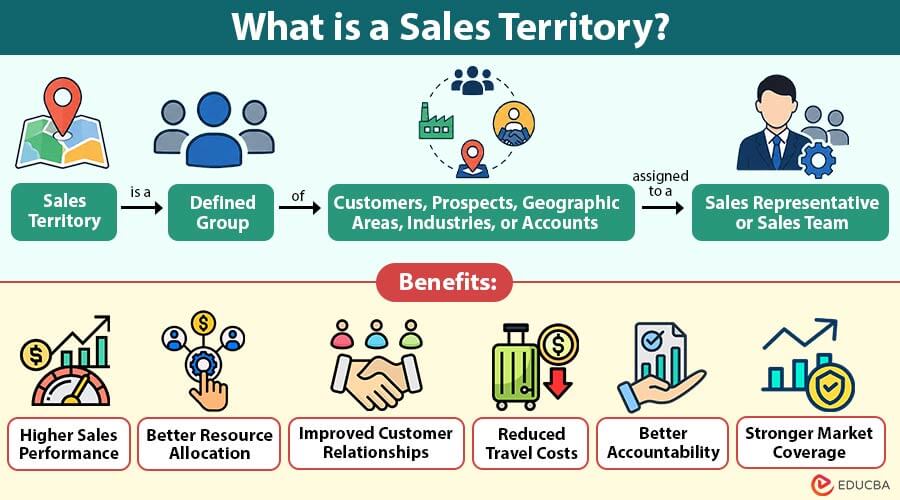
A sales territory is a defined group of customers, prospects, geographic areas, industries, or accounts assigned to a sales representative or sales team. It helps businesses divide their market into manageable sections and ensures that sales representatives know which customers they are responsible for.
Sales territories can be based on different factors, such as location, customer type, industry, company size, product category, or sales potential. For example, a software company may assign one sales representative to manage healthcare companies, while another handles financial services companies.
Table of Contents:
Key Takeaways:
- Sales territories divide customers and prospects into manageable groups for better sales coverage and accountability.
- Businesses can create territories based on geography, customer type, industry, products, accounts, or any combination thereof.
- Effective territory management improves sales productivity, resource allocation, customer relationships, forecasting, and overall market coverage.
- Regular territory reviews help businesses address changing customer needs, market conditions, workloads, and sales opportunities.
Why is Sales Territory Important?
Effective sales territory management helps businesses make better use of their sales resources. When territories are clearly defined, sales representatives can focus on the right customers and spend less time deciding who should handle an account.
1. Improves Sales Productivity
Clearly assigned territories help sales representatives focus on their specific customers and prospects. They can spend more time selling instead of searching for accounts or managing territory conflicts.
2. Provides Better Customer Coverage
Sales territories ensure that important customers and market segments are not ignored. Each account has a responsible representative who can regularly communicate with customers.
3. Reduces Sales Conflicts
Without clear territory boundaries, multiple representatives may contact the same customer. This can create confusion and internal competition. Defined territories reduce these conflicts.
4. Supports Fair Target Allocation
Businesses can analyze the potential of each territory and assign realistic sales targets. This creates a more balanced distribution of opportunities among sales representatives.
5. Helps Control Sales Costs
Well-designed territories can reduce unnecessary travel, duplicate activities, and inefficient use of sales resources. This can help businesses lower selling costs.
6. Improves Sales Forecasting
When sales data is organized by territory, managers can compare performance and identify changes in customer demand. This makes sales forecasting more accurate.
Types of Sales Territories
Businesses use different types of sales territories depending on their products, customers, and market structure.
1. Geographic
A territory divided according to specific locations, allowing representatives to manage customers within assigned cities, regions, states, or countries.
For example, a company assigns representatives to North India, South India, East India, and West India.
2. Customer-Based
Customer-based territories divide accounts according to customer characteristics. These characteristics may include company size, revenue, purchasing behavior, or customer value.
For example, one sales team may handle enterprise customers while another handles small and medium-sized businesses.
3. Industry-Based
An approach organized around specific industries, allowing representatives to develop specialized knowledge about customer needs, challenges, and requirements.
For example, one representative handles healthcare companies, while another focuses on banking and financial services.
4. Product-Based
An approach organized around specific products, allowing representatives to specialize in selling particular product lines or solutions effectively.
For example, one sales team may sell cybersecurity products while another sells cloud solutions.
5. Account-Based
An approach focused on specific customer accounts, with dedicated representatives managing important, strategic, or high-value business relationships.
For example, a software company assigns dedicated sales representatives to manage its largest corporate customers.
6. Hybrid Sales
A combination of multiple approaches, such as geography, customer type, industry, or products, to improve management flexibility.
For example, a company assigns representatives by region and further divides customers based on industry or company size.
How to Create a Sales Territory?
Creating effective sales territories requires businesses to study their customers, market opportunities, and sales resources.
Step 1: Analyze Your Market
Start by identifying the total market, target customers, existing accounts, prospects, and revenue opportunities. Analyze factors such as customer location, industry, company size, and buying behavior.
Step 2: Identify Customer Segments
Group customers according to meaningful characteristics. For example, customers can be divided into enterprise, mid-market, and small-business segments. Customer segmentation helps businesses assign the right sales resources to the right accounts.
Step 3: Evaluate Territory Potential
Not every territory has the same number of customers or revenue potential. Analyze historical sales, customer demand, market size, and growth opportunities before assigning targets.
Step 4: Define Territory Boundaries
Step 5: Assign Sales Representatives
Match sales representatives with territories based on their skills, experience, product knowledge, and customer relationships.
For example, an experienced representative may manage strategic enterprise accounts, while another representative handles smaller accounts.
Step 6: Set Sales Targets
Set realistic goals for each territory. Targets should consider market potential, historical performance, customer demand, and available sales resources.
Step 7: Monitor Performance
Track territory performance regularly. Compare revenue, conversions, pipeline value, customer acquisition, and other sales metrics across territories.
Step 8: Adjust Territories When Needed
Sales territories should not remain unchanged forever. Changes in customer demand, market growth, employee capacity, and business strategy may require territory redesign.
Sales Territory Management
It is the process of planning, assigning, monitoring, and improving sales territories. It ensures that sales resources are distributed effectively and that representatives have balanced opportunities.
Effective territory management usually involves four major activities:
1. Territory Planning
Defining sales territories using market data, customer locations, potential, and business goals for effective coverage.
2. Account Assignment
Assigning customers and prospects to appropriate sales representatives based on location, industry, value, or account needs.
3. Performance Tracking
Measuring sales results, revenue, conversion rates, customer coverage, and representative performance across different territories.
4. Territory Optimization
Adjusting territories when market conditions, customer distribution, sales potential, or representative workloads become unbalanced.
Key Sales Territory Metrics
Businesses can use several metrics to measure territory performance.
1. Revenue
Revenue measures total income generated by a specific area during a defined period.
2. Sales Growth
Sales growth measures changes in territory revenue over time, showing whether sales performance is improving or declining.
3. Win Rate
Win rate measures percentage of sales opportunities successfully converted into customers within a specific territory.
4. Pipeline Value
Pipeline value measures total potential revenue from open sales opportunities within a specific territory.
5. Customer Acquisition
Customer acquisition measures number of new customers gained by sales representatives within their assigned territory.
6. Average Deal Size
Average deal size measures the typical revenue generated per sales deal within a specific territory.
7. Customer Retention
Customer retention measures how effectively sales teams maintain existing customers and encourage continued business relationships.
Benefits of Effective Sales Territory Planning
A well-designed structure can provide several business benefits.
1. Higher Sales Performance
Representatives can focus on high-value opportunities and spend their time more effectively.
2. Better Resource Allocation
Businesses can assign salespeople according to market potential and customer needs.
3. Improved Customer Relationships
Customers receive consistent attention from representatives who understand their requirements.
4. Reduced Travel Costs
Geographic territories can reduce unnecessary travel and improve field-sales efficiency.
5. Better Accountability
Clear territory ownership makes it easier to understand who is responsible for specific customers and results.
6. Stronger Market Coverage
Businesses can identify underserved markets and assign resources where additional sales coverage is needed.
Common Challenges in Sales Territory Management
Although territory planning provides many benefits, businesses may face several challenges.
1. Unequal Territory Potential
Some territories may have significantly more customers or revenue opportunities than others. This can make sales targets unfair.
2. Changing Customer Locations
Customers may move, expand, close operations, or open new locations. Territory assignments must adapt to these changes.
3. Territory Conflicts
Conflicts can occur when multiple representatives believe they are responsible for the same customer or opportunity.
4. Poor Data Quality
Incorrect customer locations, outdated account information, or duplicate records can result in poor territory assignments.
5. Changing Market Conditions
Market demand can change quickly. A territory that was highly valuable one year may have lower potential later.
6. Resistance to Territory Changes
Sales representatives may resist changes because they have established customer relationships or believe that changes to their territory could affect their commissions.
Example
Here is a practical example showing how a company can divide customers into sales territories.
Consider a software company selling business applications across India. The company has 2,000 customers and 5 sales teams.
Instead of allowing every representative to approach every customer, the company creates territories based on geography and customer size.
- Team 1: North India enterprise customers
- Team 2: South India enterprise customers
- Team 3: West India mid-market customers
- Team 4: East India mid-market customers
- Team 5: Small-business customers across India
Each team receives specific accounts, sales targets, and pipeline goals. Managers can then compare performance across territories and identify areas that need additional sales support.
If one territory has significantly higher demand, the company can add sales representatives or redesign the territory to balance the workload.
Final Thoughts
Sales territory management organizes sales teams, assigns accounts, and improves market coverage. Companies can divide customers by geography, industry, account value, or products. Effective territory planning uses accurate data and regular performance analysis to balance opportunities, improve productivity, strengthen accountability, increase customer coverage, support forecasting, and drive sustainable revenue growth.
Frequently Asked Questions (FAQs)
Q1. Who is responsible for managing sales territories?
Answer: Sales managers, territory managers, and sales operations teams typically design, review, and maintain territory assignments according to business requirements.
Q2. How often should sales territories be reviewed?
Answer: Sales territories should be reviewed regularly, such as quarterly or annually, and whenever major changes occur in customers, markets, staffing, or business strategy.
Q3. Can one customer belong to multiple sales territories?
Answer: Yes, a large customer may be divided across territories when it has multiple locations, product requirements, or business units requiring separate sales responsibilities.
Q4. What role does technology play in sales territory planning?
Answer: Sales software can help businesses map accounts, analyze market data, assign customers, track workloads, and identify gaps in sales coverage.
Recommended Articles
We hope that this EDUCBA information on “Sales Territory” was beneficial to you. You can view EDUCBA’s recommended articles for more information.

