


What is Search Everywhere Optimization?
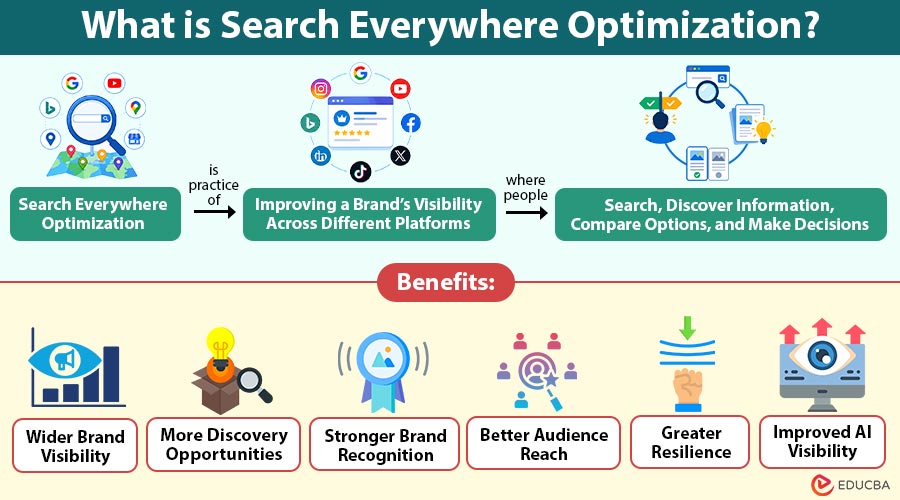
Search Everywhere Optimization is the practice of improving a brand’s visibility across the different platforms where people search, discover information, compare options, and make decisions. Instead of focusing only on the traditional search engines, it considers platforms such as Google, YouTube, Reddit, Amazon, LinkedIn, app stores, and AI assistants.
The approach recognizes that search behavior has become distributed across multiple digital environments. Users may search Google for detailed information, YouTube for demonstrations, Reddit for opinions, Amazon for products, or AI assistants for recommendations and summaries. Therefore, brands need to optimize their content and digital presence according to the platforms their audiences actually use.
Table of Contents:
- Meaning
- Importance
- Working
- Platforms Covered By Search Everywhere Optimization
- Difference
- Benefits
- Challenges
- Best Practices
- Example
- Applications
Key Takeaways
- Search Everywhere Optimization expands brand visibility across search engines, social platforms, communities, marketplaces, and AI environments.
- Businesses should prioritize platforms based on audience behavior, search intent, business goals, and platform-specific opportunities.
- Adapting content formats and messaging helps brands address different discovery experiences without simply duplicating content everywhere.
- Consistent information, credible content, and performance measurement strengthen visibility across evolving digital search and discovery environments.
Why is Search Everywhere Optimization Important?
Traditional SEO mainly focuses on improving a website’s visibility in search engine results. However, users now interact with search in many different ways. They may watch videos before buying a product, read community discussions before choosing a service, or ask an AI assistant to compare options.
This fragmentation means that a brand can rank well on Google but remain difficult to find on other important platforms. Search Everywhere Optimization addresses this gap by considering the complete discovery journey rather than treating Google rankings as the only measure of visibility.
It also helps businesses adapt to zero-click and AI-assisted experiences, where users may receive information directly within a search result or conversational interface without immediately visiting a website.
How Does Search Everywhere Optimization Work?
Search Everywhere Optimization combines several optimization activities into one broader strategy.
1. Identify Search Behavior
The first step is to understand where the target audience searches for information. A software company may receive discovery through Google, YouTube, LinkedIn, developer communities, and AI assistants. A consumer product company may depend more heavily on Google, Amazon, TikTok, YouTube, and review platforms.
Businesses should identify the platforms that influence their customers instead of automatically targeting every available channel.
2. Create Platform-Relevant Content
Each platform has different content requirements and user expectations. A detailed article may perform well on Google, while a short demonstration may suit YouTube or TikTok better.
Similarly, marketplace listings need clear product information, while community platforms often reward useful and authentic discussions. Content should therefore be adapted, not copied, across platforms.
3. Strengthen Website SEO
Traditional SEO remains an important foundation. Technical performance, useful content, internal linking, structured information, and relevant authority signals help search engines understand and surface a website.
A strong website can also provide reliable source material that other search and AI systems may use when identifying information about a brand or topic.
4. Optimize for AI Search
AI assistants increasingly influence how users discover and evaluate information. Businesses should make important information easy for automated systems to understand and retrieve.
Clear headings, direct explanations, factual statements, consistent terminology, structured content, and credible supporting information can improve machine readability and make content easier to interpret.
5. Build Consistent Brand Signals
Keep business information consistent across your website, social profiles, directories, marketplaces, and other platforms. Differences in names, descriptions, services, pricing, or other business details can create confusion.
Consistent information helps users recognize the same brand across different discovery environments.
Platforms Covered by Search Everywhere Optimization
Search Everywhere Optimization can include many platforms, depending on the business and its audience.
1. Search Engines
Google, Bing, and other traditional search engines remain important for informational, commercial, and navigational searches.
2. AI Assistants
AI platforms can provide summaries, recommendations, comparisons, and direct answers. Businesses increasingly need content that can be understood and referenced within these experiences.
3. Video Platforms
YouTube and other video platforms are important for tutorials, demonstrations, product reviews, educational content, and visual explanations.
4. Social Search
Platforms such as TikTok, Instagram, LinkedIn, and Pinterest can function as discovery environments, particularly for products, services, trends, professional topics, and visual content.
5. Community Platforms
Reddit and other discussion communities can influence product research and decision-making because users often seek firsthand experiences and opinions.
6. Marketplaces
Amazon and other marketplaces have their own internal search systems. Product titles, descriptions, categories, reviews, images, and other listing information can affect visibility.
7. App Stores
For mobile and software businesses, app stores are important discovery environments. App names, descriptions, categories, ratings, reviews, and visual assets contribute to how users find apps
Difference Between Search Everywhere Optimization and Traditional SEO
The table below highlights the key differences between the two:
| Aspect | Search Everywhere Optimization | Traditional SEO |
| Primary Focus | Multi-platform discovery | Search engine visibility |
| Main Channels | Search engines, AI, social, video, marketplaces, communities | Search engines |
| Content | Articles, videos, listings, posts, discussions, profiles | Web pages |
| Measurement | Visibility, mentions, citations, engagement, traffic, and conversions | Rankings and organic traffic |
| Strategy | Audience and platform-centered | Website-centered |
Benefits of Search Everywhere Optimization
Below are the key benefits of search everywhere optimization:
1. Wider Brand Visibility
A globe surrounded by multiple search platforms, screens, and connected visibility signals, representing broader digital brand exposure.
2. More Discovery Opportunities
A magnifying glass branching toward multiple platforms, search results, videos, communities, and marketplaces, showing increased discovery opportunities.
3. Stronger Brand Recognition
A recognizable brand symbol appearing consistently across multiple screens, with visual repetition indicating stronger recognition and recall.
4. Better Audience Reach
Multiple audience profiles connected to tailored content channels, representing personalized communication and improved reach across different user groups.
5. Greater Resilience
A strong central brand supported by multiple independent platforms, showing reduced dependence and greater resilience against algorithm changes.
6. Improved AI Visibility
A structured information document connected to an AI interface and knowledge nodes, representing clearer understanding and potential AI references.
Challenges of Search Everywhere Optimization
Despite its advantages, search everywhere optimization requires careful planning.
1. Resource Requirements
Maintaining high-quality content across multiple platforms requires significant time, specialized skills, ongoing management, and consistent effort from marketing teams.
2. Different Ranking Systems
Each platform uses different ranking signals and algorithms, so strategies effective on Google may not deliver similar results elsewhere.
3. Content Adaptation
Businesses must adapt content to each platform’s format, audience, search behavior, and communication style instead of publishing identical content.
4. Measurement Complexity
Search visibility across multiple platforms complicates performance tracking, requiring businesses to monitor different metrics and reporting systems.
5. Platform Changes
Search algorithms, recommendation systems, and AI interfaces frequently change, requiring businesses to review strategies and adjust optimization efforts regularly.
6. Brand Consistency
Maintaining accurate, consistent, and up-to-date brand information across numerous platforms becomes increasingly difficult as businesses expand their digital presence.
Best Practices for Search Everywhere Optimization
Businesses can follow several practices to develop an effective strategy.
1. Prioritize Relevant Platforms
Do not attempt to optimize every platform equally. Focus on the environments where the target audience actively searches.
2. Use Search Intent
Create content according to what users want to accomplish, such as learning, comparing, evaluating, purchasing, or troubleshooting.
3. Adapt Content Formats
Convert useful information into appropriate formats, such as articles, videos, product descriptions, social posts, and community contributions.
4. Maintain Accurate Information
Keep brand names, descriptions, products, services, and other important information consistent across platforms.
5. Build Authority
Publish reliable information supported by evidence, expertise, useful examples, and clear explanations.
6. Monitor Brand Mentions
Track how the brand appears across search engines, AI platforms, social networks, communities, and other relevant channels.
7. Measure Business Outcomes
Look beyond rankings. Monitor qualified traffic, leads, conversions, engagement, mentions, citations, and assisted conversions where possible.
Example
Consider a company selling project management software. Its traditional SEO strategy may focus on ranking an article for searches such as “project management software.”
A Search Everywhere Optimization strategy could expand this approach by creating detailed comparison articles for Google, tutorial videos for YouTube, concise educational posts for LinkedIn, useful discussions within relevant communities, optimized information for software directories, and clear product information that AI systems can understand.
The goal is not to publish the same article everywhere. Instead, the company creates a connected presence that addresses different stages of the user’s research journey.
For example, a user may discover the company through a Google article, watch its YouTube tutorial, compare alternatives through an AI assistant, and eventually visit the company’s website to request a demonstration.
Applications of Search Everywhere Optimization
Search Everywhere Optimization can support many business activities.
1. E-Commerce
Brands can improve product discovery through search engines, marketplaces, social platforms, videos, and AI recommendations.
2. B2B Marketing
Companies can build visibility through search engines, LinkedIn, industry communities, research content, and AI-driven discovery.
3. Education
Educational websites can distribute explanations through articles, videos, social platforms, and AI-search-friendly resources.
4. SaaS Businesses
Software companies can optimize documentation, comparison pages, tutorials, app listings, review profiles, and educational content.
5. Local Businesses
Restaurants, retailers, healthcare providers, and service businesses can improve discovery through local search, maps, social platforms, review sites, and relevant community channels.
Final Thoughts
Search Everywhere Optimization expands the traditional SEO mindset from search engines to the broader digital environments where audiences discover and evaluate information. Businesses can strengthen visibility by prioritizing relevant platforms, adapting content formats, maintaining consistent brand signals, and measuring meaningful outcomes. A strategic approach helps brands remain discoverable as search behavior continues evolving.
Frequently Asked Questions (FAQs)
Q1. Is Search Everywhere Optimization suitable for small businesses?
Answer: Yes. Small businesses can focus on a few high-value platforms where their customers are most active rather than maintaining a presence across every channel.
Q2. How is Search Everywhere Optimization related to customer journeys?
Answer: It supports customers across different stages, from initial awareness and research to comparison, evaluation, and final purchase decisions.
Q3. Can Search Everywhere Optimization improve brand trust?
Answer: Yes. Consistent, useful, and credible information across trusted digital environments can strengthen how users perceive a brand.
Q4. Does Search Everywhere Optimization require a separate strategy for every platform?
Answer: Not necessarily. Businesses can develop a central strategy and adjust its content, format, messaging, and presentation to suit individual platforms.
Recommended Articles
We hope that this EDUCBA information on “Search Everywhere Optimization” was beneficial to you. You can view EDUCBA’s recommended articles for more information.


