
What are Seed Keywords?
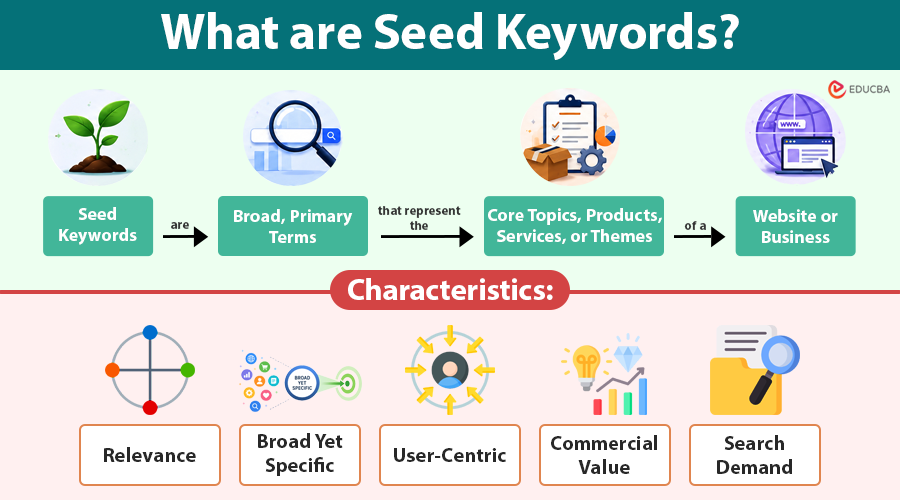
Seed keywords are broad, primary terms that represent the core topics, products, services, or themes of a website or business. They are the starting keywords used during keyword research to generate additional keyword ideas.
In simple terms, seed keywords are the basic words or phrases that describe what a business or website is about. Seed keywords are usually short phrases consisting of one to three words and generally have high search volume.
For example, a fitness website may use seed keywords such as fitness, exercise, and weight loss.
Table of Contents:
- Meaning
- Importance
- Characteristics
- How to Find Seed Keywords?
- Methods
- Tools
- Benefits
- Challenges
- Examples
Key Takeaways:
- Seed keywords establish the foundation for comprehensive keyword research and SEO planning.
- Effective seed keywords align closely with business goals and user intent.
- Expanding seed keywords helps discover valuable long-tail and related search terms.
- Regularly updating seed keywords ensures content remains relevant amid changing trends.
Importance of Seed Keywords
Seed keywords play a critical role in SEO and content marketing.
1. Form the Basis of Keyword Research
Every keyword research campaign starts with seed keywords. They help marketers uncover relevant search terms.
2. Identify User Intent
These core terms reveal what users are interested in and the type of information they are seeking.
3. Generate Content Ideas
Marketers can create blog topics, landing pages, and website content around related keywords.
4. Improve Search Visibility
Choosing relevant terms ensures content aligns with user searches, increasing the chances of higher rankings.
5. Support Competitor Analysis
Analyzing competitors’ target terms helps businesses uncover new opportunities and identify market gaps.
6. Enhance PPC Campaigns
Widely used in pay-per-click advertising campaigns to build targeted ad groups.
Characteristics of Good Seed Keywords
Not every broad term qualifies as an effective seed keyword. Good seed keywords possess the following characteristics:
1. Relevance
The keyword should closely align with the business, industry, product, service, or content topic.
2. Broad Yet Specific
Good keywords are broad enough for expansion while remaining clearly niche-focused.
3. User-Centric
Effective keywords reflect the actual search terms users commonly type into search engines.
4. Commercial Value
High-value keywords often relate directly to products, services, purchases, or business objectives.
5. Search Demand
Strong keywords typically demonstrate consistent search volume, indicating substantial audience interest online.
How to Find Seed Keywords?
Finding requires understanding your business and audience.
Step 1: Understand Your Business
Identify:
- Products
- Services
- Industry
- Target audience
- Business objectives
Ask:
- What do you sell?
- What problems do you solve?
- What topics define your business?
Step 2: Brainstorm Core Topics
List broad categories related to your business.
Example for a digital marketing company:
- SEO
- Email marketing
- PPC advertising
- Content marketing
- Social media
Step 3: Analyze Customer Language
Review:
- Customer inquiries
- Reviews
- Emails
- FAQs
- Social media comments
Customers often use valuable terms that can become important keyword opportunities.
Step 4: Study Competitors
Examine competitor websites to identify major topics and keywords they target.
Look at:
- Navigation menus
- Category pages
- Blog topics
- Meta titles
Step 5: Use Keyword Research Tools
Keyword tools can generate extensive keyword suggestions based on initial seed terms.
Methods for Generating Seed Keywords
Below are some of the most effective methods businesses and marketers can use to discover relevant keyword ideas and build a strong foundation for keyword research.
1. Product and Service Listing
List all products and services offered because they naturally represent core business keyword opportunities.
2. Industry Terminology
Identify commonly used industry terms, jargon, and technical phrases relevant to your niche or market.
3. Customer Problem Identification
Determine customer pain points and challenges, as problem-based keywords often attract highly targeted audiences.
4. Website Category Analysis
Analyze website categories and sections since they often represent primary topics and valuable seed keywords.
5. Competitor Keyword Analysis
Study competitor websites using SEO tools to uncover important keywords driving their search traffic.
6. Google Search Suggestions
Use Google’s autocomplete and related searches to discover popular keyword variations and trending search queries.
Tools for Finding Seed Keywords
Below are some popular tools commonly used to discover and analyze keyword opportunities.
1. Google Keyword Planner
This tool provides keyword suggestions, search volume data, and competition metrics for SEO planning.
2. Google Search Autocomplete
Google Autocomplete displays real user search predictions, helping identify popular and relevant keyword ideas.
3. Google Trends
Google Trends analyzes keyword popularity over time and helps identify seasonal and trending topics.
4. Ahrefs
Ahrefs offers extensive keyword research features, competitor analysis, backlink insights, and content opportunities.
5. SEMrush
SEMrush helps marketers discover keywords, analyze competitors, track rankings, and improve SEO strategies.
6. Moz Keyword Explorer
Moz Keyword Explorer identifies keyword opportunities while providing search volume, difficulty, and ranking potential data.
7. Ubersuggest
Ubersuggest generates keyword ideas, analyzes SEO performance, and provides competitor keyword insights.
8. AnswerThePublic
AnswerThePublic generates question-based keyword ideas by analyzing common user searches and queries.
Benefits of Using Seed Keywords
The following benefits highlight how it strengthens SEO strategies, improve content planning, and drive targeted website traffic.
1. Streamline SEO Strategy
Provides clear direction, making keyword research, content planning, and SEO implementation more efficient.
2. Discover Long-Tail Keywords
Helps marketers uncover highly targeted long-tail phrases that attract qualified search traffic.
3. Improve Content Relevance
Creating content around related keyword clusters improves relevance and better satisfies user search intent.
4. Increase Organic Traffic
Targeting relevant keyword variations enhances search rankings, significantly increasing website visibility and organic traffic.
5. Support Topic Clustering
It organizes content into topic clusters, thereby strengthening the website’s structure and topical authority.
6. Enhance Paid Advertising
Advertisers use seed keyword groups to create organized, targeted, and higher-performing advertising campaigns.
Challenges of Seed Keyword Research
Despite its importance, seed keyword research presents several challenges.
1. Selecting Overly Broad Terms
Choosing overly broad keywords may attract irrelevant visitors and significantly reduce overall conversion opportunities.
2. High Competition
Popular keywords often face intense competition, making it increasingly difficult to achieve higher search rankings.
3. Misinterpreting User Intent
Broad keywords may have multiple meanings, leading to content mismatches and reduced user engagement.
4. Changing Search Behavior
User search behaviors and trends continuously evolve, requiring marketers to update keywords regularly.
5. Limited Initial Ideas
New businesses often struggle to identify suitable seed keywords due to limited initial industry knowledge.
Examples of Seed Keywords
The following examples illustrate how different industries use seed keywords to identify core topics and generate relevant keyword opportunities.
1. Travel Website
- Travel
- Hotels
- Flights
- Vacation packages
2. Health Blog
- Nutrition
- Exercise
- Weight loss
- Healthy diet
3. Educational Website
- Online courses
- Certification
- E-learning
- Professional training
Final Thoughts
Seed keywords form the foundation of successful SEO strategies by guiding keyword research, understanding user intent, and shaping targeted content creation. Expanding relevant keywords into comprehensive keyword lists helps businesses improve search rankings, increase organic visibility, attract qualified visitors, and achieve long-term digital marketing and content optimization goals.
Frequently Asked Questions (FAQs)
Q1. How many seed keywords should I start with?
Answer: There is no fixed number, but starting with 5–20 highly relevant seed keywords is common.
Q2. Are seed keywords the same as long-tail keywords?
Answer: No. Seed keywords are broad terms, whereas long-tail keywords are more specific phrases derived from seed keywords.
Q3. How often should seed keywords be updated?
Answer: It should be reviewed periodically, especially when market trends, customer behavior, or business offerings change.
Q4. Do seed keywords help in building topic clusters?
Answer: Yes. They serve as central themes around which related subtopics and supporting content can be organized.
Recommended Articles
We hope that this EDUCBA information on “Seed Keywords” was beneficial to you. You can view EDUCBA’s recommended articles for more information.


