

Introduction to Monopoly
Monopoly is a market condition in which a single company or entity has complete control over the production or distribution of a particular product or service, with little or no competition. Simply put, a single seller sells unique products with no substitutes or competitors. The seller enjoys the power to set prices as they wish. There are several examples of monopolies across different industries.
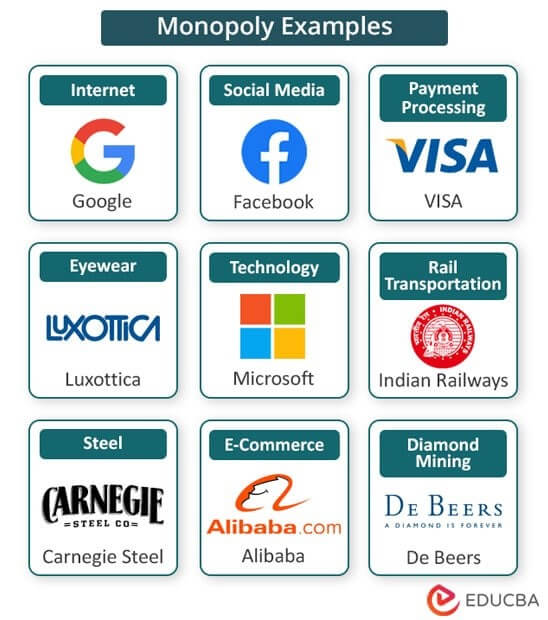
Monopoly Examples Types
A business can become a monopoly in different ways depending on market structure, geography, technology, or government control. Below are realistic monopoly examples from around the world:
1. Natural Monopoly
A natural monopoly exists when one company can provide a service more cheaply and efficiently than several companies because the setup costs are very high.
Real-world examples:
- Electricity transmission grids in most countries (e.g., National Grid in the UK)
- Railway networks such as the Indian Railways and the Japan Rail infrastructure
- Water supply systems operated by municipal authorities worldwide.
2. Geographical Monopoly
A geographical monopoly occurs when a company is the only seller available in a specific region, often due to location constraints or exclusive service rights.
Real-world examples:
- A single internet or cable service provider in remote or rural areas of the U.S., Canada, or Australia
- Isolated island airports or ferry services operated by one company
- Local utility providers in small towns have no alternative suppliers.
3. Technological Monopoly
A technological monopoly arises when a firm controls a patented technology, proprietary system, or platform that competitors cannot legally or practically replicate.
Real-world examples:
- Pharmaceutical companies holding patents for life-saving drugs (e.g., Pfizer’s COVID-19 vaccine patents during the exclusivity period)
- Google’s search algorithm dominance, driven by proprietary technology and data advantages
- Qualcomm, which controls essential patents for mobile communication technologies.
4. Government Monopoly
A government monopoly exists when the state exclusively owns and manages an industry to ensure national security, public access, or price stability.
Real-world examples:
- Postal services such as USPS (USA), Royal Mail (UK – historically), and India Post
- Electricity and water utilities in many countries
- Railway operations like Indian Railways and China Railway
- State-owned oil companies, such as Saudi Aramco.
Monopoly Examples
Below are the different Monopoly Examples:
Example #1: Google
Google has a significant market share in the internet industry compared to its competitors, such as Microsoft and Yahoo. Thus, it is a superior player in the industry.
The company’s primary source of revenue is advertising, and it currently controls a significant share of global advertising revenue, estimated at around $224.47 billion in 2023.
Its business model heavily relies on collecting user data to personalize ads based on the user’s search history and location. It gives Google an advantage over smaller advertisers who do not have access to the same level of user data. Therefore, Google is undoubtedly one of the world’s largest monopolies, with a notable presence in several other markets as well.
Example #2: Microsoft
Microsoft has enjoyed a monopoly in the computer and technology industry since 1999. Even today, Microsoft enjoys dominance in the market, recording $51.9 billion in revenue in Q4 2022.
With the cloud computing platform Microsoft Azure, Microsoft has maintained its presence and dominance in the market. Moreover, Microsoft bundled its Internet Explorer web browser with Windows, making it the preferred desktop browser in every household.
Example #3: Facebook
Facebook dominates the social media market as the leader, with 2,958 million monthly users (as of January 2023).
It is simply a monopoly due to its lack of direct competition, strong pricing power, and a dominant worldwide user base. In 2014, Facebook acquired WhatsApp, a rising competitor in the social media space, further solidifying its monopoly. As such, Facebook is a clear example of a monopoly in the social media market.
Example #4: Alibaba
Alibaba is a China-based business that is one of the few retailers to monopolize global e-commerce. It owns various online platforms, including Taobao, Tmall, and other e-commerce sites.
It allows the company to control a large share of online sales in China, giving it a dominant position and a monopoly. Alibaba now controls factors such as product prices and transaction details.
Example #5: VISA
In today’s market, businesses thrive on Visa, as consumers prefer credit cards to cash. According to the Fed Report 2021, 57% of US consumers prefer plastic, and 20% prefer cash. Merchants and retailers in the US paid $62.5 billion in swipe fees last year. It is prevalent across more than 200 countries among individuals, merchants, consumers, governments, and institutions.
Visa does not issue debit or credit cards, but it provides services for debit, credit, and prepaid cards to businesses and consumers. Visa’s clients issue the cards, while it acts as a mediator and profits by selling to merchants and financial institutions.
Example #6: Indian Railways
The Indian Railways enjoys a government-controlled monopoly, being the sole seller and the world’s fourth-largest railway network. It also dominates the railway industry from ticketing to catering facilities across 64,000 route km.
There is no substitute for government-owned railways, as they have no competition for transportation or food facilities. It is the only player in the mobile catering business, operating pantry cars on trains, static catering at established plazas, fast food units, and cell and base kitchens. Thus, all this contributes to its domination in the market.
Example #7: De Beers
The best example of a resource control monopoly is De Beers. De Beers Consolidated Mines came about in South Africa around 1888 as a union of various diamond mining entities.
De Beers enjoyed a 20th-century monopoly in the diamond market and used its dominance to shape global prices. It expanded, convincing individual miners to join. When the competitors refused to join, it swamped the market with similar productions. To regulate the prices through supply, it purchased diamonds from other manufacturers.
De Beers’ market share fell to 40% from 90% after producers in Canada, Russia, and Australia began using different channels to distribute diamonds. The awareness of blood diamonds also contributed to declining sales.
Example #8: Carnegie Steel Company
Carnegie Steel Company, founded by Andrew Carnegie and later merged into US Steel, maintained a monopoly over steel supply in the late 19th and early 20th centuries.
It enabled the company to dictate the price of steel without market competition. They vertically integrated the company, meaning controlling the entire production process from barges to mills, mines, and transportation.
Example #9: Luxottica
Luxottica, the world’s most prominent glasses (eyewear) manufacturer, was founded in 1961 in one of Italy’s small villages. Since the 1980s, the company has expanded globally and acquired other eyewear companies whenever feasible, including well-known sunglasses brands such as Ray-Ban, Vogue, Killer Loop, T3, Armani, etc.
It has also controlled leading vision care providers in the United States, including EyeMed and Vision Care. All this makes an example of a monopoly.
Additional Monopoly Examples
| Example | Industry / Market | Type of Monopoly | Why It Is a Monopoly Example |
| Amazon Web Services (AWS) | Cloud Computing | Technological / Near-Monopoly | Dominates global cloud infrastructure with high switching costs and massive scale advantages |
| Standard Oil | Oil Refining | Natural / Resource Monopoly | Controlled nearly 90% of U.S. oil refining before being broken up by antitrust laws |
| Intel | Microprocessors (CPUs) | Technological Monopoly | Held long-term dominance in PC processors through proprietary designs and exclusive partnerships |
| Saudi Aramco | Oil Production | Government Monopoly | State-owned company controlling most of Saudi Arabia’s oil reserves and production |
| Union Pacific Railroad | Freight Rail (USA) | Geographical Monopoly | Sole freight rail provider in large regions of the United States |
| Google Android | Mobile Operating Systems | Technological / Platform Monopoly | Dominates the global smartphone OS market with control over essential Google services |
Final Thoughts
Examples from around the world show how a single firm or authority can dominate a market through scale, technology, geography, or government support. While some monopolies, such as natural and government monopolies, can improve efficiency and ensure the reliable supply of essential services, others may limit competition, innovation, and consumer choice.
To prevent the misuse of monopoly power, governments enforce antitrust and competition laws that promote fair markets and protect consumers. Understanding real-world examples of monopoly helps businesses, policymakers, and students recognize how market dominance develops and why balanced regulation is essential for a healthy, competitive economy.
Recommended Articles
This has been a guide to Monopoly Example. Here we provide the top 9 Monopoly examples along with detailed explanations. One can also go through our other suggested articles to learn more –


