



Difference Between Merchant Banking vs Investment Banking
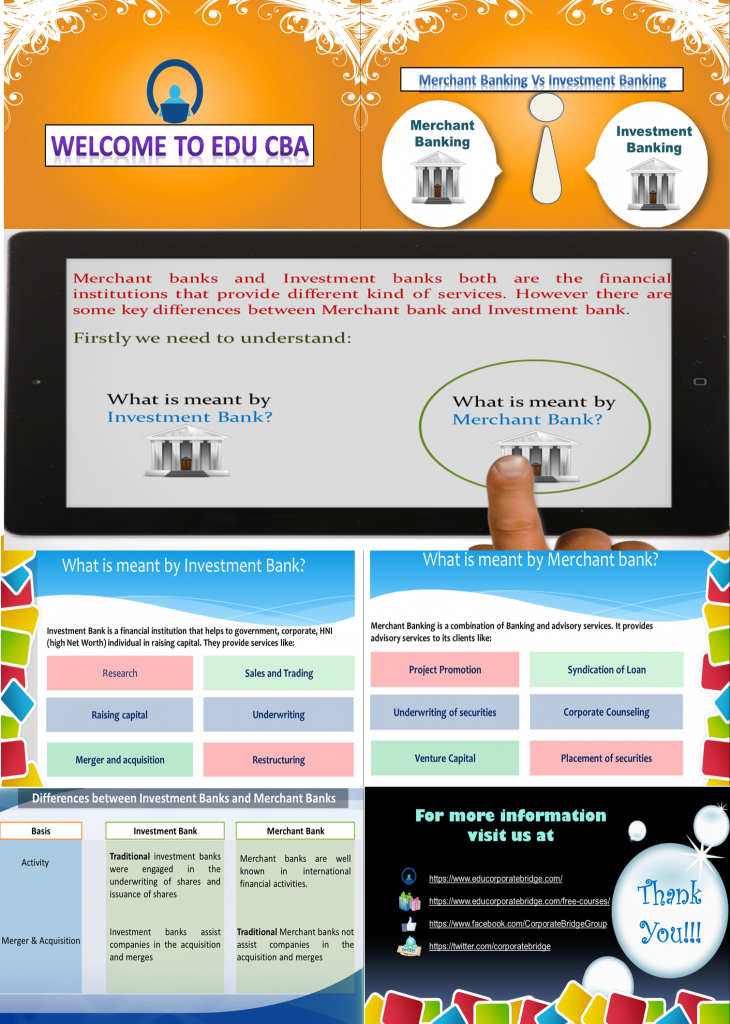
Merchant Banking is a combination of Banking and advisory services. It provides advisory to its clients in various financial, marketing, and legal scenarios. The merchant bank is a private financial institution that deals with international financial activities such as foreign corporate investment, foreign real estate investment, and trade finance. Investment Bank is a financial institution that helps government, corporate, and HNI (High Net Worth) individuals raise capital. Investment banks deal with selling and trading securities in the secondary market. It provides various kinds of ancillary services. Investment banks offer underwriting of securities and booking-related services for their clients. In this article, you get the difference between Merchant Banking vs Investment Banking.
What is Investment Banking Basics?

1. Research Services
Investment banks provide research services to their clients. It includes giving buy and sell stock recommendations, financial statement analysis, financial forecasting, and financial modeling. Also, Investment banks provide not only equity research services but also it offers fixed income research, financial research, economic research, and analytical support across various asset classes, markets, and client segments.
2. Sales and Trading
This sales and trading activity in an investment bank differs significantly from what you will find in research.
3. Raising Capital
As a financial intermediary, the investment bank helps its clients raise capital through IPO and FPO processes or private placements. They primarily help their clients for raising money through debt and equity offerings. As mentioned above, this includes raising capital through IPO (Initial Public Offerings), Private placements, or others on behalf of the client. Investment banks earn revenue through consulting fees. Clients take the help of investment banks for capital raising.
4. Underwriting
When an investment bank underwrites equity or any debt instrument, it ensures its clients that investors will purchase a new issue of stocks. Investment banks play an intermediary role between their client and the investors.
5. Merger and Acquisition
It is one of the primary functions which an investment bank performs.
Investment banks provide advice regarding mergers and acquisitions to their clients. Investment banks create different merger and acquisition models. They do accretion or dilution analysis to analyze a company. Also, Banks check synergies analysis.
6. Restructuring
Investment Bank plays a vital role in restructuring and reorganizing capital. Investment banking performs restructuring of a company to make it more profitable.
What are Merchant Banking Basics?
The merchant bank is a private financial institution that deals with international economic activities such as foreign corporate investment, foreign real estate investment, and trade finance. Merchant bank provides services like issuing LC (letters of credit), transferring funds across the border, trade advice, etc. Generally, merchant bank clients are middle-sized organizations. Merchant banks do not provide general public depositary services like commercial banks. A merchant bank’s core revenue source is a fee for its advisory services.
Merchant Bank Provides Various Kinds of Services

1. Project Promotion
Project Promotion or advisory services help corporations/companies analyze a project’s profitability. Merchant bank prepares a project report for its client, including capital structure, Liquidity analysis, profitability analysis, and economic and technical parameters.
2. Syndication of Loan
Merchant Bankers organize Term (short, medium, long) loans for their clients. It mainly includes estimating capital requirements for a particular project. Merchant banks evaluate loan proposals and perform step-by-step activities like preliminary discussions with financial institutions, preparation of loan applications, etc.
3. Underwriting of Securities
Merchant banks provide services to the client to ensure complete or minimum subscription of the issue.
4. Corporate Counseling
Merchant bankers offer customized financial solutions to their clients. They provide different kinds of advisory services.
5. Venture Capital
Merchant Bank assists venture capital services to their clients. It includes discussions with various venture capital firms, arranging all documents like a project presentation, preparing the application, negotiating terms and conditions, and finally obtaining their approval letter.
6. Placement of Securities
The merchant banker helps in the placement and distribution of various securities. They assist in issuing equity shares, bonds, insurance products, etc.
Differences Between Merchant Banking vs Investment Banking
|
Basis |
Investment Bank |
Merchant Bank |
| Activity | Traditional investment banks were engaged in the underwriting and issuing of shares. | Merchant banks are well-known in international financial activities. |
| Mergers And Acquisitions | Investment banks assist companies in the acquisition and mergers. | Traditional Merchant banks do not assist companies in mergers and acquisitions. |
| Scale | Investment banks emphasize mainly large-scale private and public companies. | Merchant banks specifically provide services to small-scale companies. |
Summary in Infographics
Recommended Articles
Here are some articles that will help you to get more detail about Merchant banking vs. investment banking, so go through the link.

