


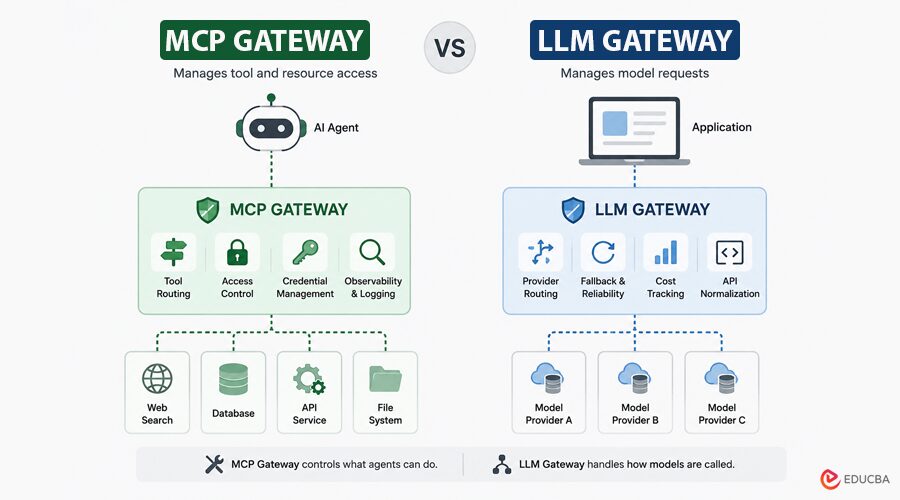
As AI systems become more sophisticated, terms like MCP gateway and LLM gateway are increasingly appearing in technical discussions. However, many organizations use these terms interchangeably, leading to confusion and, in some cases, poor architectural decisions. The reality is that an MCP Gateway vs LLM Gateway comparison involves two entirely different layers of the AI stack. Each serves a distinct purpose, addresses different challenges, and plays a critical role in modern AI infrastructure. In many production environments, you need both. This guide explains the differences between an MCP gateway and an LLM gateway, how they work together, and when your organization should use each one.
What is an MCP Gateway?
The Model Context Protocol (MCP) is a standardized framework that allows AI agents to connect with and interact with external tools, data repositories, and services. Originally introduced by Anthropic in late 2024 and now overseen by the Linux Foundation with support from major technology companies such as Google, OpenAI, and Microsoft, MCP has emerged as a widely adopted framework for connecting agents to tools, databases, and APIs. An MCP gateway manages this layer. Its job is to handle the connections between agents and the tools they need: authentication, access control, routing tool calls to the right servers, and governing which agents can access which capabilities. The core problems an MCP gateway solves:
- Tool routing: Direct agent requests to the correct MCP server
- Access control: Define which agents can call which tools with which permissions
- Credential management: Handle authentication to external services without exposing keys to agents
- Observability: Log which tools were called, by which agents, at what cost
An MCP gateway operates at the tool layer. It does not manage how models are called; it manages what those models can do once they are running.
What is an LLM Gateway?
An LLM gateway operates between your application and LLM providers, managing communication and requests. Its job is to manage how requests reach models: which provider serves them, what happens when a provider fails, how costs are tracked, and how responses are normalized across different APIs. The core problems an LLM gateway solves:
- Provider routing: Send requests to the most cost-effective, lowest-latency, or most available provider.
- Fallback and reliability: Retry on a backup provider when the primary fails.
- Cost visibility: Track token spend by request, model, and team.
- API normalization: Expose a single interface regardless of the underlying provider.
An LLM gateway operates at the model layer. It does not know or care what your application is doing; it just makes sure requests reach models reliably and cheaply.
MCP Gateway vs LLM Gateway: Key Differences
| Features | MCP Gateway | LLM Gateway |
| Sits between | Agents and external tools | App and LLM providers |
| Manages | Tool calls and resource access | Model calls and provider routing |
| Core problem | Agent governance, tool access control | Reliability, cost, API fragmentation |
| Primary users | Apps using AI agents | Any app calling an LLM |
| Emerged from | Agentic AI workflows | API infrastructure patterns |
The clearest way to think about it: an LLM gateway controls the intelligence layer, and an MCP gateway controls the action layer. An agent uses an LLM to reason and uses MCP to act. The gateway that manages the reasoning is different from the gateway that manages the acting.
Why MCP Gateways and LLM Gateways Are Often Confused?
Two things are driving the confusion: both are called “gateways” and sit in front of AI infrastructure. The naming overlap is real even if the function is not. Second, some vendors are building combined products that handle both LLM routing and MCP tool governance in a single layer. This is a legitimate architectural choice, but it is causing people to conflate the underlying concepts. A combined gateway does not mean the two problems are the same; it means that one product solves both.
Do You Need Both?
It depends on whether you are building agents. If your application calls LLMs directly for text generation, summarization, classification, or search, you need an LLM gateway. You probably do not need an MCP gateway yet because you are not running agents that use tools autonomously. If you are building agents that call external tools, query databases, browse the web, or take actions in other systems, you need both. The LLM gateway handles the model calls. The MCP gateway handles the tool calls.
Skipping either one creates the problem category that the layer was designed to prevent. A practical way to check whether your AI feature could run on a single chat. With completions API calls, you are in LLM gateway territory. If your AI feature involves an agent loop in which the model decides what to do next and then does it, you are in MCP gateway territory, too.
How Do They Work together?
In a production-grade agentic architecture, these two layers work together rather than compete. The application first sends a request to the LLM gateway, which then selects and routes that request to the most appropriate model and provider. The model reasons through the request and decides to use a tool. The tool call goes through the MCP gateway. The MCP gateway authenticates the request, routes it to the right server, and returns the result. The model incorporates the result and continues reasoning. The final response comes back through the LLM gateway. Each layer does its job. Neither replaces the other.
Where Infron Fits?
Infron is the LLM gateway layer in this stack. It gives you a single API across 400+ models and 100+ providers, with automatic fallback, per-request cost tracking, and a 99.99% uptime SLA- everything you need to make the model layer reliable before you build agents on top of it. The LLM gateway is the foundation. You do not build an agentic system on unreliable model infrastructure any more than you build a skyscraper on sand. Get the model layer right first, then add the tool layer on top.
Final Thoughts
The debate around MCP Gateway vs LLM Gateway is not about choosing one over the other. They address different layers of the AI stack and solve fundamentally different challenges. An LLM Gateway ensures reliable, cost-efficient access to AI models, while an MCP Gateway governs how AI agents access and use external tools. As organizations move toward agentic AI architectures, understanding the distinction becomes increasingly important. The most successful AI infrastructures treat the LLM gateway as the foundation for intelligence and the MCP gateway as the control layer for action, creating a secure, scalable, and production-ready architecture.
Recommended Articles
We hope this guide on MCP Gateway vs LLM Gateway helps you better understand modern AI architecture. Check out these recommended articles for more insights into AI infrastructure and agentic systems.

