


Updated August 24, 2026
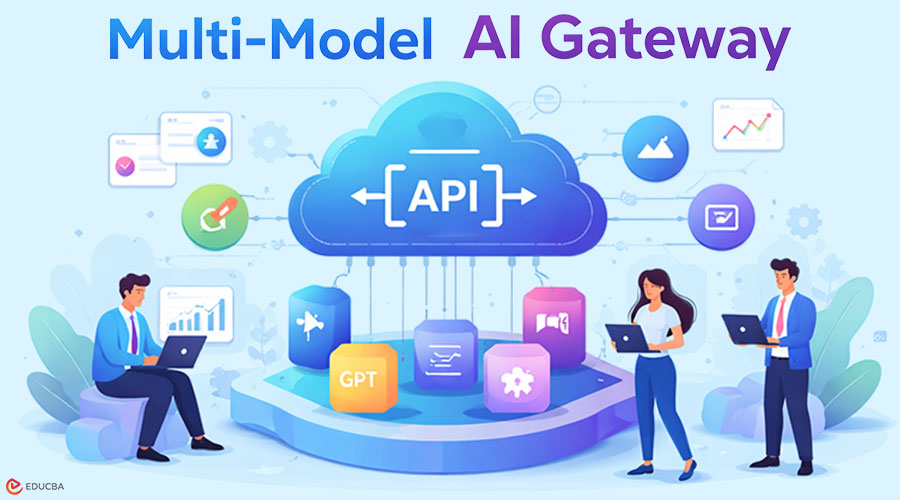
If you have shipped anything serious with large language models in the past year, you have probably hit the same wall: every flagship model lives behind a different API, a different billing portal, a different rate-limit scheme, and a different quirky SDK. What started as one OpenAI key has turned into five provider contracts, five dashboards, and five sets of environment variables you have to keep in sync across every environment. This is where a Multi-Model AI Gateway becomes valuable.
The Multi-Model AI Gateway architecture exists to collapse that complexity into a single managed endpoint. Instead of juggling multiple integrations, developers can access several LLM providers through one unified interface. In this guide, we will explore what a Multi-Model AI Gateway is, why teams are adopting it, and what developers should consider when evaluating one.
What is a Multi-Model AI Gateway?
A Multi-Model AI Gateway is a hosted service that sits between your application and the underlying LLM providers. Instead of your code calling Anthropic, OpenAI, Google, and other AI labs directly, it calls the gateway. It routes the request to whichever model you specify: Claude Opus, GPT-5.3 Codex, Gemini 3.1 Pro, GLM-5.1, KIMI K2.5, or any other supported model.
The gateway typically handles several key responsibilities:
- Authentication with upstream providers
- Request and response format normalization
- Unified API access for multiple LLMs
- Centralized usage monitoring and billing.
Many Gateway platforms also bundle compute and API access into a single subscription, so developers manage a single bill rather than multiple vendor subscriptions.
Why Developers are Adopting Multi-Model AI Gateways?
As AI-powered applications grow more sophisticated, many teams rely on different models for different tasks. It simplifies this architecture by acting as a centralized routing layer between applications and multiple LLM providers. Instead of writing and maintaining separate integrations, developers interact with a single API endpoint that dynamically connects to multiple AI models.
The Operational Problems It Solves
Four common operational problems drive teams to adopt a Multi-Model AI Gateway architecture.
- Subscription sprawl: Running a production system that uses three or four top-tier models means three or four separate credit cards, billing cycles, and procurement conversations. Every quarter, someone on finance asks why the AI line items keep multiplying.
- Environment drift: Each provider ships its own SDK with its own auth model, retry semantics, and streaming format. Keeping those libraries pinned, patched, and consistent across dev, staging, and prod is a surprising amount of toil.
- Regional latency and blocks: Some provider endpoints are geographically restricted or experience high latency in certain regions. A gateway with its own cloud egress can route around those blocks without your application code having to know.
- Model churn: The best model for your workload in January is rarely the best one in June. When an application depends on a specific SDK, developers need to update the code to replace models. Behind a gateway, it is a config flip.
A Practical Example: Self-Hosted vs. Managed
To make this concrete, consider a development team that relies on multiple models for different workloads: Claude for reasoning-heavy tasks, GPT for code generation, and Gemini for long-context document processing. Without a Multi-Model AI Gateway, this setup quickly becomes complex: three separate integrations, multiple API keys, different retry logics, and inconsistent response formats across providers.
By introducing a Multi-Model AI Gateway like the open-source OpenClaw project, the same team can unify access to multiple flagship models through a single endpoint. Beyond backend simplification, OpenClaw also offers integrations with messaging platforms such as WhatsApp, Telegram, Slack, Discord, Signal, and iMessage, allowing both application workflows and internal team communication to run on a shared AI infrastructure.
Self-Hosted Multi-Model AI Gateway
Teams that require full control over their infrastructure can choose to self-host OpenClaw. This involves provisioning a virtual machine, securely configuring API keys for each provider, and setting up the necessary messaging integrations. While this approach requires more initial setup and ongoing maintenance, it offers maximum flexibility, data control, and customization options.
Managed Multi-Model AI Gateway
For teams that prefer speed and simplicity, a managed Multi-Model AI Gateway offers a ready-to-use alternative. Services like OpenClaw’s managed cloud platform come pre-deployed with integrated model access, eliminating the need for infrastructure setup. With predictable pricing tiers (e.g., $39.90 or $89.90 per month), a managed Multi-Model AI Gateway can often be more cost-effective than maintaining multiple provider subscriptions alongside cloud infrastructure, especially for small to mid-sized teams.
When Does a Gateway Make Sense?
A Multi-Model AI Gateway is not always the right architecture for every application. If your system relies heavily on provider-specific features, such as specialized APIs, fine-tuning capabilities, or advanced tooling, direct integration may still be necessary.
However, it becomes highly valuable when:
- Your application uses multiple AI providers
- You want simpler infrastructure and billing management
- Your workloads rely mostly on standard chat or completion APIs
- You expect to switch models frequently as the ecosystem evolves.
For many teams, the operational time savings from using a Multi-Model AI Gateway quickly outweigh the cost of adopting one.
Recommended Articles
We hope this guide helps you understand how developers can simplify access to multiple LLM providers through a unified API and infrastructure layer. Explore the recommended articles below to learn more about AI development tools, LLM integration strategies, and modern AI architecture.


