


Updated February 19, 2026
Difference Between Maya vs Aztec vs Inca
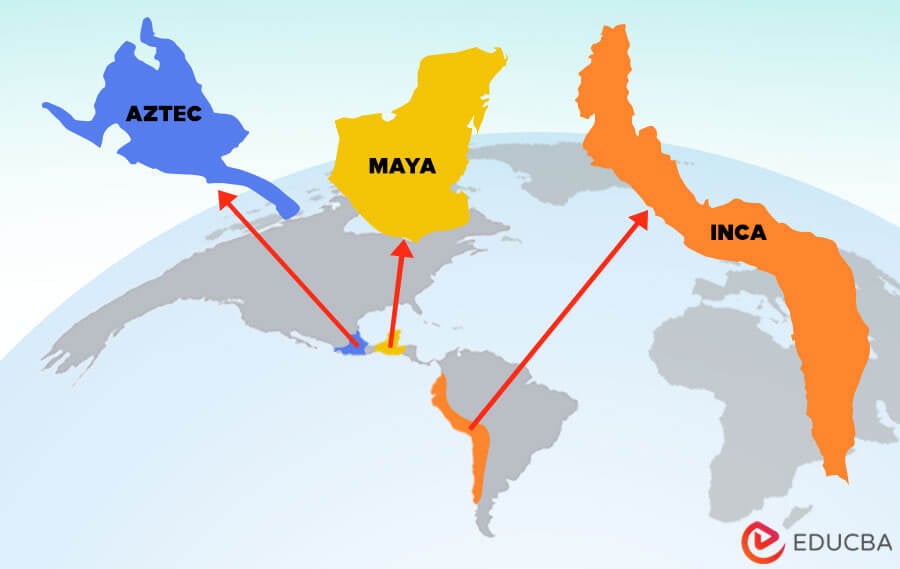
Maya, Inca, and Aztecs were three remarkable civilizations that thrived in the southern parts of America at different points in history. The Maya civilization, known for its amazing calendar that accurately predicted events such as floods and eclipses, holds a prominent place among these civilizations. The Aztecs and Incas also contributed immensely to America with their culture, heritage, power, and intelligence.
This article explores some captivating stories and notable differences between Maya vs Aztec vs Inca civilizations. But before we jump into their rich histories, let’s first learn some basic facts about these three civilizations.
Maya Civilization
The Maya civilization appeared around 2600 B.C. in the southeastern tropical parts of Honduras and El Salvador. The Maya had a highly advanced culture, a developed writing system, and remarkable advances in mathematics and astronomy. It was unique among the pre-Columbian civilizations in the Americas. They lived in farming villages on the Yucatan Peninsula and the southern highlands. Today, there are approximately 6 million Maya descendants, mainly in Mexico, Guatemala, and Belize.
Aztec Civilization
The Aztecs, on the other hand, grew in the Valley of Mexico from 1300 to 1521, benefiting from a favorable agricultural environment characterized by a moderate climate and abundant natural resources. The Aztec capital, named Tenochtitlan, was the largest city. The Aztecs were renowned for their agriculture, warfare, and temple-building. They were also famous for their diverse culture, beautiful sculptures, and advances in many other aspects. Today, around 2 million people speak Nahuatl, the language of the Aztec civilization.
Inca Civilization
Around the year 1200, the Inca civilization settled in central Peru and parts of Ecuador, Bolivia, Colombia, Chile, and Argentina. The Inca Empire was the largest in pre-Columbian America, extending approximately 2,500 miles (4,000 km) from north to south. The population was approximately 16 million. They were famous for their impressive stonework and temples made without mortar (a mixture of cement and sand). Today, their legacy continues through 10 million Quechua and Aymara speakers across South America.
Head-to-Head Comparison Between Maya vs Aztec vs Inca (Infographics)
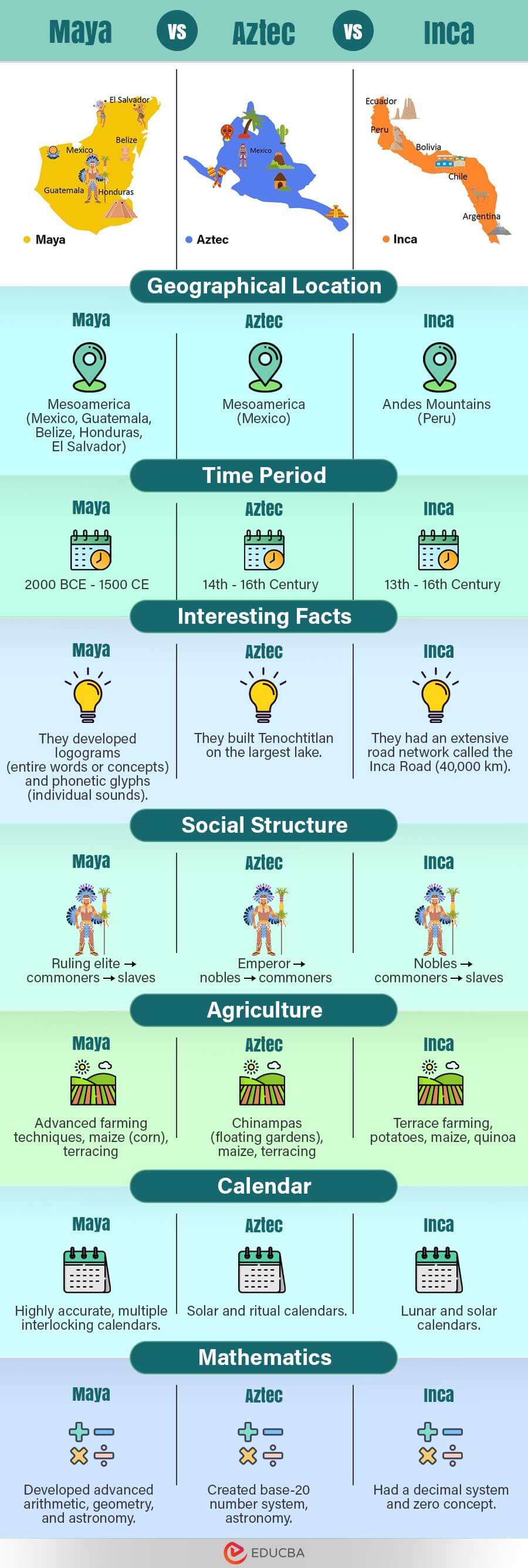
An essay writer exploring ancient civilizations can gain valuable insights into the similarities and differences among the Maya, Aztec, and Inca cultures. You can use this page to compare the histories, architectures, and societies of the two regions, which is ideal for writing an informed essay. For readers who want to dive deeper into primary sources, historical accounts, and research materials, platforms like All You Can Books offer access to a wide range of history books and academic resources that further enrich the understanding of these ancient civilizations.
Key Differences Between Maya vs Aztec vs Inca
The Maya were native people of Mexico and Central America, while the Aztec covered most of northern Mesoamerica between c.1345 and 1521 CE, whereas the Inca flourished in ancient Peru between c.1400 and 1533 CE and extended across western South America.
Below is a detailed explanation of the differences among the Maya, Aztec, and Inca civilizations.
1. Political Organization
Maya: Maya society was in city-states, handled by a king or ruler. The kings held political and religious authority, and were believed to be divine rulers who communicated with the gods. The city-states were usually organized hierarchically, with the ruling elite at the top and commoners at the bottom.
Aztec: The Aztec Empire was ruled by an emperor, the Huey Tlatoani, who held absolute power. Each province of the empire was governed by a local ruler appointed by the emperor.
Inca: The Inca Empire had a single emperor, the Sapa Inca, who was divine and held absolute power. The empire was divided into provinces, each governed by a local leader, an Apu, who reported to the Sapa Inca. The administrative and political center of the empire was Cusco, the capital city.
2. Social Structure
Maya: Maya society had a hierarchical social structure. At the top were the ruling elite: the king, nobles, and high-ranking priests. The ruling elite enjoyed privileges and controlled the wealth and resources of the civilization. Below them were the skilled craftspeople, merchants, and soldiers who played important societal roles. The majority of the population consisted of farmers and laborers. Slavery was also practiced, with prisoners from war often serving as slaves.
Aztec: The Aztec society was hierarchical, with the emperor and nobles at the top, followed by the warrior class, merchants, artisans, and commoners. Slavery was also a part of Aztec society, although it differed from the chattel slavery system that treated people as materials in other civilizations. Slaves in Aztec culture had certain rights and could even own property.
Inca: The Inca society was characterized by distinct social classes, similar to those of the Aztecs. The lowest class included enslaved individuals or those whom the Inca had conquered.
3. Agriculture
Maya: The Maya civilization developed advanced agricultural techniques to support its growing population. One of their key contributions was the domestication and cultivation of maize (corn). Maya farmers also cultivated beans, squash, cacao, avocado, and other fruits, comprising 7–10 principal crops. To maximize productivity, they used innovative agricultural practices, including terracing, raised fields, and irrigation systems.
Aztec: The Aztecs constructed chinampas, fertile floating gardens, and cultivated maize, beans, squash, chili, and amaranth, comprising 5–7 principal crops. Their sophisticated agriculture supported dense populations in cities like Tenochtitlan.
Inca: The Inca cultivated crops suited to high-altitude environments, including potatoes, maize, quinoa, beans, coca, and peppers, totaling 6–8 main crops. They also practiced terrace farming, building thousands of terraces across the Andes (estimated 14,000+) to create flat, arable land on mountain slopes.
They all employed terrace farming, constructing steps into the mountainsides to create flat areas for cultivation.
4. Architecture
Maya: Maya architecture is well-known for its impressive pyramids, temples, palaces, ball courts, and observatories. These buildings were often constructed of stone and adorned with intricate carvings and murals. The Maya displayed advanced engineering skills, including corbel arches, slanted roofs, and precise alignment with astronomical phenomena. Over 1,000 Maya structures have been discovered, including pyramids, temples, and observatories.
Aztec: The most iconic design in Aztec civilization was the Templo Mayor, devoted to Tlaloc (the god of rain and fertility) and Huitzilopochtli (the god of the sun and war). At its peak, the Templo Mayor reached approximately 60 meters in height, showcasing the Aztecs’ remarkable construction and design skills.
Inca: The Inca were renowned for their massive stone structures built without mortar, using ashlar masonry. Machu Picchu, their most famous site, spans approximately 32,000 acres and comprises more than 200 structures, reflecting their extraordinary engineering and urban planning expertise. The Templo Mayor, the peak, reached approximately 60 meters in height, showcasing the Aztecs’ remarkable construction and design skills.
5. Writing and Communication
Maya: The Maya developed a complex writing system that combined visual symbols with phonetic elements. They carved inscriptions on stone monuments, painted murals, and created intricate codices (books) made from bark paper. Maya writing recorded historical events, religious rituals, astronomical observations, and genealogical information.
Aztec: The Aztecs created codices and bark-paper books containing illustrations and glyphs that conveyed historical, religious, and astrological information. However, the Spanish destroyed most of these codices during the conquest.
Inca: The Inca civilization did not maintain a written language in the traditional sense. Instead, they used Quipus, strings of different colors and knots that encoded numerical and symbolic meanings. The quipu recorded numerical and statistical data.
6. Religion and Beliefs
Maya: The Maya worshipped many gods and goddesses associated with natural elements, celestial bodies, fertility, and agricultural cycles. Maya priests, who held significant power and knowledge, performed complex ceremonies, including bloodletting and human sacrifice, as offerings to the gods.
Aztec: Aztec society worshipped gods and goddesses, with Huitzilopochtli and Tlaloc among the most important gods. Human sacrifice was a central aspect of their religious rituals, believed to confirm the sun’s rising and the world’s continued existence.
Inca: The Inca had a polytheistic religion, worshiping various gods and goddesses. Inti, the sun god, considered the ancestor of the Inca rulers, was the most important deity. Other significant gods included Viracocha, the creator god, and Mama Quilla, the moon goddess.
7. Economy
Maya: The Mayans’ complex economic system relied on trade, agriculture, and craft production. Trade networks connected Maya cities and extended beyond their region, facilitating the exchange of goods such as jade, obsidian, textiles, feathers, pottery, and luxury items. Maya society also had a market economy in which goods could be bought and sold. Tribute and taxation systems were to support the ruling elite and maintain social order.
Aztec: The Aztec economy survived on agriculture, trade, and tribute. The empire had a vast trade network that exchanged goods such as cocoa beans, jade, feathers, and textiles.
Inca: The Inca Empire implemented a labor service system known as mit’a, under which individuals owed compulsory labor to the state. The Inca also developed an extensive network of roads and bridges, known as the Inca Road (Qhapaq Ñan).
8. Calendar
Maya: The Maya had multiple calendars, including the 365-day solar calendar (Haab), the 260-day sacred calendar (Tzolk’in), and the Long Count. The Maya used their calendar system to track time, conduct religious ceremonies, monitor agricultural cycles, and observe the stars.
Aztec: The Aztecs had a complex calendar system. They used two calendars simultaneously: a solar calendar of 365 days, called the xiuhpohualli, and a ritual calendar of 260 days, known as the tonalpohualli.
Inca: The Inca used a calendar divided into twelve lunar months and had a solar calendar. The Inca tracked time using celestial events such as solstices and equinoxes.
9. Mathematics
Maya: The Maya made significant advancements in mathematics, particularly in arithmetic, geometry, and astronomy. They had a positional numeral system that included the concept of zero. Their astronomical observations were highly accurate, yielding a calculation of the solar year of 365.2420 days, which closely matches modern measurements.
Aztec: The Aztecs developed a sophisticated mathematical system that included positional notation and a base-20 number system. They also excelled in astronomy, using their calculations to develop complex calendars: the Xiuhpohualli (a 365-day solar calendar) and the Tonalpohualli (a 260-day ritual calendar).
Inca: The Inca civilization had a decimal system and a concept of zero. The Inca demonstrated expertise in measurement and engineering, as evidenced by their precise stonework and agricultural terraces.
10. Arts and Craftsmanship
Maya: Maya art was diverse, depicting religious scenes, mythological narratives, historical events, and everyday life. They used various materials, such as jade, obsidian, clay, pigments, and feathers.
Aztec: Aztec art included various forms such as sculptures, pottery, jewelry, and textiles. They were renowned for their elaborate stone carvings, colorful featherwork, and intricate gold and silver ornaments, produced through sophisticated metalworking techniques.
Inca: The Incas were renowned for excellence in pottery, metalwork (particularly gold and silver), textiles, and stone carving, with intricate designs and vibrant colors.
11. Education and Science
Maya: Education in Maya society was primarily for the elite and those destined for leadership roles. Maya scientists made significant advances in astronomy, accurately predicting celestial events, elucidating the motions of celestial bodies, and developing a complex understanding of the cosmos.
Aztec: Education in the Aztec civilization was mainly within the family and community. Young boys and girls studied practical skills, religious rituals, and the cultural traditions of their society. They also had specialized schools for training priests, scribes, and warriors.
Inca: Young boys in the Inca civilization attended schools known as Yachay Wasi, where they learned farming techniques, engineering, and religious rituals. Girls received education at home, where they were taught domestic skills and weaving.
12. Healthcare
Maya: The Maya healers, often shamans or priests, combined herbal remedies with rituals and spiritual practices to treat illnesses. They practiced surgery, including trepanation (drilling holes in the skull), and were knowledgeable about anatomy and herbal medicine.
Aztec: Aztec medicine had a detailed understanding of medicinal plants and used them for treating various diseases. Healing practices included herbal remedies, surgical procedures, and spiritual rituals aimed at restoring health.
Inca: The Inca utilized herbal remedies, such as coca leaves, for medicinal purposes. The Inca also had a public health system that included sanitary measures and the establishment of hospitals, known as kallankas, where individuals could receive medical treatment.
13. Decline and Conquest
Maya: The reasons for the fall of the Maya civilization are environmental factors like deforestation, soil erosion, and drought. Internal conflicts, political instability, and overpopulation may have also contributed to the decline. Following the Spanish arrival in the 16th century, many Maya cities had already been abandoned, and the remaining city-states were conquered by Spain.
Aztec: The decline of the Aztec civilization began with the Spanish invasion led by Hernán Cortés in 1519. Factors such as superior weaponry, diseases brought by the Spanish, and the disruption of Aztec society contributed to their defeat. The Spanish exploited internal divisions within the empire, formed partnerships with local tribes who were enemies of the Aztecs, and ultimately conquered Tenochtitlan in 1521.
Inca: The Inca Empire experienced a decline following the arrival of Spanish conquerors led by Francisco Pizarro in the early 16th century. The Spanish exploited the Incas with superior weapons and diseases like smallpox. The capture and execution of the last Inca emperor, Atahualpa, marked the end of the Inca Empire and the beginning of Spanish colonization.
Maya vs Aztec vs Inca Comparison Table
| Category | Maya | Aztec | Inca |
| Geographical Location | Mesoamerica (Mexico, Guatemala, Belize, Honduras, El Salvador) | Mesoamerica (Mexico) | Andes Mountains (Peru) |
| Time Period | 2000 BCE – 1500 CE | 14th – 16th century | 13th – 16th century |
| Political Organization | City-states ruled by kings. | The centralized empire under the rule of an emperor. | An emperor ruled the centralized empire. |
| Social Structure | Is Hierarchical, with the ruling elite, commoners, and slaves. | Hierarchical with emperors, nobles, and commoners. | Hierarchical with nobles, commoners, and slaves. |
| Agriculture | Created advanced farming techniques, maize (corn), and terracing. | Used chinampas (floating gardens), maize, and terracing. | Famous for terrace farming, potatoes, maize, and quinoa. |
| Architecture | The civilization left behind pyramids, temples, carvings, and murals. | Their architectural marvels included temples, pyramids, carvings, and murals. | They were skilled in constructing stone structures, such as Machu Picchu and temples. |
| Writing and Communication | Their writing system included a hieroglyphic script. | They preferred a pictorial writing system and ancient manuscripts that no longer exist. | They developed the quipu (knotted cords) for recording information. |
| Religion and Beliefs | Worshipped many gods and practiced human sacrifice. | Worshipped many gods and practiced human sacrifice. | Devoted themselves to multiple gods and were faithful to their divine emperor. |
| Economy | Carried out trading of jade, obsidian, textiles, feathers, pottery, and luxury items. | Had a vast trade network of cocoa beans, jade, feathers, and textiles. | They mainly focused on labor and agriculture. |
| Calendar | They designed multiple highly accurate, interlocking calendars. | Had their solar and ritual calendars. | They were famous for lunar and solar calendars. |
| Mathematics | Developed advanced arithmetic, geometry, and astronomy. | Developed the base-20 number system for astronomy. | Had a decimal system and concepts of zero. |
| Arts and Craftsmanship | The artists were skillful in sculpture, pottery, murals, and textiles. | The art of stone carvings, featherwork, and jewelry was remarkable. | They preferred to work with pottery, metalwork, and textiles. |
| Education and Science | They only had schooling for the elite in astronomy, mathematics, and sculpture. | Education was available through family and community education and specialized schools. | They focused more on practical skills and religious teachings. |
| Healthcare | The healthcare included herbal remedies, surgery, and spiritual practices. | They advanced in the use of medicinal plants, surgery, and spiritual rituals. | They were surviving due to herbal remedies and public health measures. |
| Decline and Conquest | Their decline was due to environmental factors, internal conflicts, and the Spanish conquest. | The civilization fell due to the Spanish invasion, superior weaponry, and diseases. | The people could not survive the Spanish conquest, internal conflicts, and diseases. |
Modern Discoveries & Updates
- Maya: LIDAR technology revealed hidden cities and tunnels in Guatemala and Mexico.
- Aztec: Excavations in Mexico City uncover marketplaces, temples, and insights into daily life.
- Inca: New terraces, roads, and ceremonial centers discovered in Peru, Ecuador, and Chile.
- Existent Populations: Maya (~6M), Nahuatl speakers (~2M), Quechua & Aymara (~10M).
- Legacy: Influence on modern agriculture, architecture, astronomy, calendars, and cultural traditions across Latin America.
Frequently Asked Questions (FAQs)
Q1. Do any Mayans still exist?
Answer: Yes, there are still Mayans alive today. They comprise around six million individuals, making them the largest indigenous group in North America after Peru. The principal Mayan populations are in Mexico, with significant groups including the Yucatecs (300,000), Tzotzil (120,000), and Tzeltal (80,000).
Q2. Is the Maya language still spoken today?
Answer: Yes, Maya is still spoken today. There are approximately 7 million speakers of Mayan languages, with around 4 million in Guatemala and 2.5 million in Mexico.
Q3. Did the Maya, Aztec, and Inca know each other?
Answer: There is no evidence that the Maya, Aztec, and Inca directly interacted. The civilizations were separated by geography and time, but they shared similar cultural and agricultural practices.
Q4. What did these civilizations eat?
Answer: The Maya and Aztecs primarily relied on maize, beans, squash, and cacao. The Inca cultivated potatoes, maize, quinoa, and other high-altitude crops. All practiced terrace farming or innovative agricultural techniques to maximize harvests.
Q5. Did they have a form of writing?
Answer: The Maya developed hieroglyphic writing, the Aztecs used pictorial codices, and the Inca used quipu (knotted strings) for record-keeping.
Q6. What is their legacy in modern society?
Answer: They influenced modern agriculture, architecture, astronomy, textiles, festivals, and languages still spoken today, such as Nahuatl, Quechua, and Mayan languages.
Recommended Articles
This has guided the top difference between Maya vs Aztec vs Inca. Here we also discuss the key differences between infographics and comparison tables. You may also have a look at the following articles to learn more –

