


Understanding Invisible Watermarking
When most people hear the term “watermarking,” they picture a translucent logo emblazoned across a photo or a preview video, a clear, visible claim of ownership designed to deter casual copying. This is the world of visible watermarking, a blunt but effective tool. However, there is a far more sophisticated and secretive sibling at work in the digital shadows: invisible watermarking.
This technology embeds a unique, imperceptible signature directly into the fabric of a digital file, leaving no trace for the human eye but creating a permanent, machine-readable ID. While its most famous application is in the fight against Hollywood piracy, the true power and versatility of invisible watermarking extend far beyond the entertainment industry, quietly safeguarding our health, our history, and even the products on our shelves.
How Invisible Watermarking Works Behind the Scenes?
The core principle of invisible watermarking is elegant in its simplicity. By making minute, mathematically controlled alterations to the data that make up an image, audio file, or video, a hidden message is embedded directly into the content.
This invisible watermark can store critical metadata such as a serial number, timestamp, source identifier, or ownership information. These changes are so subtle that they blend into the natural “noise” of the file, ensuring quality and usability remain completely intact. The result is content that looks and sounds normal to users, yet carries a secret, verifiable digital signature.
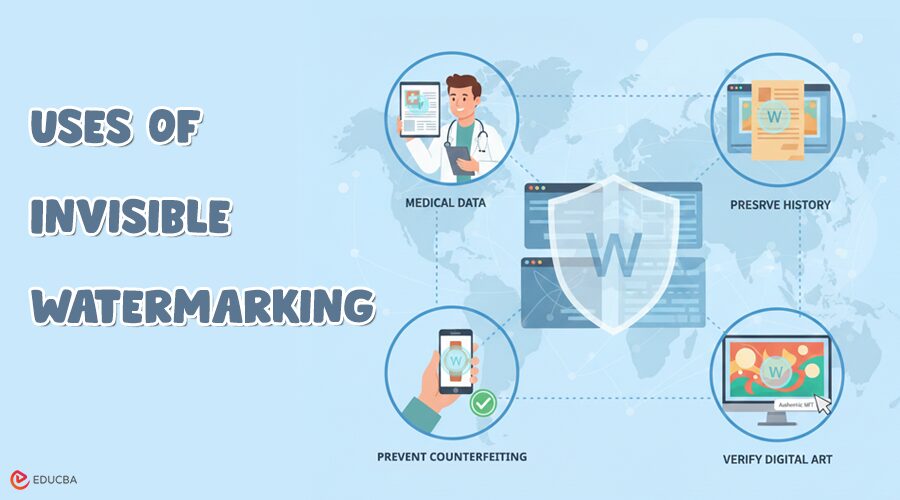
1. Invisible Watermarking in Medical Imaging
In the high-stakes world of healthcare, data integrity can be a matter of life and death. A radiologist’s diagnosis depends on the accuracy of an MRI, CT scan, or X-ray. If errors occur during transmission or attackers maliciously manipulate medical images, the consequences can be severe.
Invisible watermarking in medical imaging acts as a silent guardian. Hospitals can embed invisible digital watermarks into every scan they produce, containing patient ID, scan date and time, equipment details, and facility information.
When the image is accessed later, watermark verification software confirms its authenticity. Missing or corrupted invisible watermarks immediately signal potential tampering. This use of invisible watermarking strengthens patient safety, compliance, and data provenance across complex healthcare systems.
2. Preserving History with Invisible Watermarking
National archives, museums, and libraries are the custodians of our cultural heritage, holding vast collections of priceless photographs, historical documents, and film reels. As these institutions digitize their collections for preservation and public access, they face a new challenge: how to protect the authenticity of the digital copies and track their use. A high-resolution scan of a Civil War photograph, once posted online, can be downloaded, cropped, and re-uploaded by anyone, often stripped of its original context and credits.
Invisible watermarking techniques offer a powerful solution. Before a digitized artifact is published online, an invisible, forensic mark can be embedded. This mark can contain a unique object ID that links directly back to the archive’s official catalog entry. This serves two critical purposes. First, it acts as a persistent attribution tool. Even if others copy and share the image across the internet, the institution can verify its ownership and preserve the item’s proper context. Second, it provides a security measure against forgery. If a “newly discovered” historical photo surfaces, experts can check for the official archive’s invisible watermark. Its absence would cast serious doubt on the item’s authenticity, helping to combat the growing problem of digital historical forgeries.
3. Invisible Watermarking as an Anti-Counterfeit Shield
Counterfeit goods are a global plague, costing brands billions and putting consumers at risk, particularly in sectors such as pharmaceuticals, luxury goods, and electronics. Traditional anti-counterfeit measures, such as holograms, security threads, and special inks, are often visible and can be replicated by sophisticated criminals. Enter a new, invisible line of defense: invisible forensic watermarking embedded directly into product packaging.
Companies can print their packaging with special inks that contain a unique, machine-readable code, invisible to the naked eye but detectable by a simple smartphone app or a retailer’s scanner. This code is tied to a secure database, allowing anyone in the supply chain from the factory floor to the pharmacy counter to verify a product’s authenticity instantly. For a bottle of medicine, this could mean the difference between a life-saving drug and a dangerous fake. For a luxury handbag, it provides a discreet, unforgeable certificate of authenticity that cannot be easily copied or transferred to a counterfeit. This application shifts the battle against fakes from the product itself to its packaging, creating a seamless, secure verification process.
4. The Provenance Tracker for Digital Art
The rise of NFTs (Non-Fungible Tokens) and digital art has created a new frontier for ownership and value in the virtual world. However, how do you prove that a digital file is the ‘original’ when anyone can copy it infinitely? While the NFT itself is a ledger entry on a blockchain, the digital artwork it represents, the image or video file, is often stored separately and can be vulnerable. Invisible watermarking provides a crucial link between the two.
An artist or a gallery can embed an invisible watermark into the digital artwork file that contains a unique token ID or a cryptographic hash that directly points to its NFT on the blockchain. This means the artwork itself carries its own proof of provenance. Even if users download and share the image widely, cryptographic verification confirms its true origin and ownership. This builds trust and security in the digital art market by preventing sellers from passing off copied files as original works.
The Silent Signature of a Connected World
From the sterile environment of a hospital to the chaotic e-commerce marketplace, invisible watermarking has emerged as a quiet yet indispensable tool. It solves a fundamental problem of the digital age: the separation of a file from its origin and its truth. This technology weaves a secret signature into the very essence of our data, creating a thread of trust that leads back to its source. It is a testament to ingenuity, proving that the most powerful protections are often the ones we never see.
Recommended Articles
Explore more in-depth guides on digital security, data authentication, and content protection technologies. These resources help you understand and apply invisible watermarking effectively across modern digital systems.

