

Updated January 31, 2026
What is Globalization?
Globalization is the process of integrating a country’s economies, societies, and cultures with the world by exchanging goods, services, information, and ideas among people and nations.
One small example of globalization is the popularity of international fast-food chains like McDonald’s, which originated in the United States and now has locations in over 100 countries worldwide. Globalization is the spread of products, cultures, and business models across national borders.
It leads to increased connection and interdependence, potentially increasing economic growth, creating new job opportunities, and enhancing worldwide access to goods and services. It can also facilitate knowledge and technology sharing, increase cultural exchange and understanding, and promote greater cooperation among nations.
WTO economists now forecast world merchandise trade to grow 2.4% in 2025 (up from 0.9%) but slow to 0.5% in 2026 (down from 1.8%).
Globalization Examples
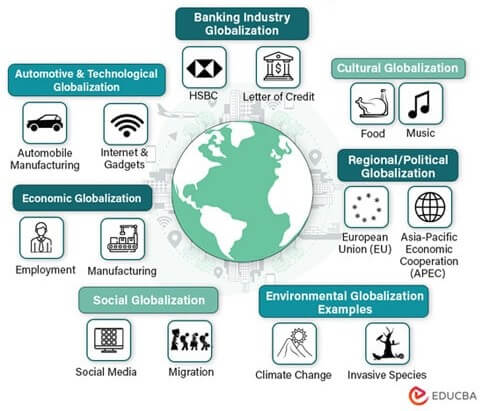
Cultural Globalization Examples
1. Food
People around the world are increasingly enjoying cuisine from various nations. For instance, Japanese sushi restaurants are present in New York, Indian curry houses in London, and American fast-food businesses in Tokyo. Moreover, meals such as hummus, tacos, and sushi rolls that were once exotic or foreign have now become common.
2. Music
The internet, social media, and streaming services have helped spread the popularity of particular music genres worldwide. For example, K-pop (South Korean pop music) has become extremely popular worldwide, with groups like BTS and Blackpink. Similarly, hip-hop music from the United States has become a global phenomenon, with artists from around the world contributing.
Regional / Political Globalization Examples
1. European Union (EU)
The EU is a 27-country economic and political union primarily based in Europe. The purpose of its establishment was to encourage economic cooperation and political stability among its members. Goods, services, and people can flow freely across national boundaries thanks to the EU, and 19 member countries share a common currency (the Euro). It has substantially improved intra-EU trade and travel, making it easier for expanding enterprises to expand across numerous countries.
2. Asia-Pacific Economic Cooperation (APEC)
APEC is a regional economic forum comprising 21 Asia-Pacific member economies, including the United States, Japan, China, and Australia. By easing trade and investment, lowering trade barriers, and supporting sustainable development, APEC aspires to foster economic growth and collaboration among its members. APEC economies account for approximately 60% of global GDP and 48% of global commerce, making it a critical platform for regional economic integration and globalization.
Environmental Globalization Examples
1. Climate Change
Climate change is an environmental issue impacting the entire planet that can be controlled through cooperative globalization. Its leading cause is the release of greenhouse gases, such as carbon dioxide and methane, from human activities, including the use of fossil fuels and deforestation. Climate change’s effects, such as rising sea levels, extreme weather events, and biodiversity loss, are global and necessitate concerted action to mitigate and adapt to them.
2. Invasive Species
Invasive species are non-native plants, animals, or microbes introduced into an ecosystem that can harm the environment, the economy, or human health. They spread via international trade and transportation as they are transported on ships, planes, and other vehicles. Moreover, it requires worldwide collaboration and coordinated action to prevent the spread of invasive species and to protect them from outcompeting native species for resources, habitats, and more.
Social Globalization Examples
1. Social Media
Social media platforms connect people worldwide and allow them to share information, ideas, and experiences. Platforms like Facebook, Instagram, and Twitter facilitate easier communication among individuals with similar interests or backgrounds. It has led to global online communities that transcend geographical and cultural boundaries.
As of 2025, about 6.0 billion people use the internet, and 5.66 billion people use social media, showing the massive scale of global digital connectivity.
2. Migration
The movement of people across borders is another example of globalization. Migration can be driven by economic, political, social, or environmental factors and can positively or negatively impact sending and receiving countries. The movement of people has contributed to cultural exchange, as people bring their customs, traditions, and languages to new places. However, migration can also lead to social tensions, conflicts, and challenges related to integration and diversity.
Economic Globalization Examples
1. Employment
MNCs operate globally, with satellite offices and branches in numerous locations. For instance, Coca-Cola operates worldwide, with its head office in Atlanta, US. They might outsource their job to a person residing in a struggling country, bringing much-needed jobs to the country and saving costs for the MNCs. It would be a win-win situation for the company and the individuals.
2. Manufacturing
Due to globalization, the production of even a single product might involve work from many countries to complete the job efficiently and cost-effectively. For instance, a shirt made using Chinese cotton by Spanish workers in a factory in Thailand ships to the United States market on a French aircraft.
Global foreign direct investment rebounded in 2025, rising by about 14% to roughly $1.6 trillion, reflecting continued investment in international operations.
Automotive & Technological Globalization Examples
1. Automobile Manufacturing
Exports of automotive products have grown tremendously due to globalization, as cross-border cooperation enables greater economies of scale. In America, the Big 3, GM, Ford, and Chrysler, have invested heavily in Mexico for car manufacturing. Due to Mexico’s low production costs, these companies manufacture cars there and ship them back to the US.
Following this, they became the price maker. Some automotive industries use parts manufactured in other countries to save costs. For instance, a car assembled in the United States uses parts from Japan, Germany, or Korea.
2. Internet & Gadgets
The internet is a significant contributor to globalization. It is not confined solely to technology but also quickly facilitates cultural exchange in the arts. The global news network CNN can spread and telecast its news using technology. The cell phone connects people from all over the world, and that too at a multimedia level.
Banking Industry Globalization Example
1. HSBC
Hongkong and Shanghai Banking Corporation Limited, also known as HSBC, is one of the world’s top banks. Founded in 1865, it operates in 85 countries worldwide, with its headquarters in London. It shows that globalization is well established in the banking industry.
2. Letter of Credit
Letters of credit that a bank issues to a person serve as a guarantee for the defined level of credit. It has facilitated trade worldwide. As a result, people don’t face the risk of bad debt when doing business with someone in another country, as the bank’s instrument backs the transaction.
More Real-World Examples (to 2026)
| Time Frame | Real Event | Description | Globalization Type |
| 2026 | Milano‑Cortina Winter Olympics | The 2026 Winter Olympics, viewed globally across 90+ countries, highlight cultural and economic interconnections. | Social & Economic Globalization |
| 2025–2026 | Davos World Economic Forum | Leaders and business figures meet to discuss global cooperation, innovation, and economic strategy. | Political & Economic Globalization |
| 2025–2026 | EU‑India & EU‑Mercosur Trade Agreements | Landmark free trade deals were concluded to strengthen economic ties and reduce tariffs. | Economic Globalization |
| 2025–2026 | Rising Global Trade Shifts | Increased tariffs and geopolitical trade shifts reshape global value chains and trade patterns. | Economic Globalization |
| 2020–2024 | COVID‑19 Pandemic | The global spread of COVID‑19 and global response efforts underscored worldwide interdependence and cooperation. | Environmental Globalization |
| 2016–2026 | Indonesia’s Cross-border Festival | Nations use tourism and cultural festivals to strengthen international cultural understanding. | Cultural Globalization |
| 2015–2026 | OpenAI (ChatGPT’s Parent Company) | Through its research, development, and open-access approach, OpenAI facilitates knowledge sharing and innovation across borders. | Technological Globalization |
| 2014–2026 | TOSSD & Global Aid | Countries and organizations provide development aid and shared resources to promote global progress. | Regional Globalization |
| 2009–2026 | Bitcoin & Cryptocurrency | Adoption of digital currencies continues to grow, breaking down barriers in global financial transactions and digital finance. | Banking Globalization |
| 1997–2026 | AI & Self-Driving Tech | Deployment of AI, automation, and autonomous systems shapes global tech collaboration and industry standards. | Technological Globalization |
| 1994–2026 | Amazon | With marketplaces in multiple continents, Amazon enables global e-commerce and cross-border consumer access. | Economic Globalization |
| 1994–2026 | NAFTA / USMCA | Trade agreements in North America evolve (NAFTA → USMCA), reducing trade barriers among the U.S., Canada, and Mexico. | Political Globalization |
| 1980–2026 | Student Exchange Programs | International programs continue to promote cultural exchange, skills development, and cross-border educational ties. | Social Globalization |
| 1996–2026 | UNAIDS | Global health initiatives continue transnational efforts to tackle HIV/AIDS and other diseases. | Social Globalization |
| 1958–2026 | PepsiCo & MNC Expansion | Multinational companies source materials and labor worldwide, driving international business operations. | Economic Globalization |
| 1896–2026 | Olympics | The Olympics remain a global cultural event, bringing people from around the world together in friendly competition. | Social Globalization |
How do Globalization Examples Work?
1. Advances in Transportation and Communication
Advances in transportation, such as air travel and shipping, have made it easier and cheaper to move goods and people across national borders. As air travel allows more people to travel abroad, international tourism increases.
Moreover, technological advances such as the internet and social media have facilitated global connectivity and communication. Platforms like Facebook and Twitter help people connect with others from different countries and cultures.
2. Trade Liberalization
Many countries have liberalized trade policies to reduce barriers to international trade, such as tariffs and quotas. It has made it easier for goods and services to flow across national borders. For example, the North American Free Trade Agreement (NAFTA) has eliminated tariffs on goods traded between the United States, Canada, and Mexico, increasing trade.
3. Investment and Financial Flows
It increased foreign direct investment and cross-border financial flows as companies expanded operations and investors sought higher returns. For example, multinational corporations such as Coca-Cola and McDonald’s have invested in overseas markets, opening up new markets for their products and creating jobs in those countries.
4. Cultural Exchange
It facilitated the exchange of ideas, values, and cultural practices across national borders through media, tourism, and migration. For example, the popularity of K-pop music and Korean dramas has spread beyond South Korea to Asia and worldwide, introducing people to Korean culture. This information should be taken into account by students studying globalization, especially those preparing to write a PhD essay, since a deeper understanding of how globalization shapes economies, cultures, and policies worldwide is essential for advanced academic work.
5. International Organizations
International organizations such as the World Trade Organization, International Monetary Fund, and World Bank facilitate greater cooperation and coordination among nations, particularly in trade, finance, and development. For example, the World Health Organization (WHO) has worked with countries worldwide to combat the COVID-19 pandemic, providing guidance and support to help countries manage the outbreak and develop vaccines.
Driving Factors of Globalization
- Technological developments: It is now simpler and less expensive to move goods, services, and ideas across borders thanks to developments in transportation, communication, and information technology.
- Liberalization of trade and foreign investment: Governments worldwide have reduced trade barriers such as tariffs and quotas and opened their economies to foreign investment.
- Economic interdependence: As nations’ trade and investment ties deepen, so does their reliance on one another for stability and economic prosperity.
- Multinational corporations: Large organizations with operations in several countries have substantially contributed to globalization by investing in international markets and building global supply chains.
- Global financial systems: As the world’s financial markets have grown, it has become simpler for businesses and individuals to invest and transfer funds internationally.
- Cultural exchange: Increased travel, communication, and media have made it easier for ideas, values, and cultural practices to spread.
- Government initiatives: Through measures such as tax breaks for exporters, restrictions on foreign investment, and protectionist trade policies, governments have fostered or restrained globalization.
Criticism
- Widening inequality: Critics argue that globalization has increased income inequality within countries and between developed and developing nations. They contend that while wealthy people and big businesses primarily benefit from globalization, multinational corporations frequently exploit developing nations’ cheap labor.
- Environmental Degradation: Environmentalists link it to increased environmental degradation, including climate change, deforestation, and pollution. Critics argue that pursuing economic growth and profit comes at the expense of the environment and has facilitated the spread of harmful practices such as overfishing and industrial agriculture.
- Loss of cultural diversity: The spread of globalization has led to the homogenization of cultures. Promoting Western cultural values and practices often comes at the expense of local traditions. According to critics, it may result in cultural diversity and loss of identity.
- Erosion of labor standards: Critics argue that it has led to a race to the bottom regarding labor standards. Companies seek to cut costs by exploiting workers in developing countries with poor labor protections. They contend this may result in risky working conditions, inadequate pay, and human rights violations.
- Financial instability: The growth of global financial markets has heightened instability, with large-scale crises affecting both developed and developing countries. Critics argue that it has facilitated the spread of financial contagion, with problems in one part of the world quickly spreading to others.
What are Expert’s Opinions on Globalization?
1. Pro-globalization: Some experts argue that it has had many positive effects on the world, such as promoting economic growth, reducing poverty, and increasing access to education and healthcare. They argue that globalization has allowed countries to specialize in their comparative advantages, leading to greater efficiency and productivity, and has created new opportunities for trade, investment, and innovation.
2. Anti-globalization: Other experts argue that globalization has had negative consequences, including increased inequality, environmental degradation, and cultural homogenization. They say it has led to a concentration of wealth and power in the hands of a few and has weakened workers’ and communities’ bargaining power. They also argue that it has led to the loss of cultural diversity and the erosion of local traditions and values.
3. Critical globalization: Some experts take a critical perspective, acknowledging its benefits and costs. They argue that it has brought about significant changes worldwide, but that these changes have been unevenly distributed, creating winners and losers. They argue that the management should ensure its benefits are more equitable and minimize its negative consequences.
Future Outlook of Globalization Examples
Some experts believe that globalization will continue to grow due to technological advancements and economic interdependence. They contend that the benefits of globalization, including high living standards and faster economic growth, are numerous and likely to endure.
However, there are also many challenges, including rising inequality, environmental degradation, and political instability. Some experts predict these challenges could lead to a backlash, with countries turning inward and adopting more protectionist policies. Moreover, the COVID-19 pandemic has highlighted the weaknesses of global interconnectivity by disrupting supply chains and travel worldwide. According to some experts, this could lead to greater regionalization and localization as nations strive to reduce their reliance on overseas commerce and investment.
Overall, it is difficult to predict the future; there may be a rise or a retreat in this global interconnectedness. It all depends on various social, economic, and political factors.
Final Thoughts
The globalization argument is broad and multidimensional, encompassing diverse opinions and interests. Some academics say globalization must foster equitable growth, social inclusion, and environmental sustainability.
Others resist globalization to maintain local cultures, communities, and values. In the end, the future of globalization depends on how society and authorities respond to its difficulties and opportunities. While globalization cannot be stopped/reversed, nations can shape and direct it to benefit human well-being and planetary health.
Frequently Asked Questions (FAQs)
Q1. What is the first globalization example?
Answer: Dating back to 50 BCE and 250 CE, the earliest example of globalization is the Silk Road. It is an ancient trade route connecting Asia, China, and the Mediterranean.
Q2. What are the three types of globalization?
Answer:
- Economic globalization: the integration of national economies into a global economic system. It involves the free flow of goods, services, capital, and labor across national borders, as well as the increasing role of multinational corporations and international financial institutions in shaping economic policies.
- Cultural globalization: the spread of cultural values, norms, ideas, and practices across national borders. It involves the diffusion of cultural products, such as music, movies, fashion, and food, as well as the increasing influence of global media and communication technologies on local cultures.
- Political globalization: the increasing interdependence and cooperation among national governments and international organizations in addressing global issues. It involves the development of global governance mechanisms, such as international treaties, institutions, and norms, as well as the growing role of civil society and transnational advocacy networks in shaping global policies.
Q3. Who is the father of globalization?
Answer: Peter Sutherland, known as God’s Banker, is the father of globalization. His influence helped promote free trade and global integration.
Recommended Articles
This was an EDUCBA guide to Globalization Examples. To learn more, please read the recommended articles.


