


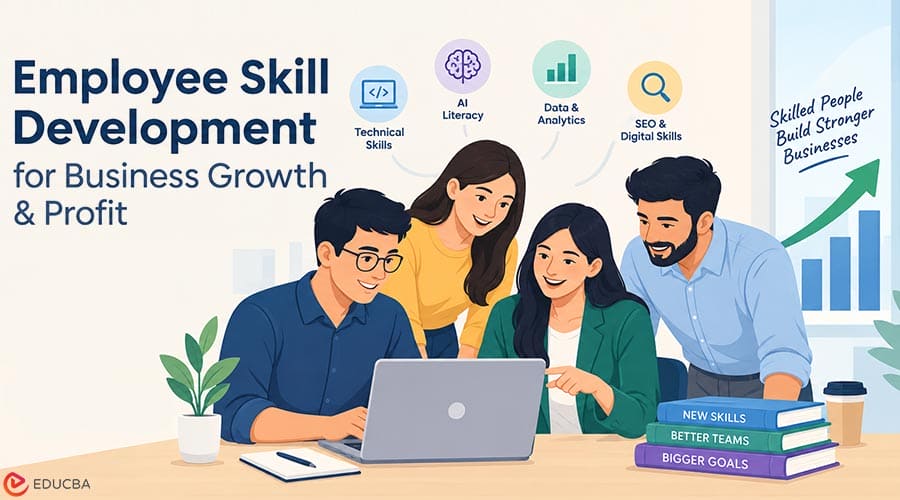
Most companies treat employee skill development as an obligation: a compliance checkbox, an onboarding formality, or an annual refresher nobody remembers by February. That framing misses what skill development is when done well: one of the few investments a company makes that pays off in both directions, improving output quality while also reducing the cost of getting work done. The businesses seeing measurable revenue and profit gains from training aren’t the ones running the most workshops. They target specific, high-leverage skill gaps that map directly to where the business is trying to grow.
Why Generic Employee Skill Development Programs Underperform?
The most common mistake in corporate learning is treating employee skill development as a uniform program applied evenly across departments, a standard onboarding curriculum, a rotating slate of soft-skills webinars, the same leadership course for every manager regardless of what their team actually does. This approach produces attendance numbers but rarely produces measurable business outcomes, because it optimizes for coverage rather than impact. Organizations getting a real return on training spend start from the opposite direction: they identify the two or three capability gaps most directly limiting growth right now, and they build focused, often role-specific training around closing exactly those gaps, rather than running a generic curriculum and hoping it helps.
Building Technical Capability Without a Hiring Budget
One of the clearest examples of targeted upskilling paying off directly in revenue is technical capability. A company that wants to launch a customer-facing tool a quoting calculator, a booking flow, an internal dashboard has traditionally faced a binary choice: hire a developer or pay an agency. Training existing employees to use modern low-code and AI-assisted platforms changes that calculation entirely. Teaching a product manager or operations lead to use a website to app converter, for instance, lets them turn an existing web tool into a functional mobile app without waiting on a development queue that may not open up for months. This kind of employee skill development rarely produces a polished engineering-hire-level output, but it doesn’t need to. It compresses the distance between “we have an idea” and “we have something customers can actually use.” That compression shows up directly in how fast a company can act on opportunities its competitors are still scoping out.
Preparing Teams for AI-Driven Operations
A parallel skills gap is emerging around how employees actually work alongside AI systems rather than simply using them as novelty tools. As more companies fold AI into core operations, from customer service routing to demand forecasting, employees increasingly need working fluency in how these systems make decisions, where they’re likely to fail, and how to intervene when they do. Training programs built around enterprise AI literacy, teaching non-technical staff to interpret model outputs, flag anomalies, and escalate edge cases appropriately, have become an important part of employee skill development for mid-sized companies. Businesses that skip this step often end up with expensive AI tooling that nobody on staff knows how to supervise properly, quietly eroding the return on that technology investment. The businesses that invest in this training instead get a workforce that can extract real operational value from tools that would otherwise sit underused.
Teaching Teams to Measure What Actually Worked
A less obvious but equally valuable skill gap sits in measurement itself. Many companies make marketing and operational decisions based on correlation: a change was made, a metric moved, and the change gets credited with the improvement, whether or not it actually earned that credit. Training marketing and analytics staff in incrementality testing, a method for isolating whether a specific action caused an outcome or coincided with it, gives a company a genuinely more reliable basis for reallocating budget and effort. Most employees were never taught this skill in traditional marketing or business education, and companies that build this capability internally consistently make sharper decisions about where to invest because they can tell the difference between a channel that looks like it’s working and one that’s actually producing incremental results.
Growing In-House Expertise in Complex, High-Value Disciplines
Some of the highest-return training investments target disciplines that are historically outsourced entirely, simply because building internal expertise seemed too specialized to attempt. Ecommerce search optimization is a strong example. Companies that have spent years paying external agencies for ecommerce SEO services are increasingly training internal staff to handle at least part of that work directly, because the discipline, once broken into structured skill areas like product page architecture, technical crawlability, and catalog-level content strategy, is teachable to an existing employee who already understands the product line intimately. The result isn’t necessarily full independence from outside expertise, but a meaningfully lower reliance on it, along with an internal team that can execute smaller changes immediately instead of waiting on an agency’s monthly cycle. This makes targeted employee skill development particularly valuable for companies looking to build long-term in-house capabilities.
Making the Financial Case for Targeted Training
For employee skill development to justify itself financially, evaluate it like any other capital allocation decision: what specific outcome is it expected to produce, and how will the company know if it worked?
| Skill Investment Area | Business Outcome It Targets | How to Measure Impact |
| Rapid app/tool building | Faster time-to-market for customer-facing tools | Days from idea to working prototype |
| AI operations literacy | Better returns on existing AI tooling | Reduction in AI-tool errors requiring escalation |
| Testing and measurement rigor | Smarter allocation of marketing spend | Percentage of budget tied to verified incremental results |
| In-house technical SEO capability | Reduced dependency on external agencies | Agency spend reduction/turnaround time on site changes |
Framing training this way shifts the internal conversation from “how much did we spend on learning and development this quarter” to “what specific capability gap did we close, and what did closing it produce.” That shift often determines whether leadership cuts the training budget during the next downturn or keeps it because leaders can clearly see what the program delivered. Effective employee skill development becomes easier to justify when you can connect its impact to measurable business outcomes.
Final Thoughts
Employee skill development can drive business growth when training aligns with specific business goals. Instead of training employees in everything, companies can focus on the capabilities that address current skill gaps, improve productivity, and support their next stage of growth.
When businesses connect training with measurable outcomes, they can better understand the value of their investment. A focused approach to employee skill development can improve efficiency, strengthen in-house expertise, reduce unnecessary costs, and build a workforce better prepared to support long-term business growth.
Recommended Articles
We hope this guide helps you understand employee skill development, including how targeted training can improve productivity, build in-house expertise, support AI adoption, and contribute to business growth and profitability. Explore our recommended articles for more insights on employee training, professional development, workplace skills, business growth, productivity, and workforce development.

