


What is Credit Exposure?
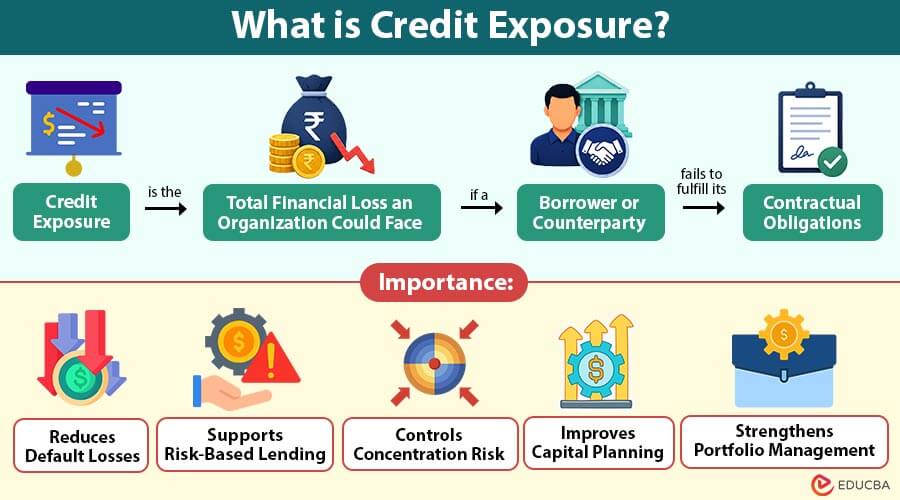
Credit exposure is the total financial loss an organization could face if a borrower or counterparty fails to fulfill its contractual obligations. It represents the amount of money at risk due to credit-related events such as default, delayed payments, bankruptcy, or deteriorating credit quality.
For example, suppose a bank lends ₹50 lakh to a company. If the company fails to repay the loan, the bank has exposure to that borrower. However, the actual loss may be lower than ₹50 lakh if the bank holds collateral or can recover part of the outstanding amount.
Credit exposure differs from credit loss. Exposure measures the amount at risk, while credit loss represents the amount ultimately lost after considering recoveries.
Table of Contents:
- Meaning
- Importance
- Working
- Types
- Difference
- How is Credit Exposure Measured?
- Factors that Affect Credit Exposure
- Techniques
- Example
Key Takeaways:
- Credit exposure measures the financial amount at risk when borrowers or counterparties fail to meet contractual obligations.
- Effective exposure management helps organizations control default losses, concentration risk, and unexpected financial impacts across portfolios.
- Exposure depends on outstanding balances, credit utilization, collateral, guarantees, maturity, and changing market conditions.
- Credit limits, diversification, netting, collateral, monitoring, and stress testing help organizations manage and reduce credit exposure effectively.
Why is Credit Exposure Important?
Managing credit exposure is important because excessive concentration can create substantial financial losses.
1. Reduces Default Losses
Monitoring exposure helps organizations identify borrowers whose obligations have become excessively large relative to their financial capacity.
2. Supports Risk-Based Lending
Banks can use exposure information when determining credit limits, pricing, collateral requirements, and lending conditions.
3. Controls Concentration Risk
A financial institution may have many borrowers but still face significant risk if too much exposure is concentrated in one borrower, industry, geography, or economic sector.
4. Improves Capital Planning
Banks need to maintain sufficient financial resources to absorb potential credit losses. Exposure measurements support risk and capital management processes.
5. Strengthens Portfolio Management
Tracking exposure across borrowers and financial products helps institutions understand their overall credit risk profile.
How Does Credit Exposure Work?
Credit exposure arises whenever one party provides financing, credit, or financial value to another party and expects future payment.
The basic process can be understood as follows:
1. Credit is Provided
A lender provides funds, goods, services, or financial value to another party, creating potential repayment obligations and credit exposure.
2. An Obligation is Created
The borrower or counterparty agrees to repay the value provided under specific contractual terms, schedules, conditions, and agreed requirements.
3. Exposure Develops
The lender remains financially exposed until the borrower repays, settles, or otherwise fully fulfills the outstanding contractual obligation.
4. Credit Quality Changes
The borrower’s financial condition may improve or deteriorate over time, changing the lender’s potential credit loss exposure.
5. Default May Occur
If borrower fails to meet contractual obligations, the lender may suffer financial losses depending on outstanding exposure and recovery.
6. Recovery is Assessed
Collateral, guarantees, insurance, or other recovery sources may reduce the lender’s final loss after a borrower defaults.
Credit exposure can change over time. For example, exposure on a revolving credit facility may increase when a borrower draws additional funds and decrease when the borrower makes repayments.
Types of Credit Exposure
It can take several types depending on the financial arrangement.
1. Loan Exposure
Loan exposure represents the amount a lender has outstanding to a borrower through loans or financing arrangements, creating potential losses if repayment fails.
2. Credit Card Exposure
Credit card exposure includes outstanding balances and available unused limits, because customers may borrow additional amounts, increasing the lender’s potential credit risk.
3. Trade Credit Exposure
Trade credit exposure arises when businesses provide goods or services before receiving payment, leaving them exposed until customers fully settle outstanding invoices.
4. Counterparty Exposure
Counterparty exposure occurs when a business or financial institution may suffer losses because another party fails to fulfill contractual financial obligations.
5. Settlement Exposure
Settlement exposure occurs when one party completes its transaction obligations but has not yet received the expected payment or asset from its counterparty.
6. Off-Balance-Sheet Exposure
Off-balance-sheet exposure includes loan commitments, guarantees, letters of credit, derivatives, and undrawn facilities that may create future credit risk for lenders.
Difference Between Credit Exposure and Credit Risk
The table below highlights the key differences between the two.
| Basis | Credit Exposure | Credit Risk |
| Meaning | Refers to the amount potentially at risk from a borrower or counterparty. | Refers to the possibility that a borrower or counterparty may fail to meet obligations. |
| Focus | Focuses on the amount exposed to potential loss. | Focuses on the possibility of loss. |
| Nature | Represents a financial amount or position. | Represents a probability or possibility of financial loss. |
| Example | A bank has ₹1 crore of exposure to a borrower. | The borrower may default on the ₹1 crore obligation, creating potential loss. |
| Simple Formula | Credit Exposure = Amount potentially exposed to default | Credit Risk = Possibility of loss arising from default |
How is Credit Exposure Measured?
Credit exposure can be measured using different approaches depending on the type of financial instrument.
For a straightforward loan, exposure may initially be based on the outstanding principal and other amounts that are contractually due.
A simplified calculation can be represented as:
For certain financial instruments, measuring exposure is more complex because the amount at risk can change over time.
Financial institutions may use concepts such as Exposure at Default (EAD) to estimate the amount that could be outstanding when a borrower defaults.
For example, consider a company with:
- Outstanding loan: ₹40 lakh
- Undrawn committed facility: ₹20 lakh
- Estimated amount likely to be drawn before default: ₹8 lakh
The estimated exposure at default could be approximately:
₹40 lakh + ₹8 lakh = ₹48 lakh
The exact calculation depends on the institution’s methodology, contractual terms, applicable accounting standards, and regulatory requirements.
Factors That Affect Credit Exposure
Credit exposure can change because of several factors.
1. Borrower Creditworthiness
A borrower’s financial health affects the likelihood that existing exposure will result in losses. Changes in profitability, leverage, cash flow, liquidity, or credit quality can increase or decrease the lender’s exposure to credit losses.
2. Outstanding Balance
The outstanding balance directly affects the amount a lender may lose if a borrower defaults. Generally, as the amount borrowed increases, the lender’s credit exposure also increases.
3. Credit Utilization
For revolving credit facilities, exposure can change as borrowers draw down or repay available credit. Higher utilization generally increases the lender’s current exposure, while repayments reduce it.
4. Collateral
Collateral can reduce potential credit losses by providing an asset that the lender may recover or liquidate if the borrower defaults. The actual protection depends on the collateral’s value, enforceability, liquidity, and applicable laws.
5. Guarantees
A third-party guarantee can provide an additional source of repayment if the primary borrower defaults. The strength of the guarantee depends on the guarantor’s creditworthiness, financial capacity, and the legal terms of the guarantee.
6. Maturity
Longer-dated transactions may involve greater uncertainty because the borrower’s financial condition and broader economic conditions can change over time. Longer maturities can therefore increase potential credit risk.
7. Market Movements
For derivatives and other market-linked contracts, credit exposure can change as market conditions change. Movements in interest rates, foreign exchange rates, equity prices, commodity prices, or other underlying variables can increase or decrease a counterparty’s amount owed.
Credit Exposure Management Techniques
Organizations use several techniques to control and reduce credit exposure.
1. Credit Limits
Banks and businesses establish maximum exposure limits for individual borrowers or counterparties.
2. Diversification
Spreading exposure across multiple borrowers, industries, and geographic regions can reduce concentration risk.
3. Collateral Management
Lenders may require collateral such as property, securities, inventory, or other eligible assets to reduce potential losses.
4. Netting Agreements
In certain financial transactions, legally enforceable netting arrangements can reduce exposure by allowing eligible obligations between counterparties to offset each other.
5. Guarantees and Credit Protection
Guarantees, credit insurance, and other forms of credit protection may reduce the loss an organization ultimately experiences.
6. Continuous Monitoring
Organizations monitor borrower financial statements, payment behavior, credit ratings, market conditions, and other indicators to identify changes in credit quality.
7. Stress Testing
Stress testing examines how exposure and potential losses could change under adverse economic or market conditions.
Example of Credit Exposure
Consider a manufacturing company that sells goods worth ₹25 lakh to a retailer on 60-day credit terms. The retailer must make full payment after receiving the goods.
Until the retailer pays the invoice, the manufacturer has ₹25 lakh of credit exposure because it has already delivered the goods but has not yet received payment.
Suppose the retailer later experiences financial difficulties and fails to pay the invoice. The manufacturer may recover ₹10 lakh through collection efforts or other arrangements.
The potential credit loss would therefore be:
₹25 lakh − ₹10 lakh = ₹15 lakh
This example shows that credit exposure represents the amount owed by the counterparty, while the eventual credit loss depends on the amount that cannot be recovered
Final Thoughts
Credit exposure measures the financial amount at risk if a borrower or counterparty defaults. It arises through loans, credit facilities, trade credit, derivatives, and guarantees. Effective management uses EAD, PD, and LGD, along with credit limits, diversification, collateral, monitoring, and stress testing, to reduce potential losses.
Frequently Asked Questions (FAQs)
Q1. Can credit exposure be negative?
Answer: In most lending situations, credit exposure is not negative. However, certain netting arrangements or derivative positions can produce a negative current replacement value.
Q2. Does a higher credit limit always mean higher credit exposure?
Answer: Not necessarily. A higher limit creates greater potential exposure, but actual exposure depends on how much of the facility the borrower uses.
Q3. How does repayment affect credit exposure?
Answer: When a borrower repays principal or other outstanding obligations, the lender’s exposure generally decreases, assuming no additional borrowing occurs.
Q4. How do derivatives create credit exposure?
Answer: Derivatives can create exposure when their market value becomes favorable to one counterparty, and the other counterparty would owe money if the contract were terminated.
Recommended Articles
We hope that this EDUCBA information on “Credit Exposure” was beneficial to you. You can view EDUCBA’s recommended articles for more information.


