


What is a Noteholder?
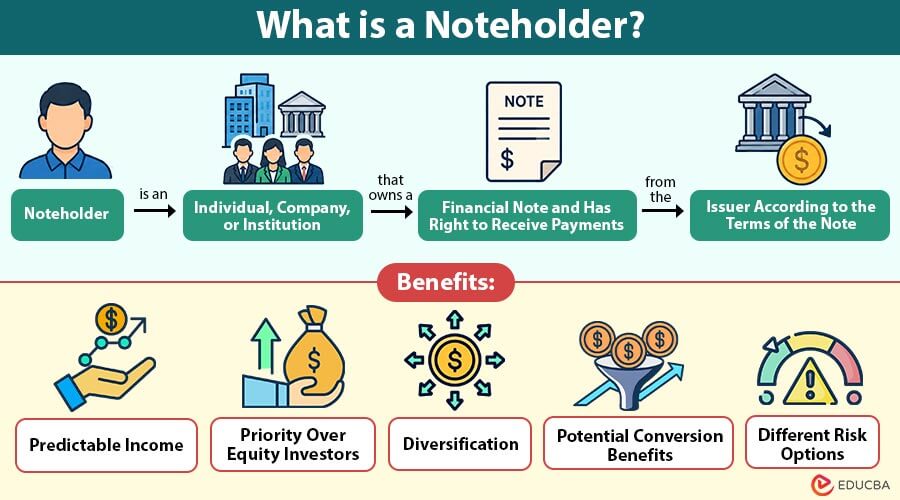
A noteholder is an individual, company, or institution that owns a financial note and has the right to receive payments from the issuer according to the terms of the note. These payments may include interest and repayment of the principal amount.
A note is a debt instrument that represents a borrowing arrangement between an issuer and an investor. When a person purchases a note issued by a company, government, or financial institution, that person becomes a noteholder. The issuer must make payments according to the agreed schedule.
Noteholders are generally creditors rather than owners of the issuing company. Therefore, they usually do not receive ownership rights simply by holding a note. Their primary interest is receiving interest payments and recovering the principal amount when the note matures.
Table of Contents:
- Meaning
- Working
- Key Features
- Types
- Rights
- Responsibilities
- Difference Between Noteholder and Shareholder
- Difference Between Noteholder and Bondholder
- Benefits
- Risks
- Example
- What Should Investors Consider Before Becoming a Noteholder?
Key Takeaways:
- Noteholders are creditors who receive interest and principal payments under the note’s terms.
- Noteholders may hold secured, unsecured, convertible, commercial, or promissory notes based on structure.
- Noteholders face credit, default, interest rate, liquidity, inflation, and conversion-related investment risks.
- Investors should carefully evaluate issuer creditworthiness, maturity, security, payment terms, liquidity, and conversion conditions.
How Does a Noteholder Work?
The relationship between a noteholder and an issuer begins when the issuer raises funds by issuing a note. The investor purchases the note and provides capital to the issuer.
For example, suppose a company issues a five-year note with a face value of ₹1,00,000 and an annual interest rate of 8%. An investor purchases the note and becomes a noteholder.
The company must then make interest payments according to the terms of the agreement. At maturity, the company generally repays the ₹1,00,000 principal amount.
The process can be summarized as:
Issuer → Issues Note → Investor Purchases Note → Investor Becomes Noteholder → Receives Interest → Receives Principal at Maturity
The exact rights and payment terms depend on the note agreement.
Key Features of a Noteholder
Several characteristics define a noteholder’s position in a debt arrangement.
1. Creditor Status
A noteholder is typically a creditor of the issuer. The note represents money the issuer has borrowed and must repay.
2. Interest Income
Depending on the type of note, a noteholder may receive fixed or variable interest payments. The note agreement generally specifies the interest rate and payment frequency.
3. Principal Repayment
The issuer generally must repay the principal amount when the note matures, subject to the agreement’s terms and conditions.
4. Defined Contractual Rights
A noteholder’s rights are established by the terms of the note. These may include payment schedules, interest rates, maturity dates, security arrangements, and remedies in case of default.
5. Limited Ownership Rights
Unlike shareholders, noteholders generally do not have ownership rights in the company. They normally do not participate in ordinary shareholder voting or receive dividends merely because they hold a note.
Types of Noteholders
Noteholders can be classified based on the type of note they hold and their relationship with the issuer.
1. Secured Noteholders
A secured noteholder holds debt backed by specific collateral, giving them a legal claim over pledged assets if the issuer defaults under the agreed terms.
2. Unsecured Noteholders
An unsecured noteholder holds debt without specific collateral and relies on the issuer’s financial position and contractual obligations for repayment when due.
3. Convertible Noteholders
A convertible noteholder holds debt that may convert into equity under specified conditions, commonly during future financing rounds or predefined events.
4. Commercial Noteholders
A commercial noteholder invests in short-term corporate debt instruments that companies issue to finance working capital and other immediate business requirements.
5. Promissory Noteholders
A promissory noteholder is entitled to receive payment under a promissory note, which specifies the borrower’s repayment amount, schedule, and agreed terms.
Rights of a Noteholder
A noteholder’s rights depend on the specific agreement and applicable laws. Common rights include the following:
1. Right to Receive Interest
If the note carries interest, the noteholder has the contractual right to receive interest according to the payment schedule.
2. Right to Principal Repayment
The noteholder generally has the right to receive the principal amount when the note matures, provided the issuer meets its obligations.
3. Right to Information
Depending on the type of note and applicable regulations, noteholders may receive financial information, notices, reports, or other information relevant to the debt instrument.
4. Right to Take Action in Default
If an issuer fails to meet its contractual obligations, the noteholder may have certain remedies. These can include demanding payment, pursuing legal remedies, or enforcing security when applicable.
5. Rights During Restructuring or Bankruptcy
If the issuer becomes financially distressed, noteholders may have claims against the issuer. The priority of those claims depends on factors such as whether the debt is secured, subordinated, or senior.
Responsibilities of a Noteholder
The following are the key responsibilities a noteholder should fulfill to manage the investment effectively and protect their financial interests.
1. Understand Note Terms
Review the interest rate, maturity date, repayment conditions, collateral, conversion provisions, and default clauses before investing.
2. Monitor Payments
Track interest payments, principal repayments, maturity dates, and other payment obligations to ensure the issuer follows agreed terms.
3. Maintain Investment Records
Keep accurate records of the note, payment history, agreements, statements, and other important investment documents.
4. Evaluate Issuer Creditworthiness
Assess the issuer’s financial position, repayment capacity, credit history, and overall ability to meet its debt obligations.
5. Understand Investment Risks
Consider credit, default, liquidity, interest rate, and other risks instead of focusing only on the promised return.
6. Monitor Issuer Performance
Stay informed about significant changes in the issuer’s financial condition, business performance, or circumstances that could affect repayment.
Difference Between Noteholder and Shareholder
Noteholders and shareholders both provide capital to companies, but their positions are different.
| Basis | Noteholder | Shareholder |
| Position | Creditor | Owner |
| Return | Interest and principal | Dividends and capital gains |
| Ownership | Generally no ownership | Yes |
| Voting Rights | Generally limited or none | Usually available |
| Repayment | Usually according to debt terms | No guaranteed repayment |
| Risk | Generally lower than equity | Generally higher |
| Priority in Liquidation | Usually ahead of shareholders | Usually after creditors |
Difference Between Noteholder and Bondholder
The table below highlights the key differences between a noteholder and a bondholder based on their characteristics, terms, and investment features.
| Basis | Noteholder | Bondholder |
| Meaning | A noteholder is an individual or entity that owns a note issued by a borrower or company. | A bondholder is an individual or entity that owns bond issued by a company, government, or other organization. |
| Debt Instrument | Holds a note, which may be secured, unsecured, convertible, or promissory. | Holds a bond that represents a debt obligation of the issuer. |
| Maturity | Notes generally have short- to intermediate-term maturities, depending on the agreement. | Bonds frequently have longer maturities, although this can vary by market and instrument. |
| Interest | May receive fixed or variable interest according to the note’s terms. | Usually receives periodic interest payments according to the bond’s terms. |
| Principal Repayment | Receives the principal amount according to the agreed repayment schedule. | Receives the bond’s principal, typically at maturity or according to its terms. |
| Common Issuers | Companies, startups, individuals, and other borrowers may issue notes. | Governments, corporations, municipalities, and other organizations commonly issue bonds. |
| Terminology | The term generally refers to someone who owns a note. | The term specifically refers to someone who owns a bond. |
| Risk | Risk depends on factors such as collateral, issuer creditworthiness, maturity, and note structure. | Risk depends on factors such as issuer creditworthiness, maturity, interest rates, and bond structure. |
Benefits of Being a Noteholder
Holding a note can provide several potential benefits.
1. Predictable Income
Interest-bearing notes can provide investors with regular and predictable income through scheduled interest payments, provided the issuer meets its obligations.
2. Priority Over Equity Investors
Noteholders generally have higher claims than shareholders during liquidation, although priority depends on the note’s ranking and specific contractual terms.
3. Diversification
Notes can diversify investment portfolios by adding debt instruments alongside equities, helping investors spread exposure across different asset classes and issuers.
4. Potential Conversion Benefits
Convertible notes may allow investors to convert debt into equity, providing potential participation in the company’s future growth and appreciation.
5. Different Risk Options
Investors can select secured, unsecured, senior, subordinated, convertible, and other notes based on their risk tolerance and investment objectives.
Risks Faced by Noteholders
Noteholders also face several risks.
1. Credit Risk
Credit risk arises when the issuer experiences financial difficulties and cannot make scheduled interest or principal payments according to agreed terms.
2. Interest Rate Risk
Interest rate risk occurs when rising market rates reduce the market value of existing fixed-rate notes, potentially causing losses if they are sold.
3. Liquidity Risk
Liquidity risk occurs when a note has limited market demand, making it difficult for noteholders to sell quickly at favorable prices.
4. Inflation Risk
Inflation risk reduces the purchasing power of future interest and principal payments, potentially lowering the noteholder’s real investment returns over time.
5. Conversion Risk
Conversion risk occurs when convertible noteholders face uncertainty about conversion timing, valuation, eligibility, or conditions affecting conversion into company equity.
6. Default Risk
Default risk arises when an issuer cannot fulfill obligations, causing payments to be delayed, restructured, reduced, or potentially lost entirely.
Example of a Noteholder
Consider a company that wants to raise ₹50 lakh for business expansion. It issues notes with a five-year maturity and an annual interest rate of 9%.
An investor purchases a note worth ₹5 lakh. The investor becomes a noteholder and is entitled to receive interest according to the agreement. If interest is paid annually, the investor may receive ₹45,000 per year before applicable taxes and other considerations.
At the end of five years, the company is expected to repay the ₹5 lakh principal, assuming it meets its contractual obligations.
If the note is secured, specific assets may serve as collateral. If it is convertible, the investor may have an opportunity to convert the debt into shares under the specified conditions.
This example shows how a noteholder provides financing while receiving contractual rights to payments.
What Should Investors Consider Before Becoming a Noteholder?
Before investing in a note, investors should evaluate several factors:
1. Issuer Creditworthiness
Assess the issuer’s financial strength, repayment capacity, credit history, cash flows, and ability to meet interest and principal obligations.
2. Interest Rate
Compare the note’s interest rate with similar investments, and consider whether the additional return adequately compensates for the associated investment risks.
3. Maturity
Consider the maturity period and determine whether you can keep your capital invested until the note matures.
4. Security
Determine whether the note is secured by specific collateral or unsecured, and understand how this affects potential recovery during default.
5. Payment Terms
Review the interest payment frequency, principal repayment schedule, payment methods, and other contractual conditions governing the issuer’s repayment obligations.
6. Default Provisions
Understand the consequences of default, available legal remedies, acceleration clauses, and protections provided to noteholders if the issuer fails.
7. Liquidity
Check whether an active secondary market exists, allowing you to sell the note before maturity without accepting a significant price reduction.
8. Conversion Terms
For convertible notes, understand conversion triggers, conversion ratios, valuation caps, discounts, timing, and conditions governing conversion into company equity.
Final Thoughts
A noteholder is an investor or entity that owns a debt note and has contractual rights to receive interest and principal payments from the issuer. Noteholders are creditors, not company owners. Their rights and protections depend on the note’s terms, including maturity, security, repayment, and conversion provisions.
Frequently Asked Questions (FAQs)
Q1. Can a noteholder sell a note before its maturity date?
Answer: Yes, a noteholder may be able to sell a note before maturity if the note is transferable and a willing buyer exists. However, the sale price may differ from its original value.
Q2. Can an individual become a noteholder?
Answer: Yes, individuals can become noteholders by purchasing or receiving eligible debt notes. The investment amount, eligibility, and applicable requirements depend on the type of note.
Q3. Can a noteholder transfer ownership of a note?
Answer: In some cases, a note can be transferred to another person or entity. However, transfer restrictions, issuer approval, registration requirements, or other contractual conditions may apply.
Q4. Can a noteholder negotiate the terms of a note?
Answer: Yes, depending on the transaction. Private notes, for example, may involve negotiations over interest rates, maturity, collateral, repayment schedules, covenants, and other provisions before the agreement is finalized.
Recommended Articles
We hope that this EDUCBA information on “Noteholder” was beneficial to you. You can view EDUCBA’s recommended articles for more information.

