


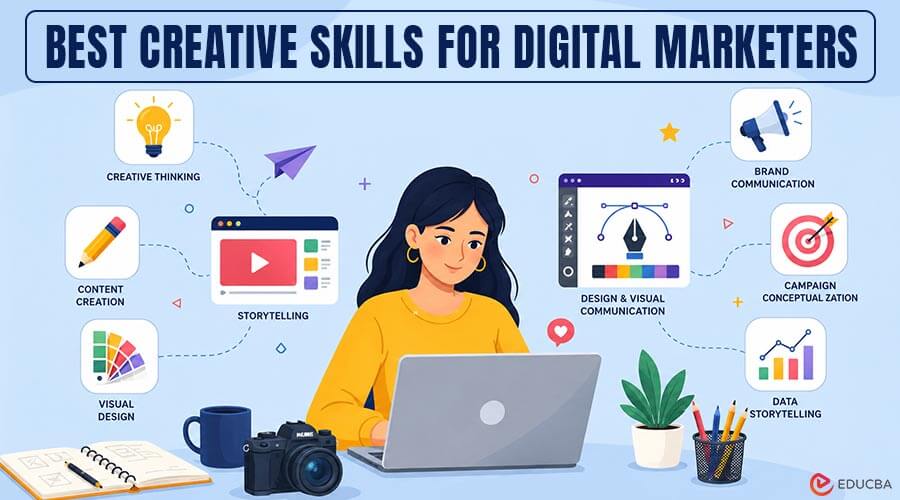
Digital marketing roles have become increasingly difficult to separate into neat categories. A marketer working on a product launch may help shape the paid campaign, review a landing page, coordinate an email sequence, and prepare content for several social platforms all within the same week. That does not mean every marketer needs to become a professional designer, animator, or video editor. However, developing the right creative skills for digital marketers can make it easier to plan campaigns, communicate with creative teams, choose appropriate formats, and evaluate whether an asset supports the campaign objective.
Creative Skills for Digital Marketers to Learn Beyond Campaign Setup
The following creative skills can help digital marketers improve campaign planning, creative collaboration, and overall marketing effectiveness.
1. Learn to Think Beyond the Individual Asset
One of the most important shifts is moving from asset-level thinking to campaign-level thinking. A designer might be asked to create a LinkedIn ad, an email header, and a landing-page hero for the same launch. Treating these as three unrelated design requests can quickly create inconsistencies. The ad emphasizes one benefit, the email introduces another message, and the landing page can feel like a different campaign entirely.
A marketer should first identify the common foundation: Who is the audience? What problem matters most to them? Which benefit should lead the campaign? What proof supports that benefit? What action should the audience take? Once you answer those questions, each channel can adapt the same core idea instead of inventing a new one.
This is particularly useful for marketers learning broader digital marketing skills. Learning digital marketing skills helps you understand the importance of different channels and audiences; creative literacy adds another layer by helping marketers connect those channels visually and strategically.
2. Understand How Landing Pages Communicate
A landing page gives a marketer far more room than an advertisement, but that extra space can become a problem when every stakeholder wants to add something. Good page planning starts with hierarchy. Visitors should quickly understand the offer, its value, and their next step. Supporting details, proof, and objections can then appear in a logical order. That is why learning some basic UX thinking helps even marketers who will never design a page themselves.
Being able to sketch a simple wireframe or explain why a testimonial belongs near a decision point makes communication with web designers much easier. For teams producing this work at greater volume, Superside’s web design services combine UX research, wireframes, responsive design, landing pages, copy and reusable design systems. The combination is useful because it reflects how web creative actually works: copy, structure and visual design influence one another rather than happening independently.
3. Learn How to Brief Ad Creative for Testing
Another useful skill is understanding the difference between creating variations and creating meaningful tests. Changing a button color on five otherwise identical ads produces five files, but it may not produce five useful hypotheses. A stronger test could compare a problem-led concept with a product demonstration, a testimonial, or a benefit-focused message. Before requesting new creative, marketers should be able to explain what they want to learn. For example, a brief might ask whether customers respond more strongly to ease of use or time savings.
Designers can then create different concepts around those ideas while keeping other campaign variables reasonably controlled. The learning continues once the ads are live. Instead of looking only at which individual ad generated the best CTR or conversion rate, marketers can examine whether certain creative characteristics repeatedly perform well. Superads helps teams analyze paid creative across Meta, Google Ads, TikTok and LinkedIn, including patterns around elements such as hooks, formats, products and messaging angles.
Before requesting new creative, marketers should be able to explain what they want to learn. For example, a brief might ask whether customers respond more strongly to ease of use or time savings. Designers can then create different concepts around those ideas while keeping other campaign variables reasonably controlled. Superside’s ad creative work follows this broader testing-oriented approach across static design, motion, video, illustration, and landing pages, with creative variants intended to support experimentation rather than simply increase asset count.
4. Know When Static Design is Not Enough
Some information is easier to understand when it moves. A static graphic may work perfectly for a simple offer, while a short animation may be better for demonstrating a workflow. Video becomes useful when the product needs to be seen in use or when a person, environment, or story adds credibility. Marketers do not need advanced animation skills to make these decisions.
They do need enough knowledge to understand concepts such as storyboarding, pacing, aspect ratios, captions, and cut-downs. Learning Motion graphics helps you understand the foundations. Even basic familiarity makes it easier to write realistic briefs and avoid requesting a 60-second video when the actual placement requires six seconds of vertical content.
5. Design for Systems, Not Only Campaigns
As marketing output grows, another problem appears: teams recreate the same things repeatedly. Buttons are redrawn. Email modules change slightly from campaign to campaign. Landing pages use different spacing. Social templates slowly drift from the brand. That is where design systems become useful. A design system turns recurring visual decisions into reusable components and rules. Instead of deciding how every button, card, or CTA should look each time, the team has an approved foundation that can still accommodate new creative ideas.
Superside’s design-system work uses reusable components across web, landing pages, and other creative production, which helps teams maintain consistency without forcing every campaign into the same layout. For learners, the important lesson is that consistency does not mean repetition. A system defines what should remain stable while leaving room for the campaign idea to change.
6. Creative Literacy Makes Marketers Better Collaborators
The strongest marketers are not necessarily the people who can execute every task themselves. They understand enough about neighboring disciplines to make better decisions. Learning how visual hierarchy works improves landing-page briefs. Understanding motion improves video briefs. Knowing design system principles improves campaign consistency.
Understanding meaningful creative testing leads to better ad requests. Marketing increasingly happens at the intersection of these disciplines. Understanding how they fit together lets a marketer turn a campaign idea into a consistent experience rather than a collection of unrelated assets.
Recommended Articles
We hope this guide to creative skills for digital marketers helps you strengthen your creative approach and build more effective campaigns. Check out these recommended articles for more insights to improve your digital marketing skills and results.


