

Differences Between C# vs VB.Net
C# is a general and modern object-oriented programming (OOP) language provided by Microsoft that runs on the .Net Framework. C# is pronounced as “C-Sharp.” C# is designed to work with Microsoft’s .Net platform. C# is expected to speed up the delivery of new products with high-quality, stable services to the market. VB.NET is pronounced as Visual Basic .NET, and it is an object-oriented programming language that is implemented on the .NET Framework by Microsoft. One of the good features is that the VB.Net program can also run on Mono, which means it is restricted to running under Windows and even Mac OSX or Linux.
C#
C# is a programming language designed for the Common Language Infrastructure (CLI). Using the C# programming language, different types of secure and robust applications can be developed.
Some of the applications are listed below:
- Windows applications.
- Web applications and Web service applications.
- Distributed applications.
- Database applications, etc.
Software giant Microsoft developed this programming language in the year 2000, and it is part of the C family. ECMA and ISO have certified C # as a standard programming language.
The main aim of designing C# is to support information exchange and services over the Web and enable developers to build robust, portable applications.
It simplifies programming by using XML (Extensible Markup Language) and Simple Object Access Protocol (SOAP), by which the programmer need not write additional code for each step.
VB.Net
VB.NET is an update for the classic Visual Basic language, which targets the Microsoft .NET Framework. VB.NET and Visual Basic have a lot of similarities and also have some differences.
It is one of the most famous and productive, stable tools for developing applications very quickly, as it supports a wide range of Windows, Web, Mobile, and Office applications that can be built on the .NET Framework.
Software giant Microsoft developed the VB.NET programming language in 2001, and it runs on the .NET Framework, with full access to all libraries in the .NET Framework.
Head-to-Head Comparison Between C# vs VB.Net
Below are the top 3 differences between C# and VB.Net:
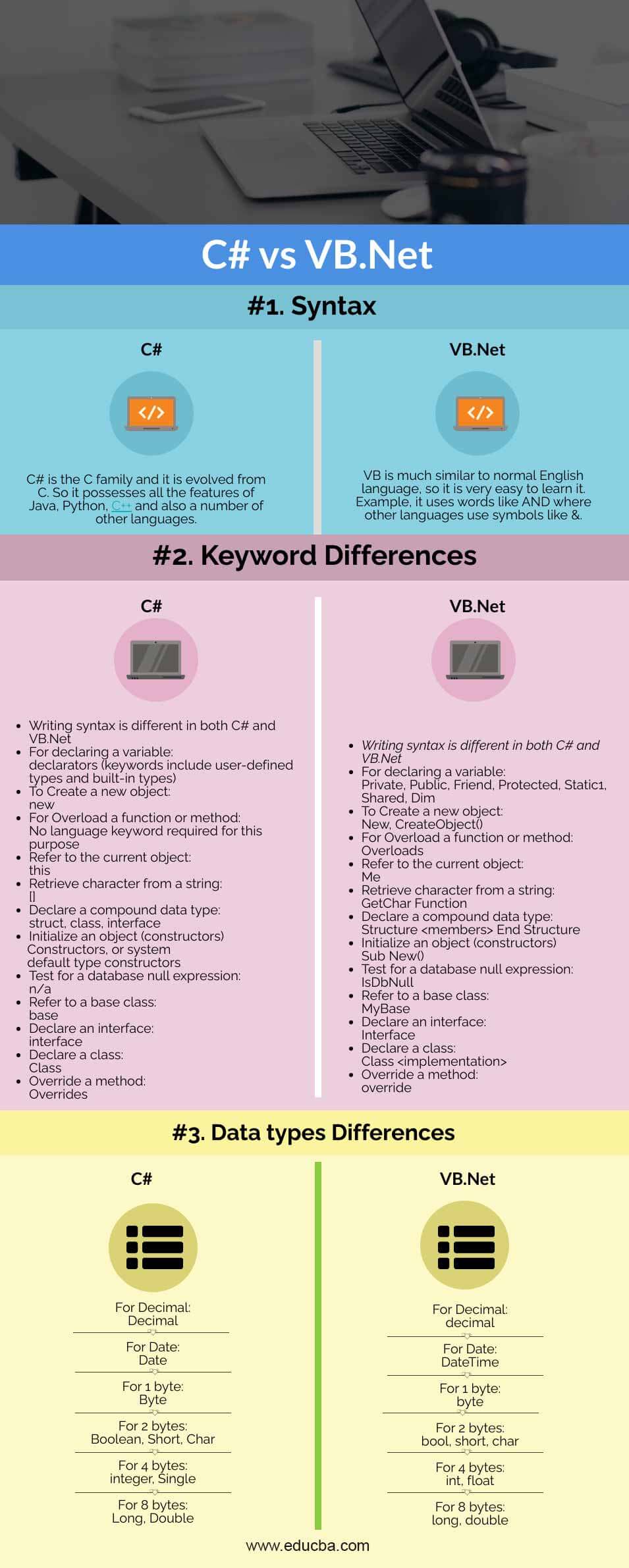
Key Differences Between C# vs VB.Net
As you can see, there are many differences. Let’s look at the top differences:
1. To release unmanaged resources, a keyword is used in C#, which is unavailable in VB.NET.
2. An optional parameter is available and supported in VB.NET, which is not available in C#.
3. In VB.NET, structured and unstructured error handling are supported, whereas Unstructured error handling is not supported in the C# programming language.
4. The event in VB.Net gets bind automatically, whereas it is impossible in C#.
5. C# is case-sensitive in its syntax, whereas VB.NET is not case-sensitive.
- Shadowing: The shadow feature is supported in VB.Net, allowing a new implementation for a base class member without overriding the member. It also allows a base class member in the derived class by using the keyword “Shadows”.
This feature will not be supported in C#:
- Hiding: Hiding is a feature supported by C# that allows a new implementation for a base class member without overriding the member. It also allows a base class member in the derived class just by using the keyword “new”. This feature will not be supported in VB.Net.
6. VB.NET allows and forces parameters to be passed by value without worrying about how those are declared, just by enclosing the parameters in extra parentheses. At the same time, it is not at all possible to achieve this in C#.
Example:
Dim y As Integer = 5
Dim z As Integer
z = Add(y) //This will set both Y and Z to 6.
z = Add((y)) //This will set Z to 6 but the Value of Y will not be changed, as we have included extra parentheses while calling.
The Add function:
Public Function Add(ByRef x As Integer) As Integer
x = x + 1
Return x
End Function
C# vs VB.Net Comparison Table
The primary comparison is discussed below:
| Basis of Comparison | C# | VB.Net |
| Syntax | C# is part of the C family, and it evolved from C. So it possesses all the features of Java, Python, C++, and several other languages. | VB is much like standard English, so it is easy to learn. For example, it uses words like AND, whereas other languages use symbols like &. |
| Keyword Differences | Writing syntax is different in both C# and VB.Net. | Writing syntax is different in both C# and VB.Net. |
| For declaring a variable:
Declarators (keywords include user-defined types and built-in types) |
For declaring a variable:
Private, Public, Friend, Protected, Static, Shared, Dim |
|
| To create a new object:
new |
To create a new object:
New, CreateObject() |
|
| To overload a function or method:
No language keyword is required for this purpose |
To overload a function or method:
Overloads |
|
| Refer to the current object:
this |
Refer to the current object:
Me |
|
| Retrieve character from a string: [] | Retrieve character from a string:
GetChar Function |
|
| Declare a compound data type:
struct, class, interface |
Declare a compound data type:
Structure <members> End Structure |
|
| Initialize an object (constructors) Constructors or system default type constructors |
Initialize an object (constructors) Sub New() |
|
| Test for a database null expression:
n/a |
Test for a database null expression:
IsDbNull |
|
| Refer to a base class:
base |
Refer to a base class:
MyBase |
|
| Declare an interface:
interface |
Declare an interface:
Interface |
|
| Declare a class:
Class |
Declare a class:
Class <implementation> |
|
| Override a method:
Overrides |
Override a method:
override |
|
| Data Types Differences | For Decimal:
Decimal |
For Decimal:
decimal |
| For Date:
Date |
For Date:
DateTime |
|
| For 1 byte:
Byte |
For 1 byte:
byte |
|
| For 2 bytes:
Boolean, Short, Char |
For 2 bytes:
bool, short, char |
|
| For 4 bytes:
integer, Single |
For 4 bytes:
int, float |
|
| For 8 bytes:
Long, Double |
For 8 bytes:
long, double |
Conclusion
Both are built on the .NET Framework by Microsoft, making it easy for developers to build applications that meet their needs. From the C# vs VB.Net article above, developers can choose either language based on taste and requirements. However, for teams coming from an older VB6 codebase, that choice is really part of a broader migration strategy from VB6 to .NET rather than a simple preference between two syntaxes.
Recommended Articles
This is a guide to the top differences between C# vs VB.Net. We also cover the key differences between C# and VB.NET with infographics and a comparison table. You may also have a look at the following articles to learn more –

