


Updated August 25, 2026
Understanding GIS
GIS (Geographic Information System) is a technology that collects data to create a special digital map. This map has different layers that show where all living things (humans, water sources, trees) and non-living things (buildings, roads, vehicles) are situated.
GIS technology emerged in the 1960s in response to the growing need to manage and analyze geographic information. It can display data such as population density, land use, and transportation networks, and show how each relates to the others. The applications of GIS are extensive, as it helps organizations and governments solve real-world spatial problems across multiple domains. For example, GIS can help identify ideal locations for infrastructure such as airports, nuclear power plants, and military bases. Authorities use it to observe their surroundings, analyze how different layers of data interact, and make informed decisions related to urban expansion, environmental planning, and emergency management.
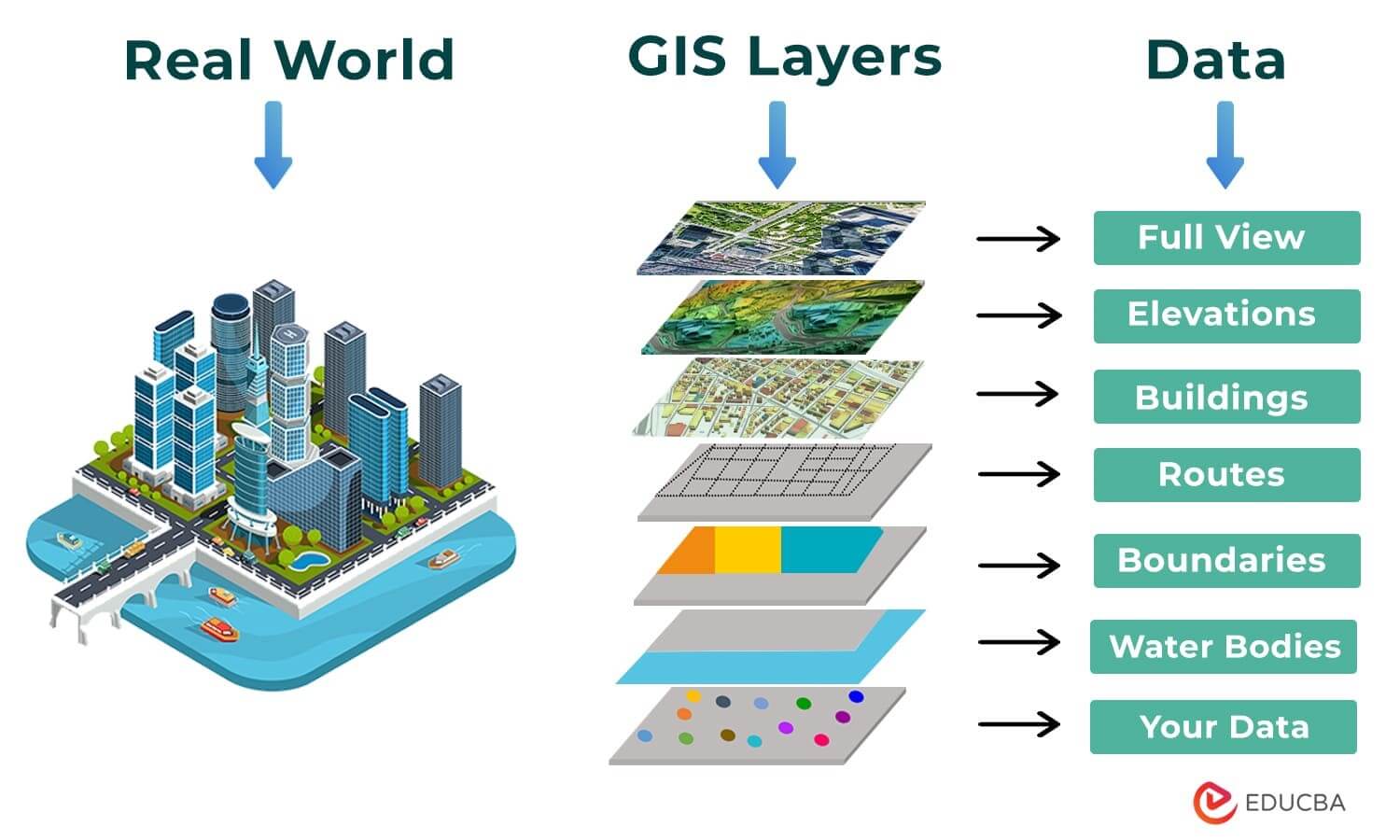
Table of Contents
What are the Applications of GIS?
Geographic Information Systems can be helpful in various domains. Some of the most common among them are:
#1. Agriculture
GIS is a useful tool in agriculture. It uses data about farms, weather, and water resources to help determine the best agricultural practices. Researchers can assist farmers in finding suitable weather conditions for specific crops and locating nearby water sources for irrigation. Governments can use GIS to develop resource management policies and identify suitable agricultural lands.
Applications of GIS in Agriculture
- Drought management: GIS helps manage droughts by identifying areas experiencing water scarcity. It helps prevent damage to plant seeds, human efforts, and expensive fertilizers.
- Pest control: It is also used to predict pest outbreaks from pests like locusts and rodents by analyzing spatial data for specific agricultural lands. It allows the government and farmers to plan how to deal with these pests.
- Land and soil analysis: By studying previous data sets, satellite imagery, or field observations, field workers can gather information about land and soil conditions.
- Planning of future food demand: By considering the population’s needs, the government and farmers can plan and produce enough crops to meet the demand.
Useful Tools
- ArcGIS
- QGIS
Real Example: Rice Crop Plantation
A software named “Image Processing and Analysis Software (ENVI) program” is a useful tool that helps with the planting of rice crops worldwide. It uses GIS to create layers of agricultural land, allowing farmers to determine which areas are best for rice production.
#2. Environment
GIS can monitor air quality in a specific area. It uses data from satellites monitoring air quality to create maps showing areas with high pollution. The government can use this map to develop policies to improve air quality in those areas.
Applications of GIS in Environment
- Quality of Life: It helps monitor air and water quality to assess real-world habitat conditions.
- Planning: It simplifies selecting the proper location for new infrastructure by assessing the project’s environmental impact.
- Resource management: Governments can identify areas with natural resources such as water bodies, forests, and agricultural land.
- Climate change: They can analyze climate data to assess associated risks.
Useful Tools
- ENVI
- GRASS GIS
Real Example: Construction Project Approval
Parivesh is an online system in India where people can submit construction proposals for approval. Using GIS, the software assesses whether a project could harm the environment, enabling the government to decide whether to accept or reject these proposals. Government officials claim it can reduce the time to approve proposals by 30%.
#3. Urban Planning and Transportation
GIS helps city planners and transportation experts combine different types of information, such as maps, satellite imagery, population statistics, and infrastructure data. It helps them make better decisions when designing sustainable, environmentally friendly cities and transportation systems.
Applications of GIS in Urban Planning and Transportation
- Growth Forecast: It’s useful in developing models to predict and plan for the future expansion of cities.
- Planning Land Usage: It enables infrastructure experts to analyze and allocate land for various purposes, such as residential, commercial, and industrial use, in urban areas.
- Transportation network: Countries can improve transportation systems, including roads, public transit, and pedestrian infrastructure, to ensure smooth movement within cities.
- Infrastructure management: Cities can efficiently manage urban infrastructure, such as bridges and public facilities, to support sustainable development.
Useful Tools
- GRASS GIS
- Whitebox GAT
Real Example: Dubai Integrated Rail Master Plan
Dubai’s Roads and Transport Authority (RTA) wanted to ensure that people could travel freely as the country’s population grew. So they developed the Dubai Integrated Rail Master Plan. This plan uses GIS to manage its transportation system by optimizing traffic signal timing and monitoring traffic flow. GIS helps RTA collect data on land area, population, and traffic zones to create suitable transport networks.
#4. Disaster Management
GIS can monitor areas at higher risk of natural disasters. So it can alert environmental authorities in case of emergencies, allowing them to act accordingly. It can help them reach the affected areas in time, respond to victims, develop recovery plans, and take measures to prevent future disasters.
Applications of GIS in Disaster Management
- Risk-Prone Locations: It helps identify risk-prone locations, such as hospitals.
- Isolation Centers: It assists in establishing isolation centers near high-risk zones.
- Calamity Records: Government officials can use them to maintain records of past calamities in an area.
- Previous Impact: GIS helps analyze the impact of previous disasters to plan for future contingencies.
Useful Tools
- QGIS
- Google Maps
Real Example: HAZUS (Hazards US)
FEMA is a US agency that helps the US government prepare for natural disasters, mainly earthquakes. They have a GIS system called HAZUS that predicts how disasters will affect specific areas. This information helps FEMA create safety plans, such as strengthening buildings and establishing emergency recovery programs in high-risk locations.
#5. Business and Marketing
Businesses and companies can use GIS tools to evaluate their competitors and analyze markets. This way, they can develop effective marketing strategies to maintain a strong market position. They can also improve production processes to make operations more efficient and effective.
Applications of GIS in Business Management
- Target Markets: It helps businesses understand customer demographics and behavioral patterns to identify target locations for new business ventures.
- Choosing Advertising Sites: It can help companies find suitable places for billboards or other advertising media.
- Managing Product Distribution: Businesses can select the most cost-effective transport routes to save money and streamline their distribution process.
Useful Tools
- CARTO
- MapInfo Pro
Real Example: Starbucks
Starbucks uses GIS to find ideal locations for new stores. They use the system to assess the income levels of people living in densely populated areas. They also check whether there are any competitors in the area and whether opening a store there would be profitable.
#6. Health and Human Services
The government can use GIS to identify areas where the population may be at risk of specific health conditions. It can help health professionals take the necessary actions in time. GIS can also help coordinate with emergency services during disease outbreaks.
Applications of GIS in Health and Human Services
- Identifying High-Risk Zones: By mapping disease distribution in a specific location, authorities can identify areas at high health risk.
- Educating about Health: GIS can assist the government in raising awareness about health-related issues, promoting healthy behaviors, and achieving other objectives.
- Emergency Response: GIS helps coordinate emergency responses by mapping healthcare facilities, emergency services, evacuation routes, and more.
Useful Tools
- MapInfo
- Google Earth
Real Example: Sightsavers
The Sightsavers team in Kenya helps people by treating diseases that can cause blindness. They use GIS to find such houses amidst hundreds of houses. GIS uses data about the town’s population to identify homes in urgent need of care. It also keeps track of previously visited houses, saving time by avoiding revisits to the same families.
#7. Tourism
GIS helps the tourism industry find popular tourist spots and use the knowledge for effective marketing. It also promotes sustainable tourism practices to enhance visitor experiences.
Applications of GIS in Tourism
- Navigation: GIS can create maps with routes, landmarks, and more to make navigation easier.
- Destination Marketing: Tourism authorities can promote tourist destinations by highlighting attractions, accommodations, restaurants, and other points of interest.
- Preserving Cultural Heritage: GIS helps protect important historical landmarks, archaeological sites, and significant places for nations.
Useful Tools
- ArcGIS
- Google Maps API
Real Example: Connecting with hidden tourist spots
The Bulawayo City Council (BCC) is a local governing body responsible for managing and administering the city of Bulawayo in Zimbabwe. BCC has started using the GIS system to connect with hidden gems, such as local hotels and heritage sites, to promote tourism and increase its global earnings. They use GIS maps to identify unsanitary areas and improve them to enhance visitor experiences.
#8. Oil and Gas
GIS uses spatial data to explore the world and find areas with oil and gas resources. It also helps assess the benefits of a new project and determine whether it affects the environment.
Applications of GIS in Oil and Gas
- Finding locations: Organizations can identify the best places to drill for oil and gas by examining Earth’s features.
- Pipeline Management: GIS is important for planning pipeline routes and ensuring they are leak-free and secure.
- Regulatory Compliance: GIS assists companies in complying with regulations by using data on land ownership, lease agreements, environmental regulations, and zoning restrictions.
Useful Tools
- Petrel
- GeoGraphix
Real Example: Niti Aayog and ISRO
NITI Aayog and ISRO collaborated to develop a GIS-based system to identify all locations in India with energy reserves (oil and gas). This system creates a simple map showing all routes for the safe and cost-effective transportation of these resources.
#9. Astronomy
GIS technology helps astronomers visualize and understand information about space, allowing them to explore the universe. This way, they can discover new things and also learn about its evolution. They can also use it to study the different parts of space and various celestial phenomena.
Applications of GIS in Astronomy
- Track Celestial Objects: It helps astronomers accurately track and locate celestial objects using celestial coordinate systems.
- Space Mapping: GIS helps create 3D maps and models of celestial bodies in our solar system, enabling visualization of astronomical data.
- Observation Sites: It makes it easier to select optimal sites for observatories by considering factors such as light pollution and atmospheric conditions.
Useful Tools
- Starlink
- Stellarium
Real Example: Confirming the presence of water on Mars
According to a study by Gaetano Di Achille and Brian Hynek from the University of Colorado at Boulder, Mars had a large ocean covering around one-third of its surface approximately 3.5 billion years ago. They used the GIS mapping system to analyze data from NASA and the European Space Agency. The researchers created a model of Mars’s surface and examined features such as deltas, valley networks, and topography.
#10. Banking
Banks can use GIS to make better decisions in various areas of their operations. They can study factors such as population density, income levels, and existing branches to determine the best locations for their new branches. They can analyze this data to customize their products and services to meet their customers’ specific needs. It helps them enhance their customer service.
Applications of GIS in Banking
- Risk evaluation: Banks can assess risk indicators such as property values and environmental risks to develop appropriate lending strategies.
- Fraud detection: They can use GIS to identify unusual patterns in financial transactions that may indicate fraud.
- Asset Management: GIS helps banks analyze real estate assets, such as offices and other properties, to make informed decisions about acquiring or leasing them.
Useful Tools
- PostGIS
- GeoDjango
Real Example: Providing banking services to underbanked areas
United Bank of Africa (UBA) uses GIS to study maps and data of regions with limited access to banking services. By doing so, they understand the challenges people in these areas face regarding financial services. This understanding enables them to provide customized services to areas with poor or no banking services.
#11. Crime & Defence
Defense authorities can use GIS to create maps of borders and critical areas. These maps can help develop effective security policies and plans. Moreover, by uploading important spatial data into a GIS, they can monitor resource allocation to improve crime prevention.
Applications of GIS in Crime and Defence
- Enforcing Policy: It allows law enforcement to examine criminal incidents, understand criminal activity patterns, and find areas where incidents happen frequently.
- Crime Scene Mapping: Officials can use GIS to create maps of crime scenes, helping them investigate cases, gather evidence, track suspects, and reconstruct crime scenes.
- Facility Management: Defense agencies can use GIS to identify suitable locations for facilities such as military bases, training grounds, and equipment storage.
Useful Tools
- IBM i2
- ERDAS
Real Example: Preventing illegal activities near defense zones
The Centre of Excellence on Satellite & Unmanned Remote Vehicle Initiative (CoE-SURVEI) in India uses GIS-based software. This software uses satellite imagery to detect suspicious activity on the country’s defense lands. It can also detect authorized or unauthorized construction, helping prevent illegal activities.
#12. Education
GIS technology is useful in education for making subjects like geography and environmental studies easier to understand. It can also help determine where to build schools to provide education for students who lack many opportunities. Additionally, GIS helps improve the student experience by ensuring resources are allocated effectively through careful planning.
Applications of GIS in Education
- Geographical data: It enhances geography education by enabling students to delve into geographical data, create maps, and comprehend spatial relationships
- Studying the Ecosystem: It aids in studying ecosystems, tracking habitat changes, and assessing the impact of human activities on the environment.
- Historical mapping: It lets students explore historical maps, analyze social patterns, and gain insights into the evolution of cities and civilizations over time.
- Hazards: It helps students simulate potential risks and develop effective evacuation plans.
Useful Tools
- ArcGIS StoryMaps
- OpenStreetMap
Real Example: Teaching using GIS
Esri UK, an England-Based software company, created a program called “Teach with GIS” to help teachers in their classrooms. This program offers various resources, including lesson plans, videos, interactive maps, and dashboards. These resources can help teachers effectively educate students aged 7 to 18.
Challenges and Limitations of GIS
There are various challenges and limitations of GIS, such as:
- Costs: It can be difficult for some organizations to purchase and use GIS technology because it is very expensive.
- Huge Data: GIS deals with large volumes of data, which can be time-consuming and require powerful hardware and efficient software.
- Technical Expertise: Using the GIS system effectively requires specific knowledge and technological expertise.
- Integration Problem: Combining data from many sources can be challenging and time-consuming.
- Privacy and Security: A major concern is keeping private and confidential data safe from unauthorized access.
Final Thoughts
Geographic Information Systems (GIS) is a useful technology that helps us analyze and understand information easily. In the future, it can change how we visualize data by creating 3D maps using virtual reality. It also has the potential to change how we use technology to solve real-world problems by enabling us to integrate AI, machine learning, and other advanced technologies.
Frequently Asked Questions (FAQs)
Q1. What are the components of GIS?
Answer: There are three key components of the Geographic Information System:
- Hardware: It consists of physical devices such as servers, GPS devices, and scanners for converting physical maps or documents into digital files.
- Software: These are specific computer programs for managing data, analyzing patterns, and visualizing spatial maps.
- Data: It is real-world information, including maps, satellite imagery, elevation models, and data on populations or roads.
Q2. Name the types of spatial data in GIS.
Answer: The primary types of data in geographic information systems are:
- Vector data: Vector data includes points, lines, and polygons. Points indicate specific map locations, lines represent features such as roads or rivers, and polygons define areas such as districts or borders.
- Raster data: Raster data consists of grids or cells that represent visual images of geographical elements, such as elevation or aerial imagery.
- Tabular data: Tabular data is organized into columns and rows, providing relevant information for different locations on the map.
Q3. Can GIS be integrated with other software?
Answer: Yes, it is possible to integrate GIS with other software systems. We can link it to databases, spreadsheets, and other programs to exchange data and perform spatial analysis within those systems.
Q4. How does GIS benefit decision-making?
Answer: GIS provides spatial analysis to assist in decision-making. It helps users analyze data, identify patterns, and understand relationships in a geographical context. The spatial perspective supports informed decision-making and the evaluation of alternative options.
Recommended Articles
This article lists all the main applications of GIS. It covers the use of GIS across different fields and the available tools, including real-world examples for each application. If you’re interested in delving deeper, here are a few more articles you can read to expand your knowledge:

