

Updated July 14, 2026
This article gives you an overview of common Spark interview questions. Apache Spark is an open-source framework that supports several programming languages, including Java, Python, Scala, and R. Spark offers better execution performance than MapReduce, with in-memory processing that can be up to 100 times faster. Thanks to its processing power, many industries now prefer using Spark.
To help you get ready, we’ve put together the top Apache Spark interview questions and answers for 2026. These questions cover beginner to advanced topics that often come up in technical interviews. Reviewing them can help you build your knowledge and improve your chances of getting your ideal Spark job.
Part 1 – Spark Interview Questions (Basic)
The first section addresses basic Spark interview questions and answers:
Q1. What is Spark?
Answer:
Apache Spark is an open-source framework that improves execution performance compared to MapReduce. It supports several programming languages, such as Java, Python, Scala, and R. Spark also offers in-memory execution, making it up to 100 times faster than MapReduce.
Spark uses the concept of RDD, or Resilient Distributed Dataset. RDDs allow Spark to store data in memory and write to disk only when necessary, which speeds up data access. Many industries now choose Spark for its strong processing power.
Q2. What is the difference between Hadoop and Spark?
Answer:
| Feature Criteria | Apache Spark | Hadoop |
| Speed | 10 to 100 times faster than Hadoop. | Normal speed. |
| Processing | Real-time & Batch processing, In-memory, Caching. | Batch processing only, Disk Dependent. |
| Difficulty | Easy because of the high-level modules. | Difficult to learn. |
| Recovery | Allows recovery of partitions using RDD. | Fault-tolerant. |
| Interactivity | Has interactive modes. | No interactive mode except Pig & Hive, no iterative mode. |
Traditional Hadoop architecture uses the MapReduce model, which reads and writes data to the hard drive. In contrast, Spark uses in-memory execution, allowing it to read and write data in virtual memory instead.
Q3. What are the Features of Spark?
Answer:
- Spark can integrate with Hadoop and work with files stored on HDFS. It can run on top of Hadoop using YARN for resource management and can also replace Hadoop’s MapReduce engine.
- Polyglot: Spark offers a high-level API for Java, Python, Scala, and R. You can write Spark code in any of these languages. Spark also provides separate shells for Scala and Python, which you can access using ./bin/spark-shell for Scala and ./bin/pyspark for Python from the installation directory.
- Speed: The Spark engine can be up to 100 times faster than Hadoop MapReduce for large-scale data processing. This speed comes from partitioning data for parallel processing and reducing network traffic. Spark uses RDDs, which can be cached across different nodes in a cluster.
- Multiple Formats: Spark includes a data source API that lets you access structured data using Spark SQL. It supports many data sources, such as Hive, HBase, Cassandra, JSON, Parquet, and ORC, by converting and importing the data into Spark.
- Spark comes with built-in libraries for tasks like batch processing, streaming, machine learning, and interactive SQL queries. Unlike Hadoop, which only supports batch processing, Spark’s MLlib helps big data developers process data more easily. This reduces the need for multiple tools and gives data engineers and scientists a powerful, easy-to-use platform.
- Apache Spark waits to execute processes until an action is needed. This is a key feature. Each transformation is added to a Directed Acyclic Graph (DAG), and when an action is called, Spark triggers the DAG to run the process.
- Real-Time Streaming: Apache Spark supports real-time computations with low latency by using in-memory execution. It is built to scale to thousands of nodes in a cluster and supports different computation models.
Q4. What is YARN?
Answer:
These are some basic Spark interview questions. YARN (Yet Another Resource Negotiator) is a resource manager. Spark uses YARN to run jobs on a cluster instead of its own manager. To use YARN, you need to configure settings like master, deploy-mode, driver-memory, executor-memory, executor-cores, and queue. Below are some advantages of Spark:
Advantages of Spark over MapReduce:
Spark has advantages over MapReduce as follows:
- Because of the ability of the In-memory process, Spark can execute 10 to 100 times faster than MapReduce.
- Apache Spark provides a high level of built-in libraries for processing multiple tasks at the same time, such as batch processing, Real-time streaming, Spark SQL, Structured Streaming, and MLlib. At the same time, Hadoop provides only batch processing.
- The Hadoop Map-Reduce process is disk-dependent, whereas Spark provides Caching and in-Memory Processing.
- Spark supports both iterative and interactive computation, performing computation multiple times on the same dataset and across different datasets, whereas Hadoop doesn’t support iterative computation.
Q5. Which is the language supported by Spark?
Answer:
Spark supports Scala, Python, R, and Java. Most big data developers prefer Scala and Python. To compile code, you need to set the path to the scala/bin directory or create a jar file.
Q6. What is RDD?
Answer:
RDD stands for Resilient Distributed Dataset. It is a collection of elements split across all nodes in a cluster, allowing parallel processing. Developers can store or cache data in memory for efficient reuse, and RDDs can be easily recovered if a node fails.
Part 2 – Spark Interview Questions (Advanced)
Now, let’s look at some advanced Spark interview questions:
Q7. What are the factors responsible for the execution of Spark?
Answer:
- Spark provides in-memory execution instead of disk-dependent execution like Hadoop MapReduce.
- RDD, or Resilient Distributed Dataset, is responsible for running multiple operations in parallel across all nodes in a cluster.
- Spark offers shared variables for parallel execution. These variables help reduce data transfer between nodes by sharing copies across all nodes. There are two types of shared variables.
- Broadcast Variable: This variable can be used to cache a value in memory on all nodes.
- Accumulators Variable: This variable is only “added” to, such as counters and sums.
Q8. What is Executor Memory?
Answer:
Each Spark application has one executor for each worker node. This property refers to how much memory will be allocated to worker nodes for an application.
Q9. How do you use Spark Stream? Explain one use case?
Answer:
Spark Streaming is useful for real-time applications. You can use tools like Flume and Kafka with Spark. Flume collects data from a source, and Kafka stores it in a topic. Spark then pulls the data from Kafka, processes it as a DStream, and applies transformations.
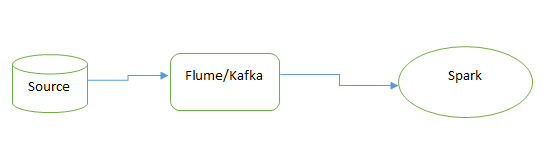
This process can be used for real-time detection of suspicious transactions, sending real-time offers, and similar use cases.
Q10. Can we use Spark for the ETL process?
Answer:
Yes, you can use the Spark platform for ETL (Extract, Transform, Load) processes.
Q11. What is Spark SQL?
Answer:
Spark SQL is a special component of Spark that supports running SQL queries.
Q12. What Lazy Evaluation?
Answer:
When working with Spark, transformations are not executed until you perform an action. This approach helps optimize data processing. Each transformation is added to a Directed Acyclic Graph (DAG), and when an action is called, Spark executes the transformations step by step.
Q13. How should I structure my answers to these questions in an interview?
Answer:
A simple and effective approach is the Definition → Explanation → Example method.
- Definition: Briefly define the concept in one or two sentences.
- Explanation: Explain how it works, why it is important, and mention key components.
- Example: Finish with a practical example from a real project or business scenario.
Example (RDD):
Definition: RDD (Resilient Distributed Dataset) is Spark’s fundamental distributed data structure for parallel processing.
Explanation: It stores data across multiple cluster nodes, supports fault tolerance through lineage, and allows transformations such as map() and filter() to execute in parallel.
Example: “In one project, we used RDDs to process several gigabytes of server log files across multiple worker nodes before loading the cleaned data into Spark SQL for reporting.”
Q14. Can you provide more real-world examples or scenarios for using Spark features?
Answer:
Here are common business use cases interviewers often discuss.
| Spark Feature | Real-World Example |
| Spark SQL | Analyze millions of sales transactions to generate daily revenue reports. |
| Structured Streaming | Monitor credit card transactions in real time to detect fraud. |
| MLlib | Build recommendation systems for e-commerce websites. |
| DataFrames | Clean and transform customer records before loading them into a data warehouse. |
| Caching | Cache frequently used lookup tables to speed up repeated queries. |
| Broadcast Variables | Broadcast a small product dimension table when joining with a large sales dataset. |
| Partitioning | Distribute large datasets evenly across executors to improve parallel processing. |
| Window Functions | Calculate running totals, rankings, and moving averages for financial reports. |
Q15. What are the most common mistakes candidates make when answering Spark interview questions?
Answer:
Interviewers frequently notice these mistakes:
- Confusing RDDs, DataFrames, and Datasets.
- Saying Spark is always “100× faster” without explaining that performance depends on the workload.
- Not understanding lazy evaluation and actions vs. transformations.
- Forgetting how partitioning affects performance.
- Ignoring shuffle operations and their performance impact.
- Unable to explain the Driver, Executor, and Cluster Manager architecture.
- Not knowing when to use cache() or persist().
- Giving only theoretical answers without practical examples.
- Forgetting Spark SQL optimization techniques such as predicate pushdown and Catalyst optimization.
- Not discussing performance tuning techniques.
Interview Tip: Whenever possible, relate your answer to a real project. Interviewers value practical experience more than memorized definitions.
Q16. Are there any advanced Spark topics or recent updates I should be aware of for 2026 interviews?
Answer:
Yes. Many companies now expect candidates to know more than basic RDD concepts.
Some important advanced topics include:
- Spark Architecture (Driver, Executors, Cluster Manager, Worker Nodes)
- Catalyst Optimizer
- Tungsten Execution Engine
- Adaptive Query Execution (AQE)
- Structured Streaming
- Delta Lake
- Apache Iceberg
- Apache Hudi
- Data Skew Handling
- Broadcast Joins
- Bucketing vs. Partitioning
- Shuffle Optimization
- Dynamic Partition Pruning
- Window Functions
- Spark on Kubernetes
- Spark with Cloud Platforms (AWS EMR, Azure Databricks, Google Dataproc)
- PySpark Performance Optimization
- Memory Management
- Checkpointing
- Fault Tolerance
- Monitoring Spark Jobs using Spark UI
Q17. You need to join a 2 GB customer table with a 20 MB country lookup table. Which join would you choose?
Answer:
I would use a broadcast join.
Broadcasting the smaller table sends it to every executor, eliminating expensive shuffle operations.
Example (PySpark):
from pyspark.sql.functions import broadcast
result = customers.join(
broadcast(country),
“country_id”
)
This significantly improves performance when one table is small enough to broadcast.
Q18. How would you design a real-time fraud detection system using Spark?
Answer:
A typical architecture would be:
Transaction Source
↓
Apache Kafka
↓
Spark Structured Streaming
↓
Fraud Detection Rules / ML Model
↓
Alerts + Database + Dashboard
Spark continuously processes incoming transactions, applies fraud-detection rules or machine-learning models, and sends alerts for suspicious activity within seconds.
Recommended Articles
We hope this EDUCBA guide on “Spark Interview Questions” was helpful. For more information, check out our recommended articles below.

