



A website can tell you about the platform’s features and the tutors. However, a detailed Cuemath review based on parent and student experiences tells the real story.
So for a Cuemath review, we took a free trial class and also read their reviews with two questions in mind:
- Are the tutors actually as patient as the platform claims?
- Does personalized learning genuinely adapt to a child?
Cuemath is one of the most popular 1:1 online math tutoring platforms, with more than 200,000 students globally and over 11 K reviews on Trustpilot, a popular public review platform in the US.
Table of Contents
- About Cuemath
- How Does Cuemath Manage Personalized Tutoring?
- What Actually Happens Inside a Class?
- Why Cuemath Believes in 1 Tutor, 1 Student?
- Cuemath Review: How 1:1 Online Tutoring Compares With Other Options
- Who Should Try Cuemath vs Who Should Not?
Key Takeaways
- Cuemath is a good option for students who want personalized 1:1 math tutoring focused on conceptual understanding rather than rote memorization.
- Parents like Cuemath for these features: tutor quality, the ability to keep the same tutor, and visible improvement in their child’s confidence.
- Cuemath definitely costs more than free self-paced apps. It requires a 3- to 6-month commitment rather than a few weeks.
- The first free Cuemath class includes a skills evaluation, so the first paid session targets a specific list of gaps rather than your child’s grade level.
- Cuemath’s pricing starts at $20 a class.
About Cuemath
Cuemath is a live, one-on-one online math tutoring program for students in kindergarten through grade 12.
Three things about Cuemath that are different from other online or 1:1 tutoring platforms:
- It teaches only math. The curriculum, tutor training, and platform tools are built for one subject.
- It is genuinely one-to-one. Not a small group of four, not a class of twelve with breakout rooms.
- The tutor does not rotate. Your child works with the same person week after week, by design rather than by luck.
The curriculum is aligned to US Common Core, Indian central education boards, and globally standardized curriculum standards.
How Cuemath Manages Personalized Tutoring?
One of the biggest findings from our Cuemath review is that personalized learning plays a major role in determining whether tutoring is effective.
Most tutoring programs assign students a tutor based on their grade, and classes begin according to the tutor’s schedule and plan.
Cuemath starts with a short evaluation during the free first class. It measures four things, based on which the tutor builds a customized learning plan aligned with the student’s goals.
| Skill | What it means |
| Fluency | Knowing facts, running procedures accurately |
| Understanding | The reason the procedure works |
| Application | Choosing the right tool for a new problem |
| Reasoning | Working logically toward an untaught answer |
That is why two children in the same grade at Cuemath are often doing different work in the same week.
What Actually Happens Inside a Class?
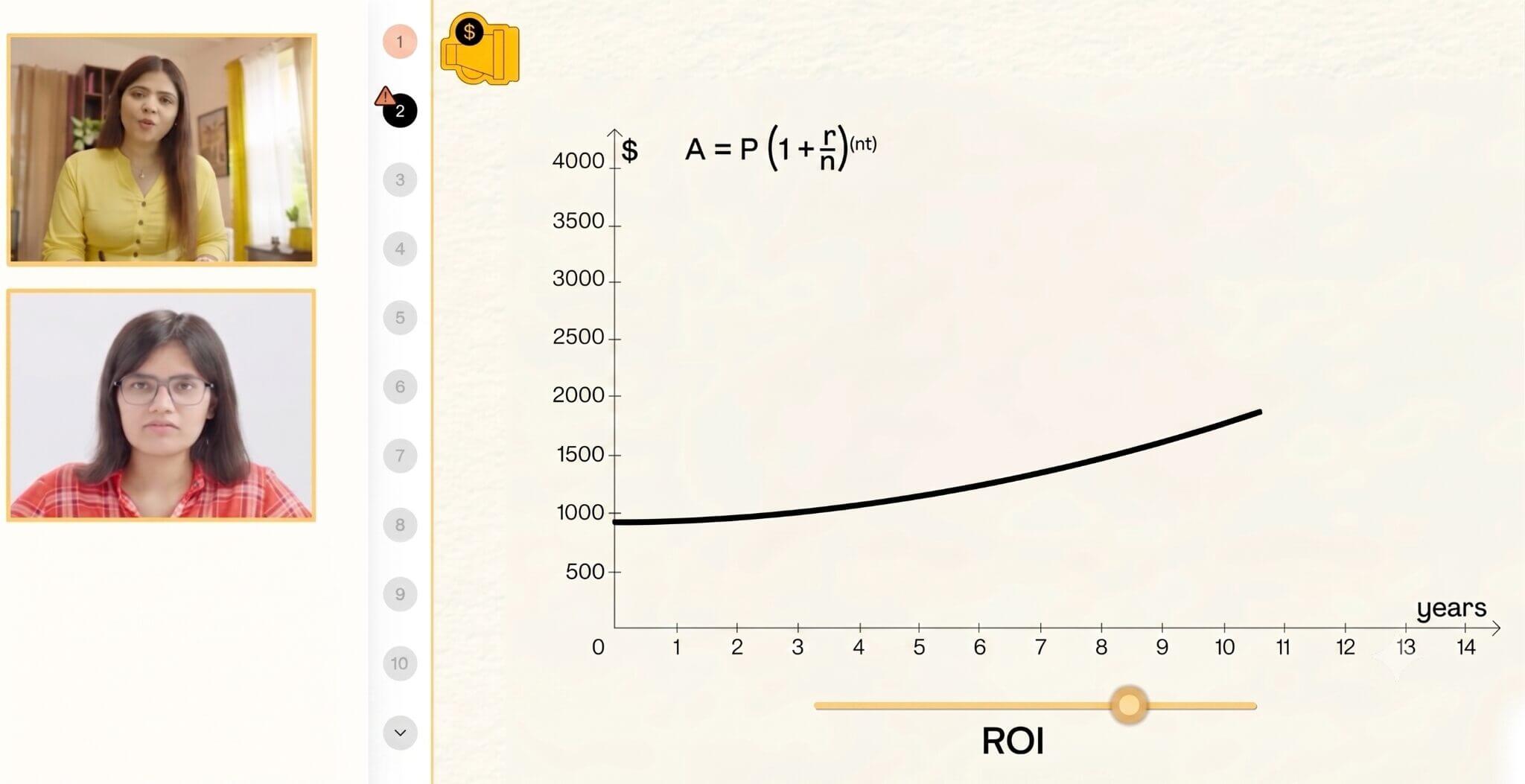
During our Cuemath review, we observed that classes take place on a shared whiteboard built into the platform, allowing tutors and students to solve problems together in real time. The tutor and your child work through problems together instead of your child watching someone else solve them.
[IMAGE: Cuemath 1:1 class on the shared whiteboard, tutor and student both solving a problem]
Cuemath tutors are trained not to hand over the answer. When a child stalls, the tutor asks a question instead: why did you pick that step, what happens if you try the other way, can you explain that back to me. It is slower than being told, and that is the point. A child who has explained a concept aloud retains it in a way a child who has copied steps does not.
The platform also tracks how much of the class your child talks about, which sounds like a gimmick until you sit through a session where the adult talks for 50 minutes and the child says 4 words.
Between classes, there is a practice app with a short daily set, plus logic puzzles and timed challenges your child can play against other students.
After every class, the tutor writes notes on what was covered and where your child struggled. Progress across the four skills appears on a parent dashboard, so you can see the trend rather than guessing from report cards.
Cuemath tutors are trained not to hand over the answer. When a child stalls, the tutor asks a question instead: why did you pick that step, what happens if you try the other way, can you explain that back to me. It is slower than being told, and that is the point. A child who has explained a concept aloud retains it in a way a child who has copied steps does not.
The platform also tracks how much of the class your child talks about, which sounds like a gimmick until you sit through a session where the adult talks for 50 minutes and the child says 4 words.
Between classes, there is a practice app with a short daily set, plus logic puzzles and timed challenges your child can play against other students.
After every class, the tutor writes notes on what was covered and where your child struggled. Progress across the four skills appears on a parent dashboard, so you see the trend instead of guessing from report cards.
Why Cuemath Believes in 1 Tutor, 1 Student?
Imagine this:
- The tutor’s patience with a child who had already decided they were bad at math
- The same tutor staying long enough to build genuine trust
- Students moving into advanced or accelerated math because of confidence
A tutor who has worked with your child for a longer time knows exactly how they like to learn, which concepts they find hard, and when to stop for the day. A tutor meeting your child for the first time spends the session finding that out. If the tutor changes every few weeks, you are paying to repeat that discovery indefinitely.
As part of this Cuemath review, we also examined real student success stories to assess the platform’s performance over time.
Vanisha, grade 6. Her scores were fine, ranging from 82% to 85%. What worried her parents was that her confidence kept slipping each term while the grades held steady. Her tutor, Madhavi Perepa, ignored the textbook’s pace and worked at Vanisha’s actual level, keeping the difficulty just within reach and ending every session with a problem she could solve. Her scores rose to a consistent 92-100% over the next two months.
“Vanisha’s grades and confidence have improved significantly since joining Cuemath. Madhvi has been very supportive and patient in developing her math skills.”
- Vanisha’s parent
Aarjav, grade 3, Ohio. His parents came in with an unusual worry. He had left a Montessori setting curious and independent, and they did not want math turning into memorization. His tutor, Neha Jain, let him sit with the concepts until they clicked, rather than handing him a procedure. He scored 818 on the Ohio State Test, the Advanced band, with above-proficient marks in all five content areas.
“She explains concepts clearly, encourages logical thinking, and helps students understand the ‘why’ behind the solution rather than simply memorizing steps.”
- Aarjav’s parent
Both cases are the same shape: a child who was not in trouble, and a gap that would have gone unaddressed because the grades looked acceptable.
Cuemath Review: How 1:1 Online Tutoring Compares With Other Options
| Option | Typical cost | Works best when | Main limitation |
| Live 1:1 online tutoring | Cuemath from $20 a class | A specific gap needs finding and fixing | Fixed weekly times; child must focus on a screen |
| In-person 1:1 tutor | About $25 an hour average, up to $100-plus | Your child cannot work online | Quality unknown until you have paid; travel eats the schedule |
| Learning center, small group | $50 to $75 an hour | Your child is motivated by other kids | Tutor split across children, so a quiet child’s gap goes unnoticed |
| Self-paced app or video library | Free to about $20 a month | Your child understands it and needs reps | Nobody notices when your child is stuck |
| Hourly tutor marketplace | $20 to $30 an hour | You need help before one specific test | Tutors change between bookings, so no continuity |
Who Should Try Cuemath vs Who Should Not?
Based on our Cuemath review and overall assessment of the program, we believe it is a strong option for most students who want to build long-term math skills. However, if your child wants instant homework help or a mentor, we think there are affordable options.
| Cuemath fits when | Look elsewhere when |
| ✓ Grades look fine, but confidence is dropping | ✕ You need several subjects covered, since Cuemath does math only |
| ✓ Word problems and reasoning are where things fall apart | ✕ You want tonight’s homework finished, not concepts taught slowly |
| ✓ Previous tutoring failed because the tutor kept changing | ✕ Your child cannot hold attention on a screen for 55 minutes |
| ✓ Your child is ahead, and school is no longer stretching them | ✕ Two fixed weekly class times will not fit your family |
| ✓ You want to know what the gap is, not just add practice | ✕ You want a two-week trial, since the shortest plan is three months |
| ✓ You can commit three months and two slots a week | ✕ A free practice app already meets the need |
Since the first class is free and includes the evaluation, you can find out where your child stands before spending anything. The tutor walks you and your child through the results at the end, so even if you decide against enrolling, you leave with a specific list of gaps instead of a vague worry. You can book the free class on Cuemath’s website.
Overall, this Cuemath review shows that the platform stands out for its personalized one-on-one tutoring, consistent tutor assignments, and structured learning plans. While it requires a longer commitment than many alternatives, it can be a worthwhile investment for students who need sustained support in math.
Final Thoughts
Choosing the right tutoring platform depends on your child’s learning style, academic goals, and the type of support they need. Based on this Cuemath review, the platform stands out for its personalized one-on-one instruction, consistent tutor assignments, and focus on building conceptual understanding rather than memorization. While it requires a longer commitment than some alternatives, the free trial class and detailed skill assessment allow parents to evaluate its approach before enrolling. For families seeking structured, long-term math support, Cuemath is a strong option.
Frequently Asked Questions (FAQ’s)
Q1. Is Cuemath worth the money?
Answer: According to our Cuemath review, the platform is worth the money if your child needs concept-focused, personalized math tutoring rather than additional practice alone. At $20 a class, it is comparatively more affordable than most private tutoring options while giving you a math specialist one-to-one.
Q2. How much does Cuemath cost per month?
Answer: Cuemath charges per class rather than per month, with two classes a week on every plan. Cuemath classes, on average, start at $20 per class. For better details on pricing and plans, we recommend checking the Cuemath pricing section.
Q3. Is Cuemath better than a local math tutor?
Answer: Cuemath and a good local tutor do similar work, and the difference lies mostly in what you can verify before paying. With a local tutor, you usually cannot judge teaching quality until several paid sessions in, and travel time caps how often it happens. Cuemath gives you a free first class, written notes after every session, and a progress dashboard. If your child genuinely cannot learn over a screen, a local tutor is still the better choice.
Q4. What grades does Cuemath cover?
Answer: Cuemath covers kindergarten through grade 12 and is aligned with the Common Core and individual state standards. It runs from early number sense through algebra, geometry, and advanced high school math, including precalculus and calculus. Students in grades 8 to 12 on the longer plans also get SAT prep and other test prep for free.
Recommended Articles
We hope this Cuemath review helps you determine whether this online math tutoring platform is the right fit for your child’s learning needs. For these recommended articles to learn more about online learning, personalized education, and how to select the right tutoring platform for your child’s academic growth.

