
What is Order-to-Cash?
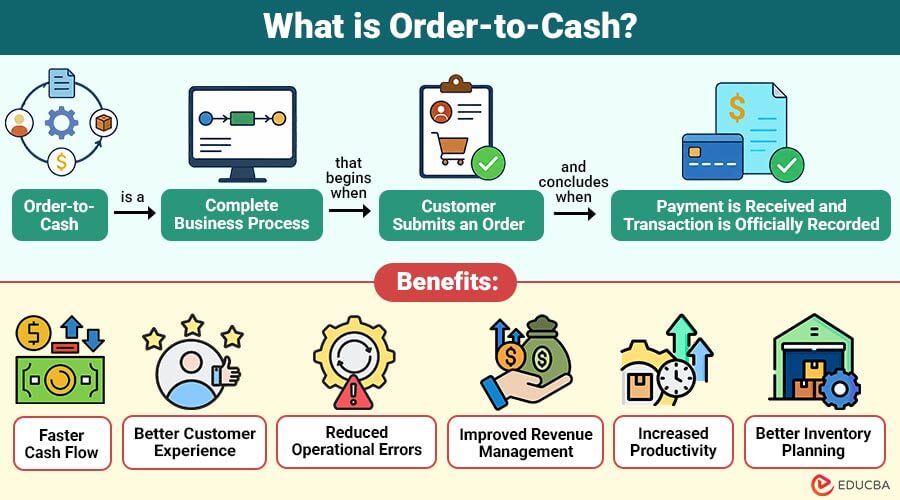
Order-to-Cash (O2C) is a complete business process that begins when a customer submits an order and concludes when payment is received and the transaction is officially recorded. It includes order management, inventory verification, order fulfillment, shipping, invoicing, payment collection, and financial reporting.
The Order-to-Cash process helps businesses deliver products or services efficiently while ensuring accurate billing and timely payments. Since it involves sales, finance, logistics, and customer service, O2C plays a vital role in improving customer satisfaction, cash flow, and operational efficiency.
Businesses across manufacturing, retail, healthcare, logistics, e-commerce, and service industries rely on an efficient order-to-cash process to reduce delays, minimize errors, and improve overall financial performance.
Table of Contents:
- Meaning
- Importance
- Stages
- Key Components
- Benefits
- Common Challenges
- Technologies
- Industries that Use Order-to-Cash
Key Takeaways:
- Order-to-Cash streamlines customer orders, fulfillment, invoicing, payments, and financial reporting for efficient business operations.
- Cash flow, customer satisfaction, operational effectiveness, and overall firm profitability are all routinely improved by an efficient O2C process.
- Automation using ERP, AI, and RPA significantly reduces errors, accelerates processes, and enhances financial visibility.
- Manufacturing, retail, healthcare, logistics, and e-commerce industries rely on O2C for efficient revenue management.
Why is Order-to-Cash Important?
The Order-to-Cash process directly affects both customer experience and business profitability. Every successful order contributes to revenue, making it essential for organizations to manage each step accurately.
A well-managed O2C process helps businesses:
1. Improve Cash Flow
Faster invoice processing and timely customer payments improve cash flow, strengthen liquidity, and effectively support daily business operations.
2. Deliver Products on Time
Efficient order processing and coordination ensure products reach customers on schedule, consistently improving reliability and overall customer trust.
3. Reduce Billing Errors
Accurate invoicing minimizes billing errors, prevents payment disputes, reduces delays, and significantly improves overall financial transaction accuracy.
4. Increase Customer Satisfaction
Timely deliveries, accurate invoices, and smooth order fulfillment create positive customer experiences, encouraging loyalty and repeat business opportunities.
5. Maintain Accurate Financial Records
Proper documentation and transaction tracking ensure accurate financial records, simplify audits, and support informed business decision-making processes.
6. Improve Collaboration Between Departments
Better coordination among sales, finance, warehouse, and customer service teams improves efficiency and reduces communication gaps effectively.
Stages of the Order-to-Cash Process
The Order-to-Cash (O2C) process consists of several connected stages that ensure smooth order fulfillment and timely payment collection.
1. Order Placement
The customer places orders with product, quantity, delivery, and payment details for accurate processing.
2. Order Verification
The business verifies customer information, pricing, inventory availability, and payment terms carefully before approval.
3. Inventory Check
Inventory availability is confirmed to prevent stock shortages and fulfillment delays before processing orders.
4. Order Fulfillment
The warehouse picks, packs, and prepares products accurately for timely shipment to customers.
5. Shipping and Delivery
Products are shipped promptly and delivered safely to customers within the committed delivery schedule.
6. Invoice Generation
Accurate invoices are generated, with pricing, taxes, payment terms, and due dates clearly stated.
7. Payment Collection
Customers make payments in accordance with agreed terms, completing the sales transaction promptly and successfully.
8. Payment Reconciliation
Received payments are matched with invoices to maintain accurate financial records and reporting consistency.
9. Financial Reporting
Completed transactions are recorded for accounting, financial analysis, compliance, and informed business decision-making processes.
Key Components of Order-to-Cash
An effective O2C process combines several business functions.
1. Order Management
Captures, verifies, and processes customer orders accurately to ensure smooth fulfillment and minimize order-related errors efficiently.
2. Customer Management
Maintains customer information, contracts, payment terms, and communication records for better service and stronger relationships.
3. Inventory Control
Monitors stock levels and product availability to effectively prevent shortages, delays, and other inventory-related issues.
4. Warehouse Operations
Manages picking, packing, labeling, and shipping to ensure consistent, accurate, and timely order fulfillment.
5. Billing
Generates accurate invoices with pricing, taxes, payment terms, and due dates to reduce billing disputes.
6. Accounts Receivable
Tracks customer payments, outstanding balances, and overdue invoices to improve collections and maintain healthy cash flow.
7. Financial Reporting
Provides insights into revenue, receivables, collections, and financial performance for informed business decision-making and planning.
Benefits of Order-to-Cash
A well-managed Order-to-Cash (O2C) process offers numerous benefits that improve cash flow, operational efficiency, customer satisfaction, and overall business performance.
1. Faster Cash Flow
Efficient invoicing and faster payment collection improve cash flow and strengthen overall business liquidity.
2. Better Customer Experience
Accurate order processing and timely deliveries increase customer satisfaction, loyalty, and repeat purchases.
3. Reduced Operational Errors
Automation reduces manual errors in order processing, invoicing, payment tracking, and data entry.
4. Improved Revenue Management
Greater visibility into sales and receivables helps businesses manage revenue more effectively.
5. Increased Productivity
Automation reduces administrative work, allowing employees to focus on higher-value business activities.
6. Better Inventory Planning
Real-time inventory tracking prevents stock shortages, overstocking, and unnecessary fulfillment delays.
Common Challenges in Order-to-Cash
Although O2C offers many advantages, businesses often encounter several challenges.
1. Manual Processes
Paper-based workflows slow operations, increase manual effort, and raise the risk of processing errors.
2. Invoice Errors
Incorrect invoices cause payment delays, customer disputes, and additional administrative work for finance teams.
3. Payment Delays
Late customer payments reduce cash flow and affect overall financial stability and business operations.
4. Inventory Issues
Inaccurate inventory records can cause stock shortages, order delays, and dissatisfied customers.
5. Poor Department Coordination
Limited communication between departments creates inefficiencies, delays, and inconsistent customer experiences.
6. Limited Visibility
Lack of real-time tracking makes monitoring orders, payments, and overall O2C performance more difficult.
Technologies Supporting Order-to-Cash
Modern businesses use digital technologies to automate and optimize the order-to-cash (O2C) process.
1. Enterprise Resource Planning
Integrates finance, inventory, sales, and operations into one centralized business management system.
2. Customer Relationship Management
Manages customer information, sales activities, and communication throughout the customer lifecycle.
3. Warehouse Management Systems
Improves inventory control, order picking, packing, and warehouse operations.
4. Transportation Management Systems
Optimizes shipment planning, carrier selection, tracking, and delivery management.
5. Electronic Data Interchange
Enables secure electronic exchange of business documents between trading partners.
6. Robotic Process Automation
Automates routine processes like processing invoices and reconciling payments.
7. Artificial Intelligence
Enhances forecasting, fraud detection, and intelligent decision-making across O2C processes.
Industries that Use Order-to-Cash
The Order-to-Cash (O2C) process is widely used across industries to manage orders, billing, and payments efficiently.
1. Manufacturing
Manages production orders, inventory, shipping, invoicing, and customer payment collection.
2. Retail
Processes customer purchases, deliveries, returns, invoicing, and payment transactions efficiently.
3. E-commerce
Automates online orders, payment processing, shipping, customer notifications, and returns management.
4. Healthcare
Handles patient billing, insurance claims, invoicing, and payment collection processes.
5. Logistics
Coordinates shipment orders, freight billing, delivery tracking, and payment reconciliation.
6. Wholesale Distribution
Supports bulk order management, inventory control, customer credit, and invoicing.
Final Thoughts
Order-to-Cash (O2C) is a vital business process that improves revenue, cash flow, and customer satisfaction. By automating O2C with ERP, AI, RPA, and cloud technologies, organizations increase efficiency, reduce errors, improve financial visibility, and support long-term business growth and profitability.
Frequently Asked Questions (FAQs)
Q1. Which departments are involved in the order-to-cash process?
Answer: The O2C process typically involves sales, customer service, finance, accounts receivable, warehouse, inventory management, logistics, and IT teams. Effective collaboration among these departments ensures smooth order fulfillment and timely payment collection.
Q2. How can businesses measure order-to-cash performance?
Answer: Businesses measure O2C performance using key metrics such as order cycle time, invoice accuracy, days sales outstanding (DSO), order fulfillment rate, payment collection time, and customer satisfaction scores.
Q3. How does order-to-cash help with regulatory compliance?
Answer: A well-managed O2C process maintains complete transaction records, accurate invoices, payment histories, and audit trails. This supports compliance with financial regulations, tax requirements, and internal governance policies.
Q4. What are the signs that an order-to-cash process needs improvement?
Answer: Common indicators include frequent order errors, delayed shipments, high invoice disputes, increasing overdue payments, poor inventory visibility, slow collections, and rising customer complaints about order fulfillment or billing.
Recommended Articles
We hope that this EDUCBA information on “Order-to-Cash” was beneficial to you. You can view EDUCBA’s recommended articles for more information.


