
What is Invoice Processing?
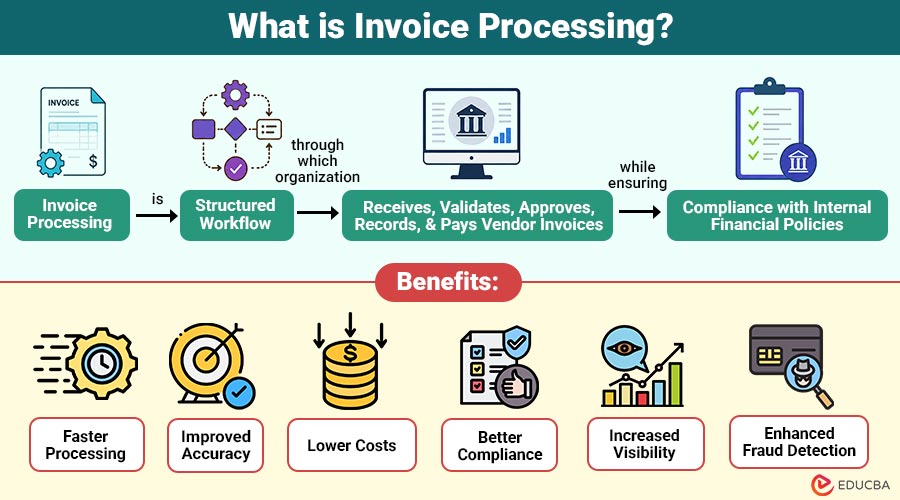
Invoice processing is the structured workflow through which an organization receives, validates, approves, records, and pays vendor invoices while ensuring compliance with internal financial policies.
The objective of invoice processing is to ensure that the suppliers are paid accurately and on time while maintaining complete financial records and preventing fraud, duplicate payments, and accounting discrepancies. It forms an essential part of the Accounts Payable (AP) function and directly impacts financial reporting, budgeting, vendor relationships, and cash flow management.
Table of Contents:
- Meaning
- Importance
- Working
- Types
- Technologies
- Benefits
- Common Challenges
- Industries that Benefit from Invoice Processing Automation
- Real-World Example
Key Takeaways:
- Invoice processing automates invoice validation, approvals, accounting, and payments for greater operational efficiency.
- Automation effectively reduces errors, duplicate payments, processing costs, and compliance risks across financial operations.
- AI, OCR, and ERP integration significantly improve accuracy, visibility, and the speed of invoice processing workflows.
- It consistently strengthens supplier relationships, cash flow management, and overall financial control.
Why is Invoice Processing Important?
Below are the key reasons why it is important.
1. Improves Financial Accuracy
Automated validation minimizes data entry errors, ensuring invoices are accurately recorded in accounting systems.
2. Enhances Cash Flow Management
Timely invoice approvals help organizations plan payments strategically and maintain healthy cash flow.
3. Strengthens Vendor Relationships
Paying suppliers on time builds trust, improves partnerships, and may provide opportunities for early payment discounts.
4. Reduces Processing Costs
Automation significantly lowers the administrative expenses associated with manual invoice handling.
5. Supports Regulatory Compliance
Invoice records are maintained accurately, simplifying audits, tax reporting, and regulatory compliance.
6. Increases Operational Efficiency
Workers dedicate more time to strategic financial operations and less time to monotonous administrative jobs.
How Does Invoice Processing Work?
It follows a simple workflow from receiving an invoice to completing payment.
1. Invoice Receipt
Invoices are received via email, paper, vendor portals, EDI, PDFs, or ERP systems.
2. Invoice Capture
OCR and AI extract key details such as vendor name, invoice number, amount, PO number, and payment terms.
3. Invoice Validation
The system verifies vendor information, tax details, the presence of duplicate invoices, purchase orders, and payment terms.
4. Purchase Order Matching
Invoice details are matched with purchase orders, goods receipts, and quality checks for accuracy.
5. Approval Workflow
Invoices are routed to authorized approvers based on amount, department, vendor, or budget.
6. Accounting Entry
Approved invoices are recorded in the ERP or accounting system and posted to relevant accounts.
7. Payment Processing
Payments are made through bank transfers, ACH, wire transfers, cheques, or digital payment methods.
Types of Invoice Processing
Organizations use different types depending on their operational needs.
1. Manual Invoice Processing
It involves receiving, reviewing, approving, and recording invoices without automation, a process that requires significant time and human effort.
2. Semi-Automated Invoice Processing
It combines automated data capture with manual approvals, improving efficiency while maintaining human oversight and control.
3. Fully Automated Invoice Processing
It uses AI and workflow automation to capture, validate, approve, record, and schedule invoice payments efficiently.
Technologies Used in Invoice Processing
Modern invoice processing combines several advanced technologies.
1. Optical Character Recognition
Optical Character Recognition converts scanned invoices and PDF documents into editable data, reducing manual data entry and processing time.
2. Artificial Intelligence
Artificial intelligence identifies invoice formats, detects anomalies, validates information, and improves processing accuracy through intelligent automation capabilities.
3. Machine Learning
Machine learning analyzes historical invoice data, continuously improving extraction accuracy, validation rules, and overall processing efficiency.
4. Robotic Process Automation
Robotic Process Automation automates repetitive invoice tasks, including data entry, approvals, notifications, and system updates, without manual intervention.
5. Enterprise Resource Planning
Enterprise Resource Planning integrates accounting, procurement, finance, and payment systems for seamless business operations.
6. Cloud Computing
Benefits of Automated Invoice Processing
Below are the key benefits mentioned:
1. Faster Processing
Automation accelerates invoice approvals, reducing processing time and ensuring faster payments across the accounts payable workflow.
2. Improved Accuracy
Automated data capture minimizes manual errors, duplicate entries, and inaccurate invoice information for reliable financial records.
3. Lower Costs
Reducing manual effort significantly lowers operational expenses, administrative costs, and overall invoice-processing costs for businesses.
4. Better Compliance
Digital audit trails effectively improve regulatory compliance, policy adherence, and financial transparency throughout financial operations.
5. Increased Visibility
Real-time invoice tracking provides better visibility into payment status, approvals, and outstanding financial obligations across departments.
6. Enhanced Fraud Detection
Automation identifies duplicate invoices, suspicious transactions, unauthorized vendors, and unusual payment activities before processing occurs successfully.
Common Challenges in Invoice Processing
Despite technological advancements, organizations still face several challenges.
1. Manual Data Entry
Manual invoice entry increases human errors, slows processing, and reduces overall accounts payable efficiency across business operations.
2. Lost Invoices
Paper invoices can be misplaced, regularly causing payment delays, missing records, and disrupted financial processes within organizations.
3. Approval Delays
Manual approval workflows slow it down, delaying payments and significantly impacting supplier relationships and operational efficiency.
4. Duplicate Payments
Duplicate invoice submissions may lead to unnecessary payments, increasing financial losses, and regular reconciliation efforts for finance teams.
5. Poor Visibility
Limited invoice tracking reduces effective visibility into approval status, payment progress, and outstanding liabilities across departments.
6. Compliance Risks
Incomplete documentation increases audit challenges, regulatory risks, and potential penalties due to noncompliance with financial reporting requirements.
7. Vendor Disputes
Delayed or inaccurate payments lead to supplier disputes, erode trust, and affect long-term business relationships with vendors.
Industries that Benefit from Invoice Processing Automation
Below are the key industries that benefit from by improving efficiency, accuracy, compliance, and financial operations.
1. Manufacturing
Manufacturing automates supplier invoices, purchase orders, and payments, improving efficiency across complex procurement and production operations.
2. Healthcare
Efficiently processes healthcare vendor invoices while maintaining regulatory compliance, financial accuracy, and consistent, timely supplier payments.
3. Retail
Retail automates high invoice volumes across stores, significantly improving payment accuracy, supplier management, and operational efficiency.
4. Banking
Banking streamlines financial operations, strengthening controls, compliance, operational efficiency, and payment accuracy across departments effectively.
5. Logistics
Logistics automates freight, transportation, and vendor operations, improving payment speed and supply chain efficiency.
6. Information Technology
Information Technology automates recurring software, hardware, and service invoices, reducing manual effort and improving payment accuracy.
Real-World Example
A manufacturing company receiving over 8,000 supplier invoices monthly replaced its manual invoice process with an automated solution integrated with its ERP system. OCR-captured invoice data, AI-validated information, and approved invoices were routed electronically for payment. As a result, the company reduced processing time, improved accuracy, lowered costs, and strengthened supplier relationships through timely payments.
Final Thoughts
Invoice processing automation improves efficiency, accuracy, compliance, and financial visibility by streamlining accounts payable workflows. Leveraging AI, OCR, machine learning, and cloud technologies enables faster payments, reduced costs, stronger supplier relationships, and better financial control, supporting sustainable business growth and long-term operational success.
Frequently Asked Questions (FAQs)
Q1. What documents are required for invoice processing?
Answer: It typically requires the supplier invoice, purchase order (PO), goods receipt note (GRN), delivery receipt, vendor details, and applicable tax documents to verify and approve payments.
Q2. How long does invoice processing usually take?
Answer: Processing time varies by organization. Manual processes may take several days or weeks, while automated invoice processing solutions can complete approvals and payments within hours or a few days.
Q3. Can invoice processing handle invoices without a purchase order?
Answer: Yes. Non-PO invoices, such as utility bills, rent, subscriptions, and professional service invoices, can be processed through predefined approval workflows and internal financial policies.
Recommended Articles
We hope that this EDUCBA information on “Invoice Processing” was beneficial to you. You can view EDUCBA’s recommended articles for more information.


