


What is SupTech?
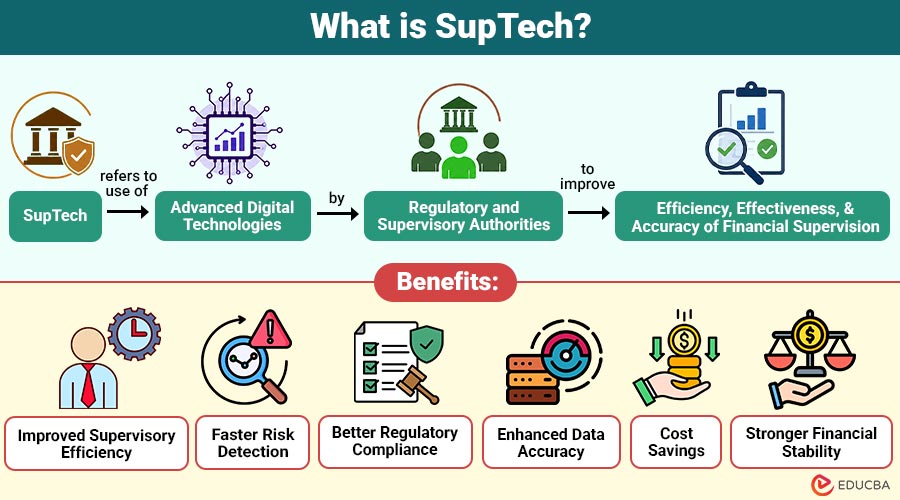
SupTech (Supervisory Technology) refers to use of advanced digital technologies by regulatory and supervisory authorities to improve the efficiency, effectiveness, and accuracy of financial supervision. It helps regulators automate data collection, continuously monitor financial institutions, detect emerging risks, and make informed regulatory decisions using data-driven insights.
Unlike traditional supervision, which relies on manual checks and regular inspections, SupTech uses automation and advanced analytics for real-time monitoring. It helps regulators identify unusual activities, track compliance, and respond quickly to financial risks.
Table of Contents:
- Meaning
- Importance
- Working
- Key Technologies
- Key Features
- Applications
- Benefits
- Challenges
- Difference
- Real-World Example
Key Takeaways:
- SupTech leverages AI and automation to improve financial supervision through real-time monitoring and data-driven regulatory decisions.
- Advanced analytics help regulators detect risks early, improve compliance, and maintain financial stability.
- Automated data collection, validation, and reporting reduce manual work and improve regulatory efficiency and accuracy.
- SupTech supports traditional supervision by enabling faster investigations, proactive oversight, and better use of regulatory resources.
Why is SupTech Important?
The following points highlight key reasons why SupTech is important for effective financial supervision.
1. Improving Regulatory Efficiency
SupTech automates supervisory tasks, making work faster while reducing delays, costs, and manual effort.
2. Enabling Real-Time Risk Monitoring
SupTech provides real-time risk monitoring, helping regulators find financial threats early before they grow.
3. Reducing Manual Supervisory Work
Automation reduces manual work, helping regulators focus on complex investigations and better supervision.
4. Detecting Suspicious Activities Earlier
Advanced analytics detect suspicious activities early, helping prevent fraud, money laundering, and compliance violations.
5. Enhancing Financial System Stability
Supervising, identifying risks early, and enabling swift action help keep the financial system stable by identifying risks early and supporting quick regulatory action.
6. Supporting Evidence-Based Regulatory Decisions
Data-driven insights help regulators make better decisions and provide more accurate, consistent supervision.
7. Increasing Transparency Across Financial Institutions
SupTech improves transparency by providing clear, reliable, and easy-to-access data from financial institutions.
How Does SupTech Work?
SupTech combines multiple digital technologies into a centralized supervisory framework.
The process generally includes:
1. Data Collection
Financial institutions submit regulatory data through secure digital platforms, APIs, automated systems, or cloud portals.
2. Data Validation
Automated tools check data for missing, incorrect, or inconsistent information before analysis.
3. Data Integration
Data from banks, payment systems, securities markets, and insurance providers is combined into a single supervisory database.
4. Advanced Analytics
Artificial intelligence and machine learning models analyze trends, identify anomalies, assess risks, and generate predictive insights.
5. Risk Assessment
Supervisors prioritize institutions that require closer attention based on automated risk-scoring models.
6. Reporting and Visualization
Interactive dashboards present key indicators, compliance metrics, and emerging risks through charts and real-time reports.
7. Regulatory Action
Based on SupTech insights, regulators investigate issues, request more information, or take supervisory actions.
Key Technologies Used in SupTech
The following technologies form the foundation of modern SupTech solutions.
1. Artificial Intelligence
AI analyzes large amounts of data, finds unusual patterns, and helps make automated decisions.
2. Machine Learning
Machine learning continuously improves risk detection by learning from historical supervisory data.
3. Big Data Analytics
Big data platforms process massive volumes of financial information from multiple institutions simultaneously.
4. Cloud Computing
Cloud infrastructure provides flexible storage, secure data sharing, and faster data analysis.
5. Robotic Process Automation
RPA automates repetitive tasks like report validation, document processing, and compliance checks.
6. Natural Language Processing
NLP extracts useful information from regulatory filings, reports, news articles, and legal documents.
7. Data Visualization
Interactive dashboards simplify complex supervisory information and improve decision-making.
Key Features of SupTech
The following features help regulators strengthen supervision through technology-driven solutions.
1. Real-Time Monitoring
Continuously monitors financial activities to detect risks, unusual activities, and compliance issues in real time.
2. Automated Reporting
Automates regulatory reporting, reducing manual work and improving reporting speed, accuracy, and efficiency.
3. Predictive Risk Analysis
AI-driven analytics predict financial risks early, helping regulators take action before problems become serious.
4. Data Quality Management
Automated data validation improves the accuracy, consistency, and reliability of regulatory reporting.
5. Centralized Supervision
Brings different supervisory tasks together on one platform to improve coordination, monitoring, and efficiency.
6. Risk-Based Supervision
Helps regulators focus on high-risk institutions, making supervision more efficient and effective.
7. Scalable Infrastructure
Cloud-based systems handle growing regulatory data while providing better performance, flexibility, security, and scalability.
Applications of SupTech
SupTech is transforming supervision across various sectors of the financial industry.
1. Banking Supervision
Regulators use automated tools to monitor capital, liquidity, lending, and operational risks more effectively.
2. Anti-Money Laundering
SupTech detects suspicious transactions and helps regulators improve anti-money laundering monitoring.
3. Insurance Supervision
Supervisory authorities assess solvency, claims management, risk exposure, and regulatory compliance across insurance companies efficiently.
4. Securities Market Oversight
Market surveillance detects insider trading, market manipulation, unusual transactions, and rule violations in real time.
5. Fintech Supervision
Regulators oversee fintech companies, payment providers, digital banks, and emerging financial technologies through automated monitoring systems.
6. Cybersecurity Monitoring
SupTech detects cyber threats, checks security measures, and improves cybersecurity in financial institutions.
Benefits of SupTech
SupTech offers numerous benefits that improve the efficiency and effectiveness of financial supervision.
1. Improved Supervisory Efficiency
Automation reduces manual work, speeds up supervision, and improves the efficiency of regulatory processes.
2. Faster Risk Detection
Real-time analytics help detect financial risks early, allowing regulators to respond quickly and take timely action.
3. Better Regulatory Compliance
Continuous monitoring helps financial institutions follow regulations and maintain strong governance practices.
4. Enhanced Data Accuracy
Automated data checks reduce errors, improve consistency, and provide reliable information for better regulatory decisions.
5. Cost Savings
Digital supervision reduces costs by minimizing manual work, paperwork, and time spent on regulatory activities.
6. Stronger Financial Stability
Early risk identification helps regulators detect problems sooner, protect financial stability, and take timely action before issues become serious.
Challenges of SupTech
Despite its advantages, SupTech implementation presents several challenges.
1. Data Quality Issues
Poor-quality data reduces accuracy, making it harder to identify risks and make better decisions.
2. Legacy Systems
Outdated supervisory systems often struggle to integrate efficiently with modern digital technologies and advanced analytical platforms.
3. Cybersecurity Risks
Sensitive financial data needs strong security to protect it from cyber attacks, data breaches, and unauthorized access.
4. High Initial Investment
Developing advanced SupTech platforms requires substantial financial investment in technology, infrastructure, implementation, and ongoing maintenance activities.
5. Skills Shortage
Regulators need experts in AI, data analysis, cybersecurity, and data science.
6. Privacy Concerns
Managing confidential financial information requires strict, consistent compliance with privacy regulations and comprehensive data protection frameworks.
Difference Between SupTech and RegTech
Although often mentioned together, SupTech and RegTech serve different purposes.
| Feature | SupTech | RegTech |
| Primary Users | Regulatory authorities | Financial institutions |
| Main Objective | Improve supervision | Improve compliance |
| Focus | Regulatory oversight | Regulatory compliance |
| Technology | AI, analytics, automation | Compliance automation |
| Data Usage | Supervisory monitoring | Internal compliance management |
| Outcome | Better financial supervision | Easier regulatory compliance |
Real-World Example of SupTech
This real-world example illustrates the benefits of using SupTech in modern regulatory environments.
A central bank receives daily transaction reports from many commercial banks. Instead of checking each report manually, a SupTech system automatically checks the data, finds unusual transactions, calculates risk levels, and identifies banks that may have compliance issues. Supervisors use easy-to-read dashboards to focus on high-risk cases first. This helps them investigate problems faster, improve financial supervision, reduce manual work, and make better use of their resources.
Final Thoughts
SupTech uses AI, automation, big data, and real-time analytics to help regulators improve financial supervision, detect risks early, ensure compliance, and maintain stability. As digital finance grows, SupTech enables faster, transparent, and data-based monitoring, creating a stronger and future-ready financial regulatory system.
Frequently Asked Questions (FAQs)
Q1. Why is SupTech becoming essential for modern financial regulators?
Answer: Growing digital financial ecosystems generate massive amounts of data. SupTech enables regulators to analyze this information efficiently, identify emerging risks faster, and strengthen oversight through technology-driven supervision.
Q2. Can SupTech replace traditional financial inspections?
Answer: No. SupTech complements traditional inspections by automating routine supervisory tasks and providing continuous monitoring, while human supervisors continue handling complex investigations and regulatory judgments.
Q3. Is SupTech useful only for large financial regulators?
Answer: No. Regulators of all sizes can use SupTech to improve supervision, use resources efficiently, monitor financial institutions better, and manage regulatory work more effectively.
Recommended Articles
We hope that this EDUCBA information on “SupTech” was beneficial to you. You can view EDUCBA’s recommended articles for more information.


