


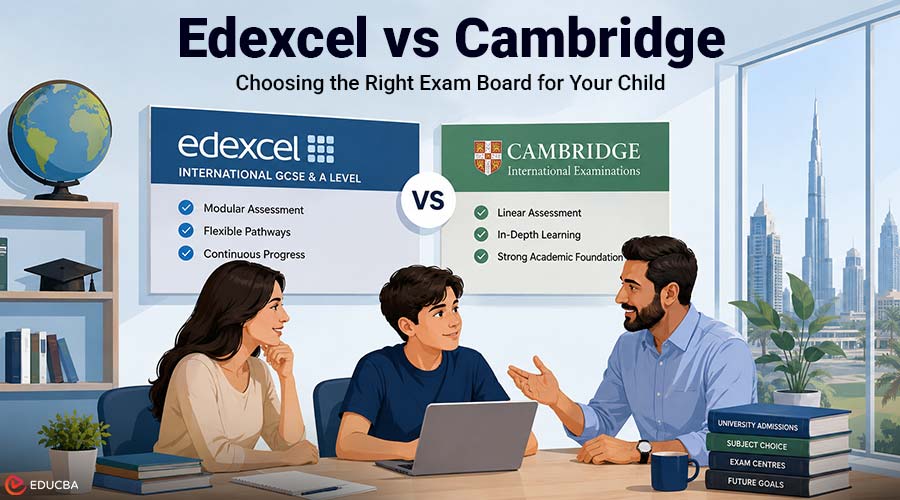
For a parent in Dubai, Doha, or Riyadh, the first real decision in a child’s secondary education is rarely the school itself. It is the exam board. Long before university applications begin, families across the Gulf find themselves choosing between two systems that look almost identical on the surface but behave very differently beneath the surface. Edexcel vs Cambridge is one of the most common comparisons among GCC families following the British curriculum. Both lead to internationally recognized IGCSE and A Level qualifications.
Universities in the UK, the United States, and the GCC accept both. Yet the choice between them quietly shapes how your child is taught, examined, and prepared for the years that follow. Most guides treat this as a simple branding question. It is not. The board you choose determines the structure of the papers, the availability of certain subjects, the location of your nearest exam center, and even the style of teaching that will suit your child best.
What Are You Actually Choosing Between?
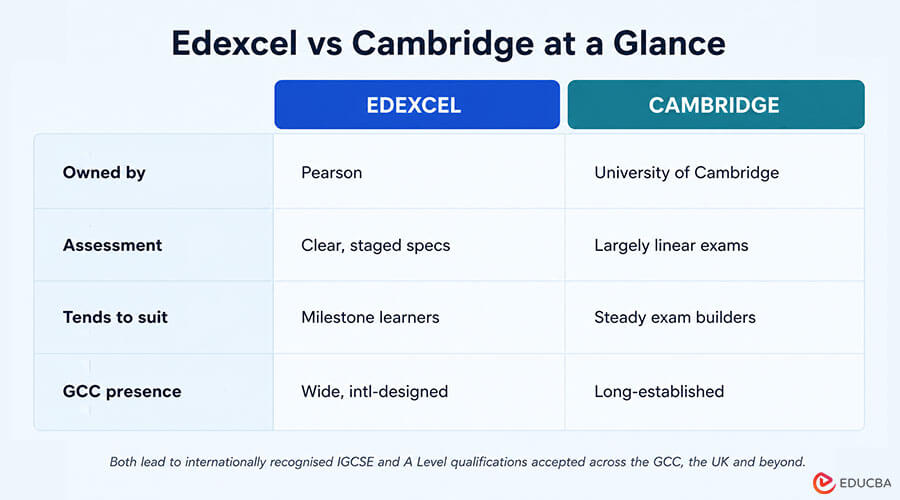
The confusion is understandable because the two boards share a common ancestry and purpose. Pearson owns Edexcel and is the only major British exam board that operates as a commercial company. Cambridge sits within the University of Cambridge and delivers its international qualifications through Cambridge International, a body with a long history in the Gulf. For most Gulf families, the practical differences only become visible once a child begins structured preparation.
This is often the point at which parents turn to specialist Edexcel and IGCSE online tutoring to bridge the gap between the board a school has chosen and the way papers are actually marked. Understanding those differences early tends to save a great deal of stress later. The mistake many families make is choosing a board by reputation alone. Reputation is not the useful signal here. What matters is fit, and fit is measurable if you know what to look at.
The Four-Factor Framework for Choosing Between Edexcel vs Cambridge
After working with families across the GCC, I have found that almost every board decision comes down to four factors, in a specific order of importance. I call it the four-factor board choice. Working through it in order prevents the most common and most expensive mistakes. The four factors are destination, subjects, logistics, and delivery. Most parents start with reputation and end up confused. Start with a destination and the rest of the decision tends to organize itself.
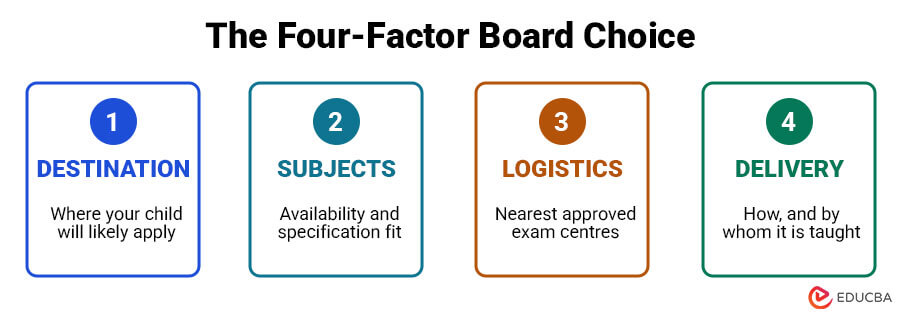
1. Destination
Begin with where your child is likely to apply, not where they are studying now. Both Edexcel and Cambridge are accepted almost everywhere, so this factor is less about acceptance and more about alignment. A child aiming for a UK university on a modular pathway may benefit from the way Edexcel structures its assessments, while a child targeting a linear, examination-heavy route may find Cambridge a more natural fit. If your child is undecided, this is not a problem. It simply means you weigh the remaining three factors more heavily, because destination is not yet a deciding force.
2. Subjects
The single most overlooked issue in the region is subject availability. Not every board offers every subject at every level, and specifications differ in ways that matter. A student who wants Further Mathematics, a specific science combination, or a particular language should confirm that their preferred board offers it before making any other decisions. Specification style matters just as much as availability. Some students perform better with the way one board sequences its content, and a strong tutor can usually tell within a few sessions which specification suits a particular learner.
3. Logistics
This is where families in the GCC feel the difference most sharply. Your child has to sit the actual papers somewhere, and exam centers are not evenly distributed across the Gulf. Before committing to a board, confirm that an approved center for it exists within a reasonable distance of your city, and check that it offers the specific subjects your child intends to take. Registration deadlines, series timing, and center capacity all vary. A board that looks perfect on paper becomes a serious problem if the nearest center for it is in another country.
4. Delivery
The final factor is how your child will actually be taught. This is where the real preparation happens, and it is the factor most families consider last, even though they should be considering it throughout. A well-chosen board taught poorly will always lose to a reasonable board taught well.
Edexcel in Practice
Edexcel, through Pearson, has built its international reputation on clear specifications and a modular philosophy in several subjects. For students who benefit from breaking a large qualification into stages, this structure can reduce pressure and allow earlier feedback on progress. In the Gulf, Edexcel is widely offered, and its International GCSE and International A Level qualifications are designed specifically for students outside the UK.
This international design shows up in small but useful ways, such as assessment scheduling and content that does not assume a UK classroom context. Families often find that Edexcel suits students who like to see measurable milestones along the way. That said, we should not overstate the modular reputation, because the board has moved several qualifications toward linear assessment, and the current specification for each subject should guide the decision.
Cambridge in Practice
Cambridge International has one of the longest footprints in Gulf education, and many established schools in the region have taught its curriculum for decades. Its qualifications are known for breadth and for a linear structure in most subjects, where students are assessed at the end of the course rather than in stages. This structure rewards students who build understanding steadily and perform well under end-of-course examination conditions.
For a self-disciplined learner with strong exam temperament, Cambridge can be an excellent match. The trade-off is that linear assessment concentrates pressure into a single series. Students who struggle with high-stakes exams may find this challenging without proper preparation and support.
A Simple Decision Process You Can Follow
The comparison becomes easier when families follow a structured process.
Step 1: Identify Future Goals
Start by considering the universities, countries, or higher education pathways your child may target. Determine whether one board aligns more naturally with those plans.
Step 2: Confirm Subject Availability
Prepare a list of subjects your child intends to study and confirm whether those subjects are available through both boards at the required level.
Step 3: Check Examination Centre Options
Identify approved examination centres for each board and confirm that they provide the exact subjects your child needs.
Step 4: Evaluate Teaching Support
Only after reviewing the first three factors should families decide how their child will receive preparation and academic support. If both boards remain suitable after these steps, teaching quality becomes the deciding factor. In many cases, the difference between Edexcel vs Cambridge matters less than having experienced teachers who understand the chosen specification.
Why Delivery Now Matters More Than the Board?
A decade ago, delivery meant finding a good teacher within driving distance. That constraint has largely dissolved. Live online lessons now give a family in Muscat or Dammam access to the same specialist teaching once limited to a handful of cities, meaning the quality of instruction is no longer tied to your postcode. This changes the whole calculation. When teachers provide quality education regardless of location, the board you choose matters slightly less, while the way they teach it matters considerably more.
A student on either board, taught in small live groups by a teacher who knows the specification intimately, will almost always outperform a student left to navigate the papers alone. For Gulf families in particular, online delivery also solves the logistics factor more quietly. Time returned from commuting becomes time available for revision, rest, and the parts of life that a full timetable usually crowds out.
What If Your Child’s School Has Already Selected a Board?
Many families in the GCC do not feel they have a free choice at all, because the school has already committed to one board. This is more common than not, and it changes the question without removing it. The decision then becomes whether the school’s board genuinely suits your child, and what to do if the fit is imperfect. If the school’s board aligns with your child’s strengths and intended destination, the framework simply confirms that you are on solid ground and that your attention can be entirely focused on delivery. If it does not align, you have three realistic options.
You can support the existing board with specialist teaching outside school hours, you can consider a private candidate route for a specific subject on a different board, or you can raise the question directly with the school before the qualification years begin. The point worth remembering is that a school’s choice is a starting position, not a verdict on your child. Many students succeed with their school’s chosen board because strong teaching matters more. Delivery, once again, carries more weight than the label on the certificate.
Final Thoughts
There is no universally correct answer to Edexcel vs Cambridge, and any guide that gives you one is selling certainty it does not have. Both boards produce students who reach excellent universities every year, from every corner of the GCC. Work through the four factors in order. Let destination and subjects narrow the field, let logistics confirm the choice is practical, and let delivery decide the rest. Choose the board that fits your child, and then invest your real energy in teaching that board effectively. That order, more than the board itself, is what separates a stressful two years from a confident one.
Recommended Articles
We hope this guide on Edexcel vs Cambridge helps GCC families make informed exam board decisions. Explore our recommended articles for more education insights and guidance.


