


Updated August 21, 2026
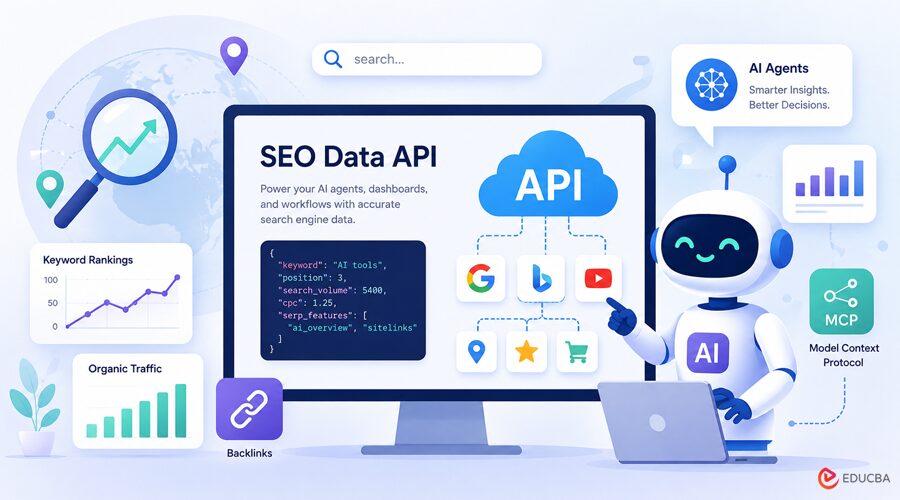
Selecting the best SEO Data API from top-tier providers depends on specific architectural needs. Whether you are building AI agents, retrieval-augmented generation (RAG) systems, or enterprise analytics platforms, choosing the right SEO Data API can significantly improve data accuracy, scalability, and automation.
- For real-time search engine tracking, SerpAPI and DataForSEO provide high speeds.
- For massive database analysis, Ahrefs and Majestic offer complete link indices.
- If you build autonomous agents, choosing a partner that supports Model Context Protocol (MCP), such as SE Ranking, simplifies pipeline execution.
Programmatic architectures rely on a stable search engine rankings API to feed retrieval-augmented generation (RAG) pipelines. Modern setups use an API for SEO metrics to avoid scraping failures. Feeding structured data directly into systems via a high-performing SEO analysis API prevents parser breakdown.
Our analysts think selecting the best SEO data API from leading SEO API providers requires careful side-by-side comparison to avoid steep overage fees and blocked requests.
How to Choose the Best SEO Data API for AI and Agent Workflows?
We think evaluating a top SEO API requires looking beyond base costs. A programmatic team must analyze the billing mechanism, rate limits, and integration options. Some developers prefer a pure pay-as-you-go model, while others want predictable monthly subscriptions.
Let us look closely at critical execution factors. Uptime, proxy rotation, and CAPTCHA bypass capabilities are vital for real-time scraping. If your system makes parallel queries, unlimited concurrency is required.
Additionally, the rise of AI agents makes native SEO API automation via the Model Context Protocol a critical selection metric. A high-quality analytics SEO API or a flexible API for SEO software should offer a hosted remote MCP server. This setup simplifies token forwarding, removing the need for custom parsing scripts.
Choosing the best API for SEO depends on whether you require a direct search engine scraper or deep database query access from premier API providers for SEO software, which represent the most reliable SEO data API providers on the market.
Best SEO Data API
Here are some of the best SEO Data API providers for developers, agencies, AI platforms, and enterprise search intelligence workflows in 2026.
1. SE Ranking: High-Performance API for SEO Metrics on a Budget
(Image Source: SE Ranking)
SE Ranking offers a versatile REST-based platform for retrieving search and audit data. Programmatic access requires a minimum deposit of $50 thanks to its pay-as-you-go pricing model. Standard subscription tiers, such as the Core tier at $103.20 per month annually or the Growth tier at $223.20 per month annually, also offer programmatic capabilities. SE Ranking is a great SEO Data API for software development teams looking to build dashboards and automate search performance reporting.
SE Ranking uses a two-tier consumption structure:
- The Project API uses up the limits of your primary subscription, making it a cost-effective choice for monitoring preconfigured keyword campaigns.
- The Data API uses separate credits on a pay-per-successful-request basis. Failed requests returning 4xx or 5xx status codes do not consume credits.
To plan costs, you must calculate credit usage. A typical query for backlink summaries across 250 domains costs 25,000 credits, as each domain check costs 100 credits. Exporting backlinks costs 1 credit per returned row. If a domain has 50,000 backlinks, exporting the full list costs 50,000 credits. The Data API functions as a dedicated SEO metrics API for real-time validation.
Our analysts note that SE Ranking supports daily rank tracking that matches manual SERP verification. This is highly useful for building client dashboards. The platform also offers specialized endpoints to track brand visibility in AI search. Their AI search leaderboard endpoint (POST /v1/ai-search/overview/leaderboard) costs a flat fee of 7,500 credits per request. It compares a primary domain against up to 10 competitors across multiple LLM engines. It returns a share-of-voice metric showing which domains have the highest visibility in AI search results.
For AI implementation, developers can deploy this tool as an SEO integration API to build automated reporting layers. It connects smoothly with n8n and Make. However, the backlink index is smaller than that of Majestic or Ahrefs. This means link data for low-authority sites can be sparse. If your software requires deep-link audits for sites with fewer than 1,000 referring domains, alternative SEO API services may offer more complete datasets.
2. Authoritas: Advanced SEO Analysis API for Enterprise Teams

(Image Source: Authoritas)
Authoritas focuses on enterprise marketing agencies, corporate brands, and software engineering teams. Their subscription tiers begin with the Essential plan at $135 per month, which includes 5 domains and 15,000 keyword credits. Their Advanced plan costs $545 per month and unlocks 35 domains, 100,000 keyword credits, and platform API access. While the Platform API is free with Advanced and Expert business plans, the Keyword Ranking (SERPs) API and the Page Structure API are billed per thousand queries, with volume-based discounts applied.
Developers can choose from three main programmatic interfaces:
- The Keyword Ranking API (SERPs API) is designed for high-volume keyword positioning checks and competitive research.
- The Platform API lets users automatically create, manage, and retrieve data from thousands of SEO projects.
- The Page Structure Content API retrieves detailed page-level data to compare ranking pages with the top 10 competing organic URLs.
This Page Structure API helps technical teams analyze what page types, such as articles, listings, or product pages, Google is prioritizing in the search results. It downloads raw page content and returns detailed analysis. This includes paragraph lengths, metadata, schema markings, and image counts across top competing URLs. Software engineers can use this programmatic endpoint as an API for SEO software to feed into AI-assisted content-writing tools.
A major feature of Authoritas is tracking brand visibility across AI engines, including ChatGPT, Gemini, Perplexity, Claude, DeepSeek, Google AI Overviews, and Bing AI search. The API tracks brand mentions, sentiment, and the specific source URLs that LLMs rely on and cite, helping brands earn their place in AI-generated answers. This makes it a preferred tool for SEO API automation of multi-channel brand visibility tracking. It replaces manual spreadsheet tracking with direct programmatic feeds.
3. Majestic: Top SEO API for Link Intelligence and Topological Authority
(Image Source: Majestic)
Majestic is a specialized link intelligence engine that tracks domain authority and backlink profiles. Their subscription tiers start with the Lite plan at $49.99 per month ($41.67 per month on annual billing), which supports 1 user and provides 1 million analysis units. The Pro plan costs $99.99 per month ($83.33 per month on annual billing) and includes 20 million analysis units, but restricts direct programmatic access. Full developer access requires the Majestic API plan, which costs $399.99 per month ($333.33 per month on annual billing). This tier includes 100 million analysis units, 20 million retrieval units, 500,000 index item units, and supports up to 5 users. Higher-volume options include API L at $799.99 per month (300 million units) and API XL at $1,599.99 per month (1 billion units).
The database contains over 3.6 trillion external links and is divided into the Fresh Index, updated daily, and the Historic Index, which dates back to 2006. The platform is famous for its proprietary metrics, Trust Flow and Citation Flow. Trust Flow measures the editorial quality and trustworthiness of referring sites, while Citation Flow measures raw topological link power based on link volume.
By integrating this tool as an analytics SEO API, developers can retrieve anchor text usage, newly added and deleted links, and referring IPs. It functions as a specialized SEO metrics API that avoids proxy management overhead. It functions as a specialized SEO software API that avoids proxy management overhead. The standard API plan allows site explorer queries to return up to 50,000 rows of data per search. It also allows developers to create OpenApps, enabling other Majestic subscribers to access custom tools built on Majestic data.
4. Zenserp: High-Speed Search Engine Rankings API for Massive Scale
(Image Source: Zenserp)
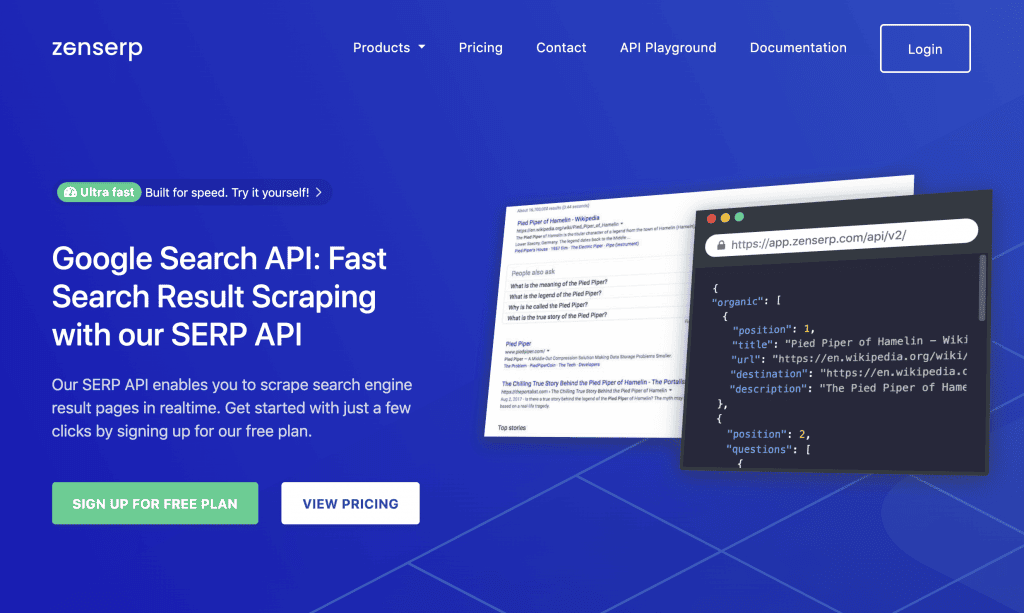
Zenserp is designed for developers requiring high-speed retrieval of search engine results. The API supports Google, Bing, Yandex, YouTube, and other search engines, returning structured JSON or CSV data. Pricing starts with a free plan of 50 searches per month. Paid plans include:
- Small: $49.99 per month for 5,000 searches ($10 per 1,000).
- Medium: $149.99 per month for 20,000 searches ($6.50 per 1,000).
- Large: $249.99 per month for 50,000 searches ($5 per 1,000).
- Premium: $499.99 per month for 120,000 searches ($4.17 per 1,000).
Annual plans offer a 20% discount.
A major feature of Zenserp is its lack of rate limits. All plans include unlimited concurrency, allowing systems to make thousands of parallel requests without encountering throttling errors. This makes it a highly scalable SEO software API that avoids proxy management overhead.
The API supports standard search, maps, shopping search, news, video results, and reverse image searches. Geolocated queries can be targeted down to specific countries and coordinates using country codes and language parameters. For AI integration, Zenserp supports Model Context Protocol workflows via a Pipedream integration, enabling autonomous agents to fetch real-time search results.
5. Bright Data SERP API: Large-Scale Unlocking and Browser Automation
(Image Source: Bright Data)
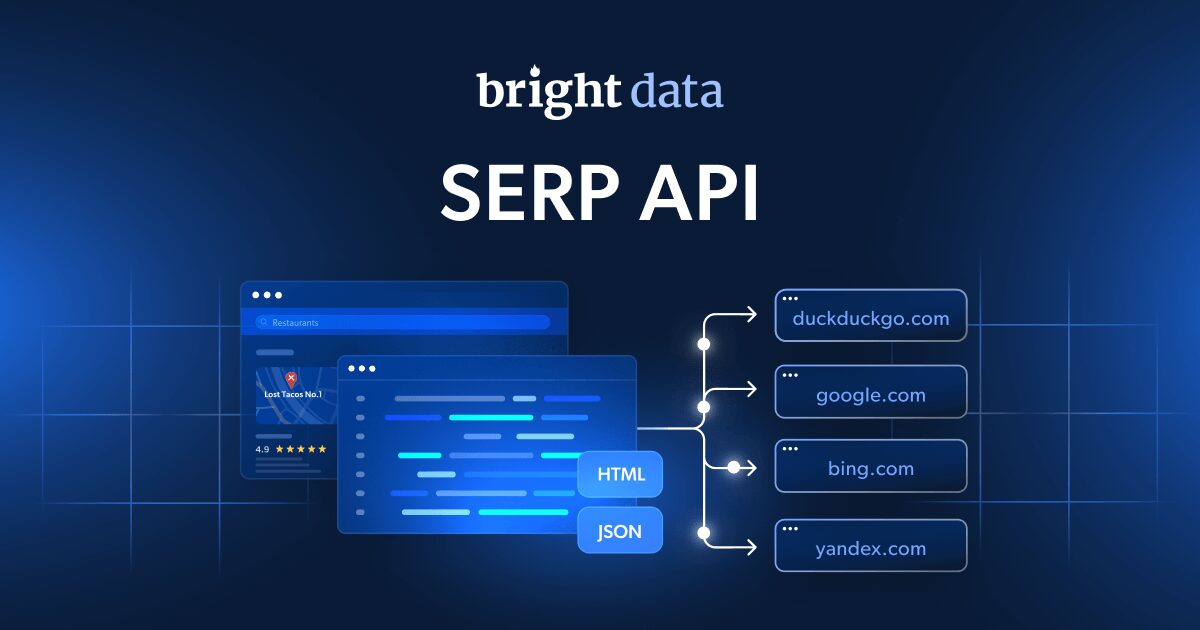
Bright Data operates the world’s largest web data extraction infrastructure, backed by over 400 million residential IP addresses across 195 countries. Their SERP API is an enterprise-grade solution that scrapes search result pages across Google, Bing, Yahoo, Yandex, and DuckDuckGo.
The pay-as-you-go pricing model starts at $1.50 per 1,000 successful requests with no monthly subscription required. Higher-volume tiers include the Growth package at $499 per month ($1.30 per 1,000 records), the Scale package at $999 per month ($1.10 per 1,000 records), and the Premium package at $1,999 per month ($1.00 per 1,000 records). Billing is calculated strictly on successful deliveries. Errored or failed requests are not billed, and no bandwidth fees are charged. Automatic proxy rotation, CAPTCHA solving, and retry logic are included in the unit price. In asynchronous mode, only the initial “send request” is billed, while follow-up polling requests are free.
Bright Data stands out as the best API for SEO for developers who need to bypass aggressive anti-bot systems. It serves as an essential API for SEO software workflows that require converting raw HTML into AI-ready Markdown. The platform provides an official Web MCP server (https://mcp.brightdata.com/mcp?token=YOUR_API_TOKEN_HERE) for Claude Desktop and other agent frameworks. The RAPId Mode (free tier) includes 5,000 free requests per month, allowing agents to conduct web searches and scrape pages as Markdown. Upgrading to Pro Mode enables browser automation and advanced web APIs, allowing agents to control remote headless browsers.
6. DataForSEO: Raw Data Power via a Flexible SEO Software API
(Image Source: DataForSEO)
DataForSEO operates on a pure pay-as-you-go billing model with a $50 minimum deposit, completely removing monthly subscription contracts. The cost per request depends on the data retrieval priority and delivery speed :
- The Standard Queue (Normal priority, up to 5-minute turnaround) costs $0.0006 per SERP request. Effective September 19, 2025, the base price covers the first page of 10 organic results.
- The Priority Queue (up to 1-minute turnaround) costs $0.0012 per request.
- The Live Method (real-time results with an average 6-second turnaround) costs $0.002 per request.
Any additional pages retrieved in the same task receive a 25% discount. For example, retrieving 10 pages in Live mode costs $0.002 for the first page, plus $0.0015 per additional page, for a total of $0.0155.
The platform serves as both a comprehensive search engine rankings API and a highly flexible SEO Data API for developers who require large-scale keyword intelligence. By using this robust system, software developers can programmatically check keyword ideas. It is highly regarded for SEO API automation because of its flat pay-as-you-go pricing structure. The platform provides specialized endpoints, such as the Backlinks API (which requires a $100 monthly minimum commitment and charges $0.02 per request plus $0.00003 per returned data row) and the Trends API ($0.001 per task).
For LLM integrations, the official DataForSEO MCP server (npx dataforSEO-mcp-server) allows AI models to query search rankings, backlinks, and on-page technical issues using plain English. The integration requires no connection fees and acts as a bridge, transforming raw data points into structured analyses and tables.
7. Serpstat: Analytics SEO API with Native Keyword Clustering
(Image Source: Serpstat)
Serpstat offers an all-inclusive search marketing platform with plans designed for freelancers, teams, and enterprises. Their Individual plan costs $69 per month and includes 5 projects and 10,000 rank-tracking checks. The Team plan costs $129 per month and unlocks 50,000 tracked keywords and access to the Search Analytics API. The Agency tier costs $499 per month, supports 30 seats, and provides 2 million API rows. For high-volume users, Serpstat offers standalone API plans starting at $180 per 1 million credits, with lower rates available for larger usage. Unused credits from these separate API plans roll over to the next billing period. No credits are deducted if a request returns an error or empty data.
Agencies can combine this tool with an API for SEO metrics to automate monthly search reports. Serpstat’s flexible endpoints function as a complete SEO analytics API for small and mid-sized agencies. A key technical advantage of Serpstat is its native keyword clustering endpoint, which programmatically groups large keyword lists based on search-result similarity. Their AI visibility tools track brand mentions, competitor placements, and visibility trends across major AI search engines and return structured query prompts. This allows developers to integrate daily search engine rankings and AI citation metrics directly into custom dashboard applications.
8. SerpAPI: Best API for SEO Rich Snippets and AI Overview Tracking
(Image Source: SerpAPI)
SerpAPI is a dedicated search engine scraping service that focuses on returning highly structured, parsed JSON data. It covers Google, Bing, Yahoo, Yandex, Baidu, YouTube, and Google Scholar. Pricing starts with a free plan of 250 searches per month. Paid tiers include Starter at $25 per month (1,000 searches), Developer at $75 per month (5,000 searches), Production at $150 per month (15,000 searches), and Big Data at $275 per month (30,000 searches). All subscriptions include US Legal Shield protection.
Independent performance benchmarks reveal that SerpAPI achieves an average response latency of 1.96 seconds and a 100% success rate. It scores a 3.8 out of 4 for output richness, parsing sitelinks, dates, People Also Ask answers, local map listings, and video snippets into structured JSON without requiring secondary requests. This makes SerpAPI a top SEO API for developers who need deep, rich snippet extraction.
Our analysts suggest that SerpAPI provides highly reliable SEO API services for capturing real-time geolocated results. SerpAPI leads the industry in AI Overview tracking, capturing AI-generated results for 68% of queried terms, complete with reference links and source attributions. They provide a hosted remote MCP server, allowing developers to connect AI agents directly to search engine results with zero configuration.
9. Ahrefs: Premium SEO Metrics API with Extensive Index Access
(Image Source: Ahrefs)
Ahrefs is famous for running one of the largest web crawlers and backlink databases in the industry, holding over 35 trillion active links. Their software tiers start at $129 per month for Lite (750 keywords, 100,000 crawl credits) and scale to $1,499 per month for Enterprise (10,000+ keywords, 5 million crawl credits). API v3 access is included with the Enterprise plan, which provides 2,000,000 monthly units. For users on Lite, Standard ($249 per month), or Advanced ($449 per month) plans, direct API access requires a separate standalone subscription. The API Standard plan costs $500 per month (500,000 rows; $1.00 per 1,000-row overage), API Plus is $2,000 per month (5 million rows), and API Premium is $10,000 per month (30 million rows).
The Ahrefs API v3 utilizes a consumption-based unit model. Every successful request has a base cost of 50 units. Default fields cost 1 unit per row. Expensive metrics, such as organic traffic data, cost 10 units per row.
Developers can deploy this robust interface as a high-performing SEO analytics API for custom dashboards. Developers can deploy this robust interface as a high-performing analytics SEO API for custom dashboards. It provides accurate authority metrics and backlink profiles directly from the source. The platform supports a remote MCP server (https://API.ahrefs.com/mcp/mcp) over Streamable HTTP. This allows AI assistants on Lite or higher tiers to securely query domain ratings, pull backlinks, or analyze keywords via natural-language conversations.
10. Semrush: Enterprise SEO Analytics API for Agency-Scale Workflows
(Image Source: Semrush)
Semrush is a standard reporting and competitive intelligence platform for marketing departments and agencies. Their pricing plans include Pro at $139.95 per month, Guru at $249.95 per month, and Advanced at $549 per month. Direct API access requires the Business plan, with API units purchased separately as consumption add-ons.
For example, pulling a report containing 1,000 organic keywords for 100 domains charges 1,000,000 API units for live data (1,000 keywords × 10 units × 100 domains). Pulling the same report from their historical index charges 5,000,000 API units (1,000 keywords × 50 units × 100 domains).
This massive dataset makes Semrush a premium SEO analysis API for tracking keyword cannibalization and competitors. Teams can build deep reporting pipelines using this native system across search and advertising. Our analysts suggest that Semrush provides highly reliable SEO API services for capturing real-time geolocated results. The platform offers an AI Visibility Toolkit as a premium add-on for $99 per month, which tracks brand performance, visibility share, and sentiment across 4 major AI engines. For local marketing, the Local Pro plan provides API access for review generation and Map Rank tracking, helping agencies manage local profiles at scale.
11. Conductor: Enterprise-Grade AEO and Search Intelligence API
(Image Source: Conductor)
Conductor is a premier enterprise-grade SEO and AEO (Answer Engine Optimization) platform built for large-scale marketing departments and technical architects. Unlike traditional scrapers, Conductor provides a unified intelligence layer that tracks brand visibility across both legacy search engines and modern AI interfaces like ChatGPT, Gemini, and Perplexity. Their pricing is geared toward enterprise needs and typically requires a custom demo to align with organizational scale.
Architects can leverage Conductor’s proprietary intelligence via several programmatic paths:
- AEO Data API: Retrieves intent signals, technical site health, and content performance data to feed into RAG pipelines and custom analytics.
- Native MCP Server: Simplifies AI agent integration by allowing models to query search visibility and citation data directly through the Model Context Protocol.
- Conductor AgentStack: Provides a suite of developer tools and turnkey agents to automate the workflow from visibility insight to content execution.
Our analysts note that Conductor is particularly strong for teams needing to monitor brand sentiment and source attributions in AI-generated answers. While many tools focus solely on keyword rankings, Conductor connects these metrics to traffic and revenue, making it a robust SEO software API for organizations looking to win the transition to generative search.
Final Thoughts
Choosing the right SEO Data API depends heavily on your system’s operational design. Whether you need real-time SERP scraping, backlink intelligence, AI visibility tracking, or enterprise analytics, the best SEO Data API should align with your architecture, scalability requirements, and budget. Top solutions:
- SE Ranking is the best SEO data API overall, offering a pay-as-you-go pricing model with a $50 minimum deposit.
- For raw scraping speed and high-fidelity parsing of rich snippets, SerpAPI and Bright Data excel.
- If the engineering goal is populating an enterprise analytics platform with raw, high-authority backlink metrics, Ahrefs and Majestic are the industry-standard SEO data API providers.
- For startups and budget-conscious developers, DataForSEO offers a highly flexible pay-as-you-go model that eliminates monthly subscription lock-ins.
- While Semrush and Ahrefs are excellent, they are not always the right fit for specialized workflows compared to other top SEO API providers.
Integrating these services into your stack enables scalable SEO API automation, transforming raw search indexing data into real-time, actionable business intelligence. Deploying a unified SEO integration API simplifies pipeline maintenance. When selecting the best SEO data API, your decision should align with your specific architectural limits and data budget.
Frequently Asked Questions (FAQs)
Q1. How does a modern SEO integration API handle geolocated searches?
Answer: A modern SEO integration API uses specific location parameters, such as canonical country codes, coordinates, or postal codes, to emulate local user requests. Scrapers route queries through proxies localized to target municipalities. This ensures that retrieved organic positions, local pack coordinates, and ad placements precisely match real search views.
Q2. What are the key differences between the best SEO API providers for real-time scraping vs. database indexing?
Answer: The key differences among the best SEO API providers lie in their data retrieval mechanisms. Real-time scraping interfaces query live search engines dynamically and parse HTML on demand. They are prone to blocking if proxy rotation is poor. Index-based services read pre-scraped, structured tables stored in historical databases. This avoids scraper blocks but limits data freshness.
Q3. Why do some SEO data API providers charge per returned row instead of per request?
Answer: Some SEO data API providers charge per returned row to align their billing with database processing costs. Deep queries, such as full backlink lists or broad keyword sets, require scanning millions of index rows. This consumes substantial cloud infrastructure power. Charging per row prevents budget deficits on high-volume queries.
Recommended Articles
We hope this guide on SEO Data APIs helps you choose the right solution for your AI agents, automation workflows, and search intelligence needs while improving access to accurate, scalable SEO data. Explore our recommended articles below to learn more about SEO automation, AI-powered search, data integration, digital marketing analytics, and enterprise SEO strategies.

