
What is XDR (Extended Detection and Response)?
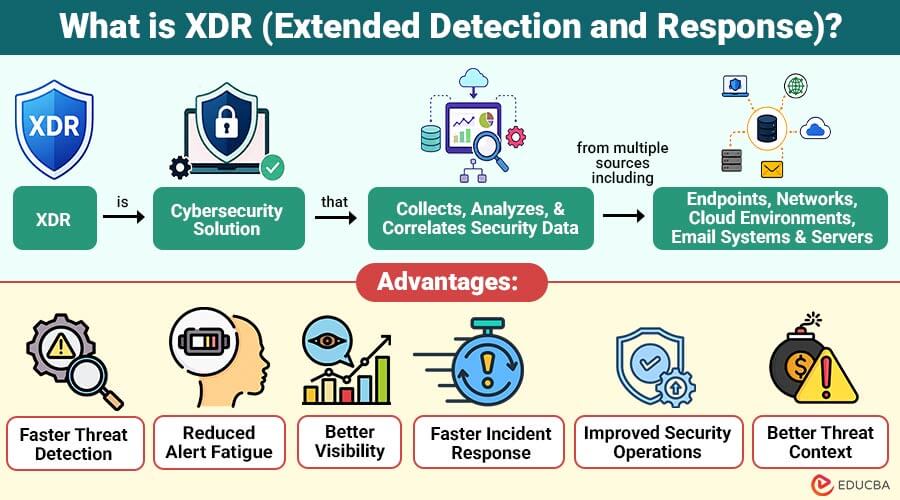
XDR is cybersecurity solution that collects, analyzes, and correlates security data from multiple sources, including endpoints, networks, cloud environments, email systems, and servers. From a centralized platform, it investigates, detects, and reacts to cyber threats using automation and artificial intelligence.
Unlike traditional security tools that operate independently, XDR provides complete visibility across an organization’s IT environment, enabling faster threat detection and incident response.
Table of Contents:
Key Takeaways:
- XDR unifies security data from multiple sources to improve threat detection and enable faster incident response.
- XDR uses AI-driven analytics to effectively identify, investigate, and respond to sophisticated cyber threats.
- XDR reduces alert fatigue by correlating security events into meaningful incidents for analysts.
- XDR enhances cybersecurity operations through centralized visibility, automation, and proactive threat management capabilities.
Why is XDR Important?
Modern organizations use multiple security solutions from different vendors. Managing them separately creates security gaps and increases response time.
XDR helps organizations by:
1. Detecting Sophisticated Attacks
Identifies advanced cyber threats across endpoints, networks, cloud, email, and identity systems before significant damage occurs.
2. Reducing Alert Fatigue
Correlates related security alerts into single incidents, reducing unnecessary notifications and analyst workload significantly every day.
3. Providing a Centralized View
Combines security information from several sources into one dashboard to make incident handling and monitoring easier.
4. Automating Threat Investigation
Automatically investigates suspicious activity and initiates predefined response actions, significantly reducing manual effort and response times.
5. Improving Visibility
Provides comprehensive visibility across on-premises, hybrid, and cloud environments for stronger security monitoring and threat detection.
6. Faster Cyberattack Response
Enables security teams to identify, investigate, contain, and remediate cyberattacks quickly before widespread organizational impact occurs.
How Does XDR Work?
The XDR workflow includes several stages.
1. Collect Security Data
XDR gathers logs and security events from various sources, including:
- Endpoints
- Servers
- Firewalls
- Cloud platforms
- Email gateways
- Identity systems
- Applications
- Network devices
2. Normalize the Data
The collected information comes in different formats. XDR converts the data into a standardized format so that events from different systems can be analyzed together.
3. Correlate Events
Instead of treating alerts separately, XDR links related events across different systems.
For example:
- Suspicious email received
- Malicious attachment opened
- Malware installed
- Endpoint connects to a malicious server
XDR combines these activities into a single incident.
4. Detect Threats
Using AI, machine learning, behavioral analytics, and threat intelligence, XDR identifies:
- Malware
- Ransomware
- Phishing attacks
- Insider threats
- Credential theft
- Lateral movement
- Zero-day attacks
- Command-and-control communications
5. Investigate Incidents
Security analysts receive detailed information, including:
- Attack timeline
- Affected systems
- Root cause
- Attack path
- Risk level
- Recommended actions
This speeds up investigation.
6. Automated Response
Depending on company policies, XDR can automatically do the following:
- Isolate infected devices
- Block malicious IP addresses
- Disable compromised user accounts
- Stop malicious processes
- Remove malware
- Alert security teams
- Generate incident reports
Key Features of XDR
Below are the key features of XDR that help organizations improve security monitoring and threat response.
1. Unified Security Visibility
Combines security data from different sources into one dashboard for easy monitoring and faster threat analysis.
2. Cross-Domain Threat Detection
Detects coordinated cyberattacks across endpoints, networks, email, cloud, and identity systems using effectively correlated security data.
3. AI-Powered Analytics
Uses artificial intelligence and behavioral analysis to accurately identify suspicious activities, anomalies, and emerging cyber threats.
4. Automated Investigation
Automatically correlates related alerts, reconstructs attack timelines, and identifies root causes without extensive manual investigation efforts.
5. Automated Incident Response
Executes predefined response actions automatically, containing threats quickly while minimizing manual intervention and security team workload effectively.
6. Threat Intelligence Integration
Integrates global threat intelligence feeds to rapidly identify known attack indicators, tactics, techniques, and malicious infrastructure.
7. Real-Time Monitoring
Continuously monitors security events across organizational systems, enabling immediate detection and rapid response to cyber threats effectively.
Advantages of XDR
Organizations adopting XDR gain several advantages.
1. Faster Threat Detection
Identifies cyber threats earlier by simultaneously analyzing security data from multiple sources, improving overall detection accuracy.
2. Reduced Alert Fatigue
Correlates related security alerts into meaningful incidents, reducing unnecessary notifications and analyst workload significantly every day.
3. Better Visibility
Provides comprehensive visibility into endpoints, networks, cloud environments, identities, and users through centralized security monitoring.
4. Faster Incident Response
Automates threat investigation and response actions, reducing attack impact and accelerating incident containment across organizational systems effectively.
5. Improved Security Operations
Simplifies security monitoring with a single centralized platform, improving efficiency, collaboration, and overall operational effectiveness across security teams.
6. Better Threat Context
Connects related security events, helping analysts more accurately understand attack progression, affected systems, and potential risks.
Challenges of XDR
Although XDR offers many benefits, organizations may encounter several challenges.
1. Integration Complexity
Connecting multiple security tools requires careful planning, configuration, and compatibility testing across diverse technology environments.
2. Deployment Costs
Using XDR platforms can cost a lot because of software, setup, infrastructure, and regular maintenance.
3. Skill Requirements
Security teams need specialized knowledge to deploy, manage, optimize, and effectively investigate incidents using XDR platforms successfully.
4. False Positives
Despite advanced analytics, occasional false security alerts may still require manual verification and investigation by security analysts.
5. Data Privacy
Organizations must securely manage sensitive security data while ensuring privacy, compliance, and proper access controls across systems.
Common Use Cases of XDR
Below are the most common ways organizations use XDR to detect threats, strengthen security, and improve incident response.
1. Ransomware Detection
Detects ransomware attacks early, stops file encryption, reduces damage, and protects important business systems.
2. Phishing Protection
Identifies malicious emails, blocks phishing attempts, and protects users from credential theft and fraudulent activities.
3. Insider Threat Detection
Monitors user behavior to identify suspicious activities, preventing unauthorized access and potential internal security breaches.
4. Cloud Security Monitoring
Continuously monitors cloud workloads, containers, and SaaS applications to detect threats and security risks promptly.
5. Identity Protection
Detects compromised accounts, unusual login behavior, and identity-based attacks before unauthorized access causes significant damage.
6. Threat Hunting
Gives security teams the ability to proactively look for hidden dangers before attackers cause significant security incidents.
Popular XDR Platforms
Some widely used XDR platforms include:
1. Microsoft Defender XDR
Provides unified threat detection, investigation, and automated response across endpoints, identities, email, cloud, and applications.
2. Palo Alto Networks Cortex XDR
Combines endpoint, network, and cloud data to detect sophisticated attacks using advanced behavioral analytics.
3. CrowdStrike Falcon XDR
Delivers AI-powered threat detection, investigation, and response across endpoints, identities, cloud, and security tools.
4. SentinelOne Singularity XDR
Uses autonomous AI to detect, investigate, and automatically respond to cyber threats across multiple environments.
5. Trend Vision One
Provides centralized visibility, threat detection, and risk assessment across hybrid enterprise environments and cloud workloads.
6. Sophos XDR
Correlates security data from multiple sources for faster threat detection, investigation, and incident response.
7. Cisco XDR
Integrates security telemetry across networks, endpoints, email, and cloud for comprehensive threat detection capabilities.
Final Thoughts
Extended Detection and Response (XDR) strengthens cybersecurity by consolidating threat detection, investigation, and response across multiple security layers into a single platform. It improves visibility, speeds incident response, reduces alert fatigue, and enhances security operations. As cyber threats evolve, XDR provides a proactive, scalable, and efficient approach to protecting modern organizations.
Frequently Asked Questions (FAQs)
Q1. Who should use XDR solutions?
Answer: XDR is suitable for organizations of all sizes that need improved threat detection, faster response, and simplified security management.
Q2. Does XDR replace existing security tools?
Answer: No, XDR usually works with existing security solutions by integrating their data and improving overall threat detection capabilities.
Q3. Can XDR protect remote employees and devices?
Answer: Yes, XDR helps secure remote users by monitoring endpoints, identities, and network activities across distributed environments.
Q4. How does AI improve XDR capabilities?
Answer: AI helps XDR analyze large amounts of security data, identify unusual patterns, prioritize threats, and automate response actions.
Recommended Articles
We hope that this EDUCBA information on “XDR” was beneficial to you. You can view EDUCBA’s recommended articles for more information.


