


The Certified Financial Planner (CFP®) certification is one of the most respected credentials in the global financial planning industry. It is considered the gold standard for professionals who provide comprehensive financial advice in areas such as investment planning, retirement planning, tax planning, insurance, estate planning, and wealth management.
As financial markets become increasingly complex, individuals and businesses seek qualified professionals who can provide holistic financial guidance. The CFP designation demonstrates that a professional has met rigorous standards in education, examination, experience, and ethics.
Key Takeaways
- CFP® (Certified Financial Planner) is one of the most respected credentials for professionals in financial planning, wealth management, and financial advisory services.
- The certification is administered by the CFP Board and is based on four core requirements: Education, Examination, Experience, and Ethics.
- Candidates must complete CFP-approved coursework, pass the CFP exam, earn a bachelor’s degree, and fulfill professional experience requirements.
- The CFP exam consists of 170 multiple-choice questions completed over 6 hours and focuses heavily on real-world financial planning scenarios.
- Major exam topics include retirement planning, investment planning, tax planning, insurance, estate planning, and professional ethics.
- The March 2026 CFP exam recorded a 67% pass rate, with 2,927 candidates passing out of 4,391 registered candidates.
- CFP professionals can pursue careers as Financial Planners, Wealth Managers, Financial Advisors, Investment Advisors, and Retirement Planning Specialists.
- The average CFP salary in 2026 is approximately $80,000 per year, with experienced professionals often earning six-figure incomes.
- CFP certification offers benefits such as global recognition, enhanced career opportunities, higher earning potential, and increased client trust.
- To maintain certification, CFP professionals must complete continuing education requirements and adhere to the CFP Board’s ethical standards.
Table of Contents
- What is CFP?
- Why is CFP Important in 2026?
- Governing Body
- Certification Requirements
- Education Requirements
- Accelerated Pathway
- Upcoming Exam Dates & Pricing
- How to Register for the CFP Exam?
- Exam Structure
- Exam Topics
- Experience Requirement
- Financial Planning Process
- Ethics Requirement
- Certification Process Step-by-Step
- Exam Preparation Strategy
- Course Duration
- Pass Rate
- Skills You Develop
- Career Opportunities
- Salary in 2026
- CFP vs CFA
- CFP vs CPA
- CFP Continuing Education Requirements
- Advantages
- Challenges
- Who Should Pursue CFP?
- Future Outlook
What is CFP?
The Certified Financial Planner (CFP®) designation is awarded to professionals who demonstrate expertise in personal financial planning and commit to high ethical standards.
A CFP professional helps clients:
- Build investment portfolios
- Plan for retirement
- Optimize taxes
- Manage risks through insurance
- Create estate plans
- Achieve long-term financial goals
- Develop comprehensive financial strategies.
Unlike professionals who focus only on investments, CFP practitioners take a holistic view of a client’s entire financial life.
Why is CFP Important in 2026?
The importance of the CFP designation continues to grow as demand for qualified financial planners rises worldwide. In an environment marked by market volatility, retirement challenges, tax complexity, and rising wealth transfers, individuals and businesses seek professionals who can provide comprehensive financial guidance.
Several recent developments highlight the growing value of CFP certification:
- The number of CFP professionals in the United States reached a record 107,529 in 2025, reflecting a 4.3% increase over the previous year.
- More than 11,000 candidates sat for the CFP examination in 2025, the highest number in CFP Board history, demonstrating strong industry demand for the credential.
- Consumer awareness of CFP certification reached 88%, and 82% of consumers preferred working with a CFP professional when seeking financial advice.
- Research found that 94% of households working with a CFP professional feel confident about achieving their financial goals, compared with 85% of those using other advisors and 81% of individuals without professional advice.
- Nearly 73% of clients reported strong trust in their CFP professional, compared to 52% for other financial advisors.
- According to the CFP Board’s 2026 Compensation Study, CFP professionals earn approximately 11% more than comparable non-certified financial professionals, after adjusting for experience and other factors.
As financial planning evolves beyond investment management to include retirement, tax, estate, insurance, and wealth-transfer strategies, CFP-certified professionals are increasingly viewed as the benchmark for comprehensive financial advice. The designation provides credibility, enhances career opportunities, and demonstrates a commitment to ethical, client-focused financial planning.
CFP Governing Body
The Certified Financial Planner (CFP®) certification is administered by the CFP Board (Certified Financial Planner Board of Standards, Inc.), a nonprofit organization that sets the standards for financial planning professionals in the United States.
The CFP Board is responsible for establishing the certification requirements related to education, examination, experience, and ethics. It also develops the CFP exam, enforces the CFP Code of Ethics and Standards of Conduct, and oversees continuing education requirements to ensure CFP professionals maintain their knowledge and professional competency.
Through its rigorous standards, the CFP Board helps ensure that CFP professionals provide ethical, client-focused financial advice and uphold the credibility of the CFP designation worldwide.
CFP Certification Requirements (The 4 E’s)
To earn the Certified Financial Planner (CFP®) designation, candidates must meet four core requirements known as the 4 E’s of CFP Certification. These requirements ensure that CFP professionals possess the knowledge, practical experience, and ethical standards needed to provide high-quality financial planning advice.
1. Education
Complete a CFP Board-approved financial planning education program covering areas such as investments, retirement planning, insurance, taxation, and estate planning.
2. Examination
Pass the CFP exam, which tests a candidate’s ability to apply financial planning concepts and develop solutions for real-world client situations.
3. Experience
Gain relevant professional experience in financial planning to demonstrate practical skills in helping clients achieve their financial goals.
4. Ethics
Agree to adhere to the CFP Board’s Code of Ethics and Standards of Conduct, which require CFP professionals to act in their clients’ best interests and maintain high professional integrity.
Together, these four requirements ensure that CFP professionals are well-qualified to provide comprehensive and ethical financial planning services.
CFP Education Requirements
Candidates must complete:
A. CFP-Approved Financial Planning Coursework
The coursework covers:
- General Principles of Financial Planning
- Insurance Planning
- Investment Planning
- Tax Planning
- Retirement Planning
- Estate Planning
- Professional Conduct
- Financial Plan Development.
Candidates must complete their education through an approved CFP program.
B. Bachelor’s Degree
Candidates must hold a bachelor’s degree (or higher) from an accredited institution.
Important:
- The degree can be in any discipline
- It does not have to be finance-related
- Candidates may complete the degree within five years after passing the CFP exam.
CFP Accelerated Pathway
The CFP Accelerated Pathway is designed for professionals who already hold advanced credentials or academic qualifications in finance, accounting, law, or related fields. Because these individuals have already demonstrated substantial expertise, they may qualify for an alternative route to CFP certification.
Eligible candidates can typically bypass much of the standard CFP coursework and complete only the required Capstone Course before becoming eligible to sit for the CFP exam.
Professionals who may qualify for the Accelerated Pathway include those holding the following credentials or qualifications:
- Certified Public Accountant (CPA)
- Licensed Attorney
- Chartered Financial Analyst (CFA®)
- Doctor of Business Administration (DBA)
- Certified Investment Management Analyst® (CIMA®)
- D. in Financial Planning, Finance, Business Administration, or Economics
- Chartered Financial Consultant (ChFC®)
- CFP Certification from Outside the U.S. through an approved Financial Planning Standards Board (FPSB) affiliate
- Chartered Life Underwriter (CLU®).
This pathway can significantly reduce the time required to meet the CFP education requirement, making it an attractive option for experienced professionals seeking to expand their expertise in comprehensive financial planning.
CFP Upcoming Exam Dates & Pricing
The CFP® exam is offered three times each year through 8-day testing windows held in March, July, and November. Candidates can select their preferred exam date and testing location from the available Prometric testing centers.
Testing appointments are scheduled on a first-come, first-served basis, so early registration is strongly recommended to secure the best test dates and locations.
CFP Exam Fees
| Registration Type | Fee (USD) |
| Early Registration | $825 |
| Standard Registration | $925 |
| Late Registration | $1,025 |
The early-bird registration fee of $825 is available until approximately six weeks before the registration deadline. Candidates registering during the final week of registration are charged the late registration fee of $1,025.
Upcoming CFP Exam Windows
| Exam Window | Registration Opens | Education Verification Deadline |
| July 14–21, 2026 | February 18, 2026 | June 23, 2026 |
| October 29 – November 5, 2026 | June 2, 2026 | October 6, 2026 |
| March 16–23, 2027 | October 21, 2026 | February 23, 2027 |
How to Register for the CFP Exam?
Registering for the CFP® exam is a straightforward process that can be completed online through the CFP Board website.
Step 1: Create a CFP Board Account
Create a CFP Board online account if you do not already have one. Candidates who have previously registered for the CFP exam or already have an account can simply log in using their existing credentials.
Step 2: Complete the Exam Registration
Log in to your CFP Board account and navigate to the “Exam” section of your Account Dashboard. Click “Select Your Test Dates” and complete the exam registration form by providing the required information.
Step 3: Pay the Registration Fee
Submit payment for the exam registration fee through your online CFP Board account. Registration fees can be paid conveniently using a credit card.
Step 4: Schedule Your Testing Appointment
After completing your registration and payment, you will receive instructions for scheduling your exam appointment through Prometric, the CFP Board’s official testing provider.
During scheduling, you can:
- Choose your preferred testing center
- Select an available exam date within the testing window
- Pick a convenient exam time
- Confirm your testing appointment.
CFP Exam Structure
The CFP® exam consists of 170 multiple-choice questions designed to test your ability to apply financial planning concepts to real-world client situations.
| Component | Details |
| Total Questions | 170 |
| Exam Duration | 6 Hours |
| Sections | 2 Sections (85 Questions Each) |
| Format | Computer-Based Exam |
Question Types
- Stand-Alone Questions
- Individual multiple-choice questions
- Typically 2–3 sentences long
- Four answer choices
- Short Scenario Questions
- Brief client scenarios
- Usually followed by 3 related questions
- Tests practical application of concepts.
- Case Study Questions
- Detailed client cases spanning multiple pages
- Typically followed by 8–12 questions
- Simulates real-world financial planning situations.
Test Time & Breaks
- Section 1: 85 Questions (3 Hours)
- Section 2: 85 Questions (3 Hours)
- 40-minute scheduled break between sections
- Optional breaks are available during the exam.
CFP Board Practice Exam
A full-length 170-question Practice Exam is included with CFP exam registration. Valued at $249, it features retired CFP exam questions and mirrors the format and difficulty level of the actual exam.
CFP Exam Topics
The CFP exam covers eight major knowledge domains that reflect the comprehensive financial planning process.
| Domain | Weightage | Key Topics Covered |
| Professional Conduct & Regulation | 8% | CFP Code of Ethics, fiduciary duty, financial services regulations, consumer protection laws, professional standards |
| General Principles of Financial Planning | 15% | Financial planning process, financial statements, cash flow management, debt management, economic concepts, time value of money, education planning |
| Risk Management & Insurance Planning | 11% | Risk assessment, life insurance, health insurance, disability insurance, long-term care planning, annuities, insurance needs analysis |
| Investment Planning | 17% | Investment vehicles, portfolio management, asset allocation, diversification, stock and bond valuation, investment strategies, alternative investments |
| Tax Planning | 14% | Income taxation, business taxation, trusts and estates taxation, tax reduction strategies, property transactions, charitable giving |
| Retirement Savings & Income Planning | 18% | Retirement needs analysis, Social Security, Medicare, retirement plans, distribution strategies, business succession planning |
| Estate Planning | 10% | Wills, trusts, estate taxes, wealth transfer strategies, beneficiary designations, estate liquidity, special needs planning |
| Psychology of Financial Planning | 7% | Behavioral finance, client biases, communication skills, financial counseling, money conflicts, crisis management |
CFP Experience Requirement
The Experience Requirement ensures that CFP® candidates develop the practical skills needed to independently provide professional financial planning services. Candidates can complete this requirement either before or after passing the CFP exam.
There are two pathways to satisfy the experience requirement:
| Pathway | Requirement |
| Standard Pathway | 6,000 hours of professional experience related to the financial planning process |
| Apprenticeship Pathway | 4,000 hours of supervised apprenticeship experience that meets additional CFP Board requirements |
Qualifying experience must involve one or more aspects of the financial planning process, such as gathering client information, analyzing financial situations, developing recommendations, implementing strategies, and monitoring financial plans.
The experience requirement helps ensure that CFP professionals not only possess technical knowledge but also have the real-world expertise needed to deliver effective financial planning advice to clients.
CFP Financial Planning Process
Qualifying experience for CFP® certification typically involves one or more stages of the financial planning process. These seven steps guide financial planners in developing and implementing effective strategies for their clients.
Step 1: Understand the Client’s Circumstances
Gather information about the client’s financial situation, goals, resources, and personal circumstances.
Step 2: Identify and Set Goals
Work with the client to establish clear financial objectives and priorities.
Step 3: Analyze Current and Alternative Courses of Action
Evaluate the client’s current financial position and explore potential strategies to achieve their goals.
Step 4: Develop Financial Planning Recommendations
Create personalized recommendations based on the client’s needs and objectives.
Step 5: Present the Recommendations
Explain the proposed strategies and discuss how they help meet the client’s goals.
Step 6: Implement the Recommendations
Assist the client in executing the agreed-upon financial planning strategies.
Step 7: Monitor and Update
Regularly review the client’s progress and adjust the plan as circumstances, goals, or market conditions change.
CFP Ethics Requirement
The ethics requirement includes:
- Agreeing to CFP Code of Ethics
- Fiduciary commitment
- Background verification
- Fitness standards review
CFP professionals must always place clients’ interests ahead of their own when providing financial advice.
CFP Certification Process Step-by-Step
Earning the CFP® designation involves completing a series of education, examination, experience, and ethics requirements. The process is designed to ensure that CFP professionals have both the technical knowledge and practical skills needed to provide comprehensive financial planning advice.
Step 1: Complete a CFP Board Registered Education Program
Complete the required coursework through a CFP Board-approved education program. The curriculum covers key areas such as investments, retirement planning, insurance, taxation, estate planning, and financial planning principles.
Step 2: Pass the CFP® Exam
After completing the education requirement, sit for and pass the CFP® exam, which tests your ability to apply financial planning concepts to real-world client situations.
Step 3: Hold or Earn a Bachelor’s Degree
You must hold a bachelor’s degree (or higher) from an accredited institution. The degree can be in any field and may be completed within five years of passing the CFP exam.
Step 4: Gain Financial Planning Experience
Complete either 6,000 hours of professional experience or 4,000 hours of apprenticeship experience that satisfies CFP Board requirements. This experience can be obtained before or after passing the exam.
Step 5: Meet the Ethics Requirement
Submit an ethics declaration, agree to follow the CFP Board’s Code of Ethics and Standards of Conduct, and successfully complete a background check.
Step 6: Earn the CFP® Certification
Once you have fulfilled the education, examination, experience, degree, and ethics requirements, you will be awarded the prestigious Certified Financial Planner (CFP®) designation and can begin using the CFP marks professionally.
CFP Exam Preparation Strategy
A successful CFP preparation plan generally includes:
- Understand the Exam Format
Begin by familiarizing yourself with the CFP exam structure, question types, topic weights, and testing format. Understanding what to expect on exam day will help you focus your preparation on the most important areas.
- Create a Study Plan
Develop a realistic study schedule that allows sufficient time to learn, review, and practice each major topic. Many candidates spend several months preparing, with extra focus on heavily weighted areas such as retirement, investment, and tax planning.
- Build a Supportive Study Environment
Choose a quiet, distraction-free study space and establish a consistent study routine. It can also be helpful to communicate your exam goals to family, friends, and colleagues so they can support your preparation efforts.
- Take Practice Exams
Practice exams are one of the most effective preparation tools. Regularly completing mock exams and practice questions helps you:
- Identify knowledge gaps
- Improve time management
- Build confidence
- Become familiar with scenario-based and case-study questions
- Consider a CFP Review Course
Many candidates enroll in a CFP review course to reinforce key concepts and learn exam-taking strategies. Review courses can help bridge the gap between coursework knowledge and the practical application skills tested on the exam.
CFP Exam Day Strategies
A strong exam-day strategy can help you stay focused and maximize your performance on the CFP® exam.
Master Multiple-Choice Questions
- Read each question carefully before reviewing the answers.
- Eliminate clearly incorrect choices.
- Answer easy questions first and return to difficult ones later.
- Make an educated guess if unsure—there is no penalty for wrong answers.
Plan Ahead
- Arrive at the testing center 30 minutes early.
- Review check-in procedures and testing rules beforehand.
- Get a good night’s sleep and maintain a healthy routine leading up to the exam.
Familiarize Yourself with the Testing Environment
- Consider Prometric’s Test Drive program to experience the testing center before exam day.
- Practice using the exam interface to reduce anxiety and improve confidence.
Tip: Stay calm, manage your time effectively, and focus on selecting the best answer rather than rushing through questions.
CFP Course Duration
The duration varies depending on educational background.
| Candidate Type | Approximate Duration |
| Students | 12–24 Months |
| Working Professionals | 9–18 Months |
| Accelerated Path Candidates | 6–12 Months |
CFP Pass Rate
The March 2026 CFP® exam administration witnessed record participation, highlighting the growing popularity of the CFP designation among aspiring financial planners.
| Statistic | March 2026 |
| Total Registered Candidates | 4,391 |
| Total Candidates Passed | 2,927 |
| Pass Rate | 67% |
CFP Skills You Develop
A CFP professional develops expertise in:
- Financial analysis
- Investment management
- Retirement planning
- Risk assessment
- Client relationship management
- Estate planning
- Tax optimization
- Wealth preservation
- Behavioral finance
- Communication and advisory skills
CFP Career Opportunities
A CFP® certification opens doors to a wide range of careers in financial planning, wealth management, banking, insurance, and investment advisory. Because CFP professionals are trained in comprehensive financial planning, they are highly valued by financial institutions and advisory firms worldwide.
Popular Career Options for CFP Professionals
| Job Role | Primary Responsibilities |
| Financial Planner | Develop comprehensive financial plans covering investments, retirement, taxes, and insurance. |
| Wealth Manager | Manage and grow the wealth of high-net-worth individuals and families. |
| Financial Advisor | Provide personalized financial advice and investment recommendations to clients. |
| Investment Advisor | Help clients build and manage investment portfolios aligned with their goals. |
| Retirement Planning Specialist | Design retirement savings and income strategies for individuals and businesses. |
| Private Banker | Offer customized banking, lending, and wealth management services to affluent clients. |
| Insurance Advisor | Recommend risk management and insurance solutions for individuals and businesses. |
| Estate Planning Consultant | Assist clients with wealth transfer, trusts, and estate planning strategies. |
| Relationship Manager | Manage client relationships and provide financial solutions through banks and financial institutions. |
| Financial Consultant | Advise individuals and organizations on financial planning and wealth-building strategies. |
Industries Hiring CFP Professionals
CFP-certified professionals are employed across various sectors, including:
- Wealth Management Firms
- Commercial & Investment Banks
- Financial Advisory Firms
- Insurance Companies
- Asset Management Firms
- Private Banking Institutions
- Family Offices
- FinTech Companies
- Retirement Planning Firms
- Brokerage and Investment Firms
Top Recruiters
Many global financial institutions value CFP-certified professionals, including:
- JPMorgan Chase
- Morgan Stanley
- Fidelity Investments
- Charles Schwab
- Merrill Lynch
- UBS
- Wells Fargo
- Bank of America
- Goldman Sachs
- Vanguard
CFP Salary in 2026
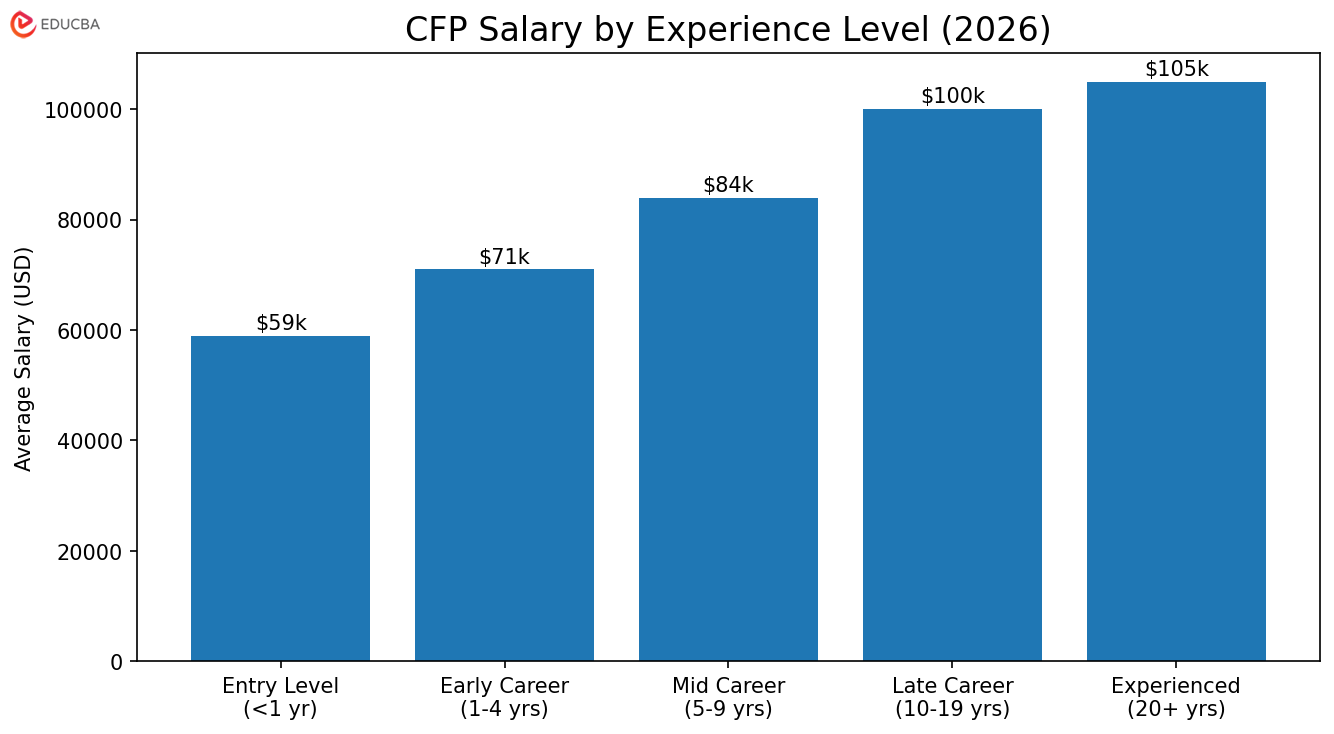
One of the major benefits of earning the CFP® designation is its strong earning potential. Salaries vary based on factors such as experience, location, employer, client assets managed, and performance-based incentives.
The average salary for a Certified Financial Planner (CFP®) in 2026 is approximately $80,000 per year.
(Data source: Payscale)
CFP vs CFA: Key Differences
| Parameter | CFP®
(Certified Financial Planner) |
CFA® (Chartered Financial Analyst) |
| Focus Area | Personal Financial Planning | Investment Management & Financial Analysis |
| Primary Objective | Helping individuals achieve financial goals | Analyzing investments and managing portfolios |
| Ideal For | Financial Planners, Wealth Managers, Financial Advisors | Investment Analysts, Portfolio Managers, Research Analysts |
| Curriculum Focus | Retirement, Tax, Insurance, Estate & Financial Planning | Equity, Fixed Income, Portfolio Management, Financial Analysis |
| Exam Structure | Single Exam (170 Questions) | Three Levels (Level I, II & III) |
| Average Completion Time | 12–24 Months | 3–4 Years (Typical) |
| Work Experience Requirement | 6,000 Hours (or 4,000 Hours Apprenticeship) | 4,000 Hours of Relevant Work Experience |
| Difficulty Level | Moderate to High | High |
| Client Interaction | Extensive Client-Facing Role | Primarily Investment & Research Focused |
| Career Path | Financial Planning & Wealth Advisory | Asset Management & Investment Research |
| Global Recognition | Strong in Financial Planning Industry | Strong in Global Investment Industry |
| Governing Body | CFP Board | CFA Institute |
CFP vs CPA: Key Differences
| Parameter | CFP®
(Certified Financial Planner) |
CPA (Certified Public Accountant) |
| Primary Focus | Financial Planning & Wealth Management | Accounting, Auditing & Taxation |
| Ideal For | Financial Advisors, Wealth Managers, Financial Planners | Accountants, Auditors, Tax Consultants |
| Client Base | Individuals and families seeking financial advice | Individuals, businesses, and organizations |
| Core Subjects | Investments, Retirement Planning, Insurance, Tax Planning, Estate Planning | Financial Accounting, Auditing, Taxation, Business Law, Regulation |
| Career Orientation | Personal Financial Planning | Accounting & Financial Reporting |
| Exam Structure | Single CFP Exam | Four CPA Exam Sections |
| Completion Time | Typically 12–24 Months | Typically 12–18 Months |
| Work Experience Requirement | 6,000 Hours (or 4,000 Hours Apprenticeship) | Varies by state jurisdiction |
| Difficulty Level | Moderate to High | High |
| Client Interaction | High | Moderate to High |
| Common Employers | Wealth Management Firms, Banks, Financial Advisory Firms | Accounting Firms, Corporations, Government Agencies |
| Global Recognition | Strong in Financial Planning | Strong in Accounting and Auditing |
CFP Continuing Education Requirements
To maintain certification, CFP professionals must complete continuing education.
Current requirement:
- 30 CE hours every two years, including ethics requirements.
Approved updates will increase this to:
- 40 CE hours every two years (38 general + 2 ethics) beginning in 2027.
Advantages of CFP Certification
- Global Recognition
CFP® is recognized worldwide as a benchmark of excellence in financial planning, making it a valuable credential for professionals seeking credibility and career growth.
- Enhanced Career Opportunities
CFP certification opens doors to roles in wealth management, financial advisory, retirement planning, private banking, and investment consulting.
- Higher Earning Potential
CFP professionals often earn higher salaries than non-certified peers due to their specialized knowledge and ability to provide comprehensive financial advice.
- Comprehensive Financial Expertise
The CFP curriculum covers investments, retirement planning, insurance, taxation, estate planning, and financial psychology, equipping graduates to become well-rounded financial professionals.
- Increased Client Trust and Credibility
Clients are more likely to trust advisors who hold a recognized professional credential and adhere to strict ethical standards.
- Flexibility Across Financial Sectors
CFP holders can work in banks, wealth management firms, insurance companies, brokerage firms, family offices, and independent advisory practices.
- Strong Networking Opportunities
Joining the CFP community provides access to a network of financial planning professionals, industry events, and continuing education resources.
- Pathway to Long-Term Career Growth
As demand for personalized financial advice continues to rise, CFP professionals are well-positioned for leadership roles and long-term career advancement.
Challenges of CFP
While the Certified Financial Planner (CFP®) designation offers significant career benefits, candidates should also be aware of the challenges involved in earning and maintaining the credential.
- Extensive Study Commitment
The CFP curriculum covers a wide range of topics, including investments, retirement planning, insurance, taxation, and estate planning, requiring substantial study time and dedication.
- Challenging Exam
The CFP exam is highly application-based and tests candidates’ ability to solve complex client scenarios rather than recall facts.
- Time-Consuming Certification Process
In addition to passing the exam, candidates must fulfill education, experience, degree, and ethics requirements, which can take several years to complete.
- Cost of Certification
Expenses such as education programs, exam registration fees, study materials, and review courses can make the CFP certification a significant financial investment.
- Continuing Education Requirements
CFP professionals must complete ongoing continuing education (CE) requirements to maintain their certification and stay current with industry developments.
- Broad Knowledge Requirement
Unlike specialized credentials, CFP candidates must develop expertise across multiple financial planning disciplines, requiring continuous learning.
- High Ethical Standards
CFP professionals are held to strict ethical and fiduciary standards and must always act in their clients’ best interests.
- Building Client Trust Takes Time
Although the CFP designation enhances credibility, developing a strong client base and professional reputation still requires experience, networking, and relationship-building.
Who Should Pursue CFP?
CFP is ideal for:
- Financial Advisors
- Wealth Managers
- Relationship Managers
- Investment Consultants
- Insurance Professionals
- Bankers
- Retirement Specialists
- Finance Graduates
- Career Changers entering financial planning.
Future Outlook for CFP Professionals
The demand for qualified financial planners is expected to remain strong as:
- Populations age
- Retirement planning becomes more complex
- Wealth transfer increases globally
- Investors seek fiduciary advice
- Financial literacy needs continue to grow.
The CFP designation remains one of the most valuable credentials for professionals seeking long-term careers in financial planning and wealth management.
Final Thoughts
The Certified Financial Planner (CFP®) certification is a premier credential for professionals seeking expertise in personal financial planning. With its rigorous standards in education, examination, experience, and ethics, CFP equips candidates to provide holistic financial advice across investments, retirement, insurance, taxation, and estate planning. For individuals aiming to establish credibility, increase earning potential, and build a successful career in wealth management, CFP remains one of the strongest professional qualifications available in 2026.
Frequently Asked Questions (FAQs)
Q1. Can I pursue CFP without a finance degree?
Answer: Yes. A bachelor’s degree is required, but it can be in any discipline. Candidates from engineering, science, commerce, arts, and other backgrounds can pursue CFP certification after completing the required financial planning education.
Q2. How many times can you take the CFP exam?
Answer: Candidates may attempt the CFP exam up to five times. If a candidate does not pass after multiple attempts, additional eligibility requirements may apply before further testing opportunities are granted.
Q3. Can CFP professionals provide investment advice?
Answer: Yes. CFP professionals are trained in investment planning and portfolio management. Many work as financial advisors, wealth managers, or investment consultants, helping clients make informed investment decisions.
Q4. Is CFP recognized internationally?
Answer: Yes. The CFP designation is recognized in multiple countries through organizations affiliated with the Financial Planning Standards Board (FPSB), making it one of the most globally respected financial planning credentials.
Q5. Can CFP professionals start their own financial planning practice?
Answer: Yes. Many CFP professionals establish independent financial planning or wealth management practices. The designation can help build credibility and attract clients seeking professional financial advice.
Q6. What is the difference between a Financial Advisor and a CFP professional?
Answer: A Financial Advisor is a broad job title that may not require a specific credential. A CFP professional has completed rigorous education, examination, experience, and ethics requirements and is held to fiduciary standards when providing financial advice.
Q7. Do CFP professionals need to renew their certification?
Answer: Yes. CFP professionals must meet continuing education requirements and comply with CFP Board standards to maintain active certification and use the CFP® marks.
Recommended Articles
We hope this guide on CFP Certification 2026 helps you understand the eligibility requirements, exam structure, career opportunities, and earning potential of becoming a Certified Financial Planner. Explore our recommended articles below to learn more about finance certifications, wealth management careers, and professional development in the financial services industry.


