


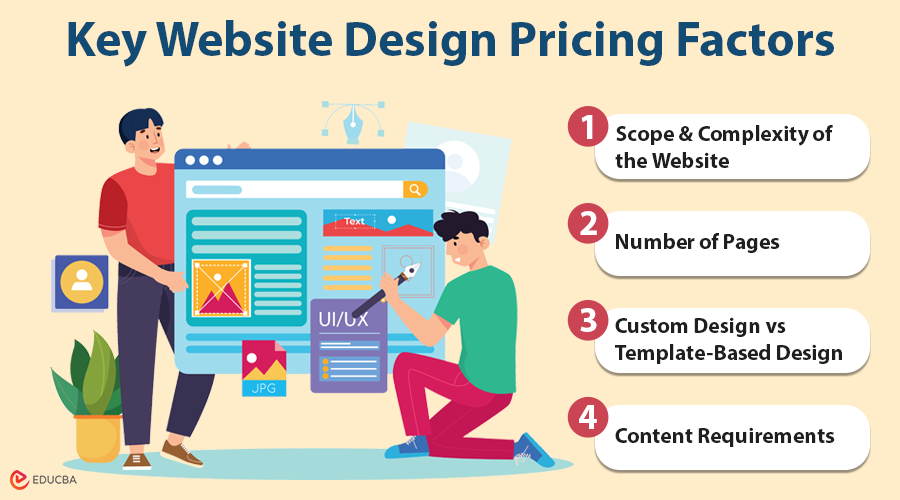
What Affects Website Design Pricing?
If you are learning about the website design process, one of the most important things to understand is how pricing works. Whether you are a freelancer, a new agency, or someone planning to outsource website design, you will need to know the website design pricing factors. This way, you can explain the value clearly to your clients and offer better price estimates for projects across the UAE.
To compete well with other freelancers or agencies in the region, it is essential to understand how different project factors influence pricing. In this article, we will break down the exact website design pricing factors. You will also learn a simple process to evaluate and quote a project more confidently.
What is Website Design and Is It Different from Website Development?
Website design is about the look and feel of a website. It includes everything related to the visual layout, user interface (UI), color schemes, typography, imagery, and how users interact with each element on the screen.
A good website design is not just about looking modern or beautiful; it is about guiding the visitor’s experience, making information easy to find, and ensuring the site is usable across devices like mobiles, tablets, and desktops.
Website development, on the other hand, is what brings that design to life. Developers take the design files and code them into a fully functioning website. This includes writing front-end code (what users see and interact with) and back-end code (what runs behind the scenes, such as databases, server integration, and user management).
While website design defines the user experience and branding, development ensures the functionality, performance, and security. Both are essential, but they require different skill sets. When you budget for a project, understand that designers and developers often price their work separately—both contribute as key website design pricing factors.
Key Website Design Pricing Factors
Designers build a website by combining planning, design thinking, content, technology, and user experience. Each of these elements can affect the total cost based on the project’s size and objectives.
Here are the key website design pricing factors. Understanding these will help you plan better, avoid unexpected costs, and offer more accurate quotes to your clients.
1. Scope and Complexity of the Website
Larger and more complex websites take more time and effort to design. A basic informational website with 4 to 5 pages is much simpler than an e-commerce platform, a booking portal, or a membership-based dashboard.
Features like dynamic content, user logins, payment systems, or multi-language support increase the level of work involved. Complexity also determines how many design layouts, wireframes, and interactions the designer needs to create. When setting your budget or quoting clients, this becomes one of the most important website design pricing factors to clarify early.
2. Number of Pages
The total number of unique page designs directly impacts the pricing. Each page may require its layout, design variations, content structure, and testing.
For example, a landing page, product page, and about page all serve different purposes and may need different design approaches. Even if some elements are reused, designing for 10 pages will take significantly more effort than designing for 3. If the client requires future scalability (like adding 50+ pages), it is also essential to plan reusable templates, which can add to the cost initially but save time later.
3. Custom Design vs Template-Based Design
Using pre-built templates can reduce design time and cost, making it a good option for smaller businesses or quick launches. However, a custom design allows full control over branding, user experience, and layout, giving a more polished and scalable outcome.
Custom design requires research, wireframing, prototyping, and multiple rounds of feedback, all of which add to the total cost. For businesses in competitive markets like Dubai, a custom design can set them apart. Here is a detailed guide from Tenet sharing complete insights on website design cost in Dubai, UAE.
4. Content Requirements
Content is a major part of website design. This includes text, images, icons, videos, and animations. If the client already has high-quality content ready, the cost is usually lower. However, if you need to write content, source images, or create visuals from scratch, the budget will increase.
Content also impacts design decisions; long-form pages need different layouts than image-heavy ones. In multilingual projects, designing for different content lengths across languages also adds complexity. Some agencies include basic content writing in their package, while others treat it as a separate add-on. Always clarify this early.
5. UX/UI Research and Strategy
If your project includes deep research into user behavior, competitor benchmarking, and conversion planning, it adds significant value and cost. UX/UI strategy involves user flows, wireframes, interaction models, and A/B testing.
These steps help make sure the final design looks good and works well for users. This is especially important for websites focused on sales, lead generation, or complex user journeys.
A strategy-first approach might seem like an added cost, but it often leads to better performance, fewer revisions, and higher ROI over time. It is ideal for projects aiming for long-term growth. You can look for leading Ui UX design agencies and get the strategy prepared.
6. Responsive and Mobile Optimization
Designing for multiple screen sizes is not optional anymore. Every website must be responsive to work smoothly on desktops, tablets, and smartphones.
However, making a design fully responsive takes extra effort. It involves adjusting layouts, font sizes, navigation, and interactions for each device type.
A mobile-optimized website may even require separate design considerations if the mobile version needs to be more focused on speed or thumb-friendly interactions. While many templates come mobile-ready, custom designs need careful adjustments, especially for feature-heavy or content-rich websites.
7. Third-Party Integrations and Features
Websites often need to connect with other tools or systems, such as CRMs, chat widgets, payment gateways, booking engines, or marketing platforms. Each integration comes with its own design and functional challenges.
For example, integrating a third-party appointment system might require custom styling to match the brand. Some features may need user interface design for forms, confirmations, and notifications. The more integrations involved, the higher the overall effort. List all required tools and plugins during the planning phase to ensure you account for them in both design and development timelines.
Final Thoughts
The UAE digital market is growing fast, and to build your mark as a freelancer or agency, you need to price your website design services wisely.
Clients expect clear value, so understanding all website design pricing factors will help you explain costs, scope projects properly, and communicate your design process with confidence.
Make sure you know what affects pricing, how to scope projects properly, and how to communicate your process with confidence. This combination of skill, transparency, and local market understanding will help you stand out and win better projects in Dubai and across the UAE.
Recommended Articles
We hope this guide on website design pricing factors helps you plan better and offer more accurate quotes for your projects. Explore these recommended articles for expert insights on web design trends, cost estimation strategies, and growing your digital presence in the UAE.

