

How Vector Search is Transforming Industry Research?
Managing and deriving insights from massive data sets is one of the challenges of data retrieval that many organizations and individuals face today.
For the same, some of the most pivotal tools have recently emerged—integrated vector search and vector database. These tools transform how organizations and individuals store, retrieve, and analyze complex data.
So, let’s learn more about vector search and vector databases and their applications and significance in industry research.
Core Concepts Explained
Let’s understand two core concepts.
1. Vector Search
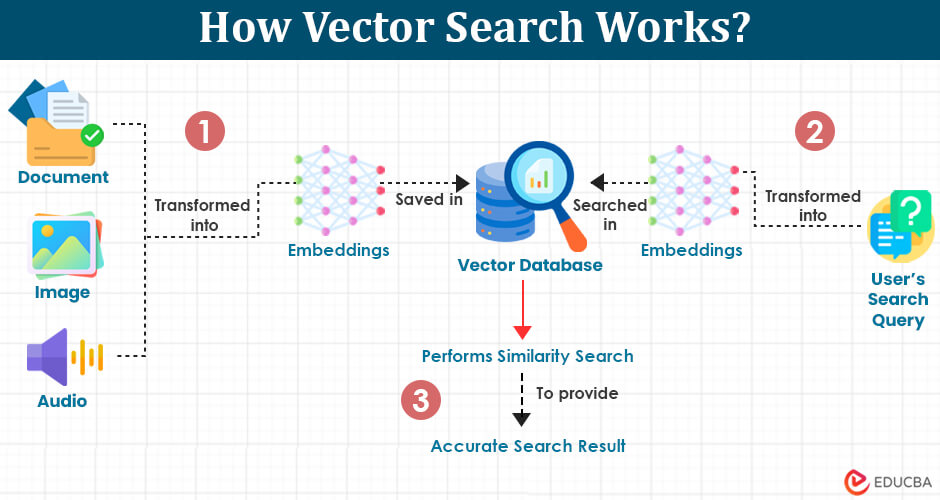
In vector search, data undergoes a process known as vector embedding to represent it as vectors. This sees words, phrases, and whole documents represented as vectors in multi-dimensional spaces. This helps search engines to understand what you are looking for, even if you don’t use the exact words.
By using math, the search engine can find things that are similar to what you are looking for instead of just matching keywords. This makes the search results more accurate and helpful.
2. Vector Databases
Vector databases are customized to store and handle vectorized data efficiently. They improve search accuracy and speed by optimizing storage and retrieval processes for this data format.
This differs from traditional databases, which struggle with semi-structured or unstructured data. Unlike traditional databases, vector databases can effectively manage various data types, including images, numerical data, and text.
Key Vector Search Applications
There are two radical applications for vector search and vector databases. These applications include machine learning advancements and enhanced information retrieval.
1. Machine Learning Advancements
Vector databases are transforming machine learning applications. They are especially transformative in training and deploying models where speedy access to pertinent information significantly improves performance and accuracy. They do this by providing a way to store and retrieve vectorized data in an efficient, structured way.
2. Improved Information Retrieval
It is changing how we find information by considering how data points relate to each other, providing incredibly relevant and accurate results. This differs from traditional search methods that sometimes give unrelated or unclear results.
Application Examples
1. E-commerce Search
An e-commerce platform like Amazon utilizes vector search to enhance product search and recommendation.
2. Healthcare and Medical Imaging
In medical imaging, vector search enables efficient retrieval and comparison of medical images for diagnosis.
3. Recommendation Systems
Streaming platforms like Netflix utilize vector-based representations of users and items to provide personalized recommendations.
4. Financial Transactions and Fraud Detection
Vector search techniques are important in banking for spotting fraudulent transactions.
For example, a bank’s fraud detection system uses these techniques to analyze transaction details like amount, frequency, and location, along with the user’s transaction history and spending habits.
By comparing each transaction’s characteristics to a database of known fraud patterns, the system can identify unusual activities, such as sudden increases in transaction amounts or transactions in unusual places. This helps the bank flag suspicious transactions for review, safeguarding customers and minimizing financial losses from fraud.
Vector Search Benefits
It brings several advantages across different fields:
1. Contextual Understanding
Thanks to vector search’s understanding of the context of different data points, it allows for more nuanced queries. This is particularly helpful in applications in which nuance and subtleties are important, such as personalized recommendations, natural language processing, and sentiment analysis.
2. Efficiency and Speed
Vector databases are good at finding similar items or documents based on these vectors. This efficiency and speed make vector databases well-suited for real-time applications that require quick responses, such as personalized recommendations, content filtering, and anomaly detection.
3. Scalability
Scalability is one of the most important benefits of vector-based search and vector databases. These databases easily allow horizontal scaling. This scalability helps to deal with huge amounts of data, such as e-commerce platforms, social media networks, and data analytics systems, where the volume of data may increase rapidly over time.
4. Content-based Search
It allows for content-based search, where items are indexed based on content features (such as text, images, or audio) rather than metadata or keywords. It enables more accurate and relevant search results, especially for multimedia data.
5. Speeds Up Machine Learning Tasks
The machine learning models often utilize vector data representations for classification, clustering, and reducing data complexity. It helps find similar items quickly, which is valuable for training, validating, and deploying models.
6. Fraud Detection
In anomaly detection, it helps identify items significantly different from most items in the dataset. It is useful in various applications, including fraud detection, network security, and quality control.
7. Improves Recommendation Systems
It plays a crucial role in recommendation systems by identifying similar items or users based on their features or behavior. It helps improve user engagement and satisfaction by providing relevant recommendations.
Challenges
Here are some of the key challenges of vector search:
1. Complex Algorithm
It cannot be implemented without complex, sophisticated algorithms. If organizations want vector search and vector databases to perform their best, they must invest in skilled individuals who can develop and maintain those algorithms.
2. Consistency and Quality of Data
The consistency and quality of data underpins the effectiveness of vector-based technologies. If there are inconsistencies or inaccuracies in the underlying data, machine learning outcomes and the reliability of vector search’s information retrieval will be compromised.
3. Constant Changes are Challenging
When the dataset is dynamic and continuously changing (e.g., real-time user-generated content), maintaining an up-to-date index and ensuring fast search performance in the face of constant updates can be challenging.
Final Thoughts
Advanced vector search technologies are important in today’s data-focused environment. They offer numerous applications that can revolutionize industry research. Most importantly, these technologies can significantly benefit organizations and their clients.
Recommended Articles
We hope this article on “Vector Search” was helpful to you. You can also refer to the articles below to learn more.

