


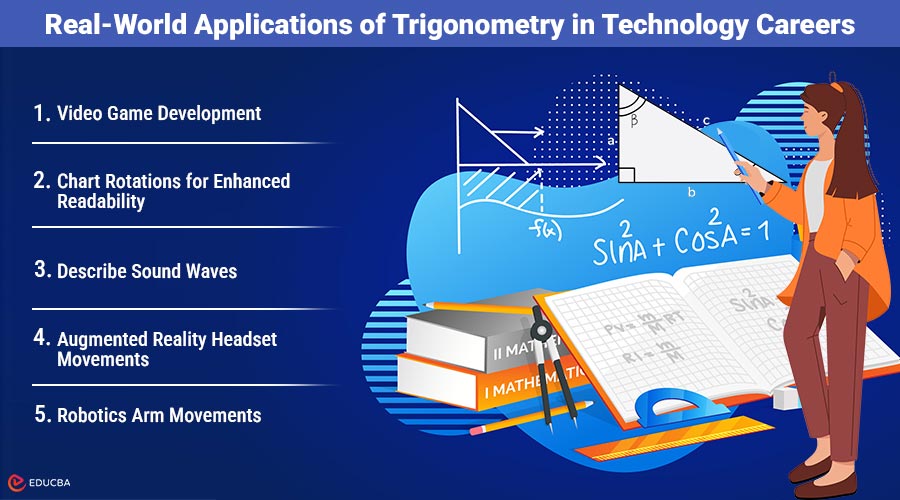
How Trigonometry Powers Modern Tech Careers?
The thought of trigonometry might bring back memories of high school math classes, filled with functions, equations, and tests. However, trigonometry in technology plays a far more practical role than most realize. From video games to robotics, AR headsets, and GPS navigation, trigonometry quietly powers many tools and devices we rely on every day. Professionals in tech-driven industries utilize trigonometric concepts to enhance accuracy, efficiency, and user experience. In this article, we explore 13 ways trigonometry impacts modern tech careers and helps create smarter, more innovative solutions.
13 Real-World Applications of Trigonometry in Technology Careers
Trigonometry plays a vital role in multiple areas of modern tech. Here are ways it is applied across careers and industries:
1. Video Game Development
Trig can help map out camera and character movements, contributing to the development of video games. Thanks to trig, it is possible to calculate the height of a character’s jump using their running speed, resulting in more accurate and engaging games. This, in turn, can result in product innovations that impress customers.
2. Chart Rotations for Enhanced Readability
When someone is reading a chart or other form of data visualization on a device, those charts may need to rotate. Trigonometric calculations can help determine the optimal tilt or rotation to maximize readability. Using a simple trigonometry calculator online, it is easy to decide on how to make data visualizations better.
3. Describe Sound Waves
Engineers rely on trig functions to model and visualize sound waves. They can determine how sound waves reflect, build filters, and fine-tune pitch. For sound engineers developing a music-focused space, they can use trig to calculate the angles at which sound waves move from speakers to a listener’s ears. This can lead to better sound quality in venues and enhance the listening experience.
4. Augmented Reality Headset Movements
With augmented reality (AR) headsets, users can access a mixed reality scenario that seamlessly integrates digital experiences with the real world. AR headsets can track tilt and yaw rotations with the help of trig functions. Sine and cosine enable AR designers to create programs that accurately capture angle shifts.
5. Robotics Arm Movements
How do robots move their arms? A robot’s sense of motion, or kinematics, can be controlled through a trig framework. Assuming a robot has a two-joint arm, it is possible to determine where the end-effector will land using trigonometric calculations. Trig calculations that cover forward and inverse kinematics can translate to smooth robotic arm movements.
6. GIS Calculations for Positions and Distances
Geographic Information Systems (GIS) utilize trigonometry to determine angles, distances, and elevations. Trig is an essential piece of the puzzle when it comes to determining directions between two places. Sine, cosine, and tangent calculations can aid in creating maps and enhancing GPS navigation systems. If you have ever used GPS to navigate from one location to another, trig has helped enable a successful journey.
7. CAD Drafting Tools
Computer-aided design (CAD) tools rely on trigonometry to create 2D and 3D models. Trig calculations can help locate points in space, model arcs, and draw accurate angles. CAD also utilizes trigonometric functions to assist users in rotating objects, and CAD can aid in critical applications such as piping or manipulating electrical systems.
8. Wi-Fi and Bluetooth Signal Analysis
Trig functions are essential to describing Wi-Fi, 5G, and Bluetooth signals. Trig can help model waves, allowing engineers to control Wi-Fi signals. Likewise, trig can help locate devices and enable more accurate signal directions.
9. Drone Path Calculations
As drones have become increasingly pervasive for applications ranging from aerial photography to agricultural mapping, ensuring the proper navigation of their paths has become even more crucial. Trig helps drones calculate paths, accounting for obstacles like wind while pinpointing more exact locations.
10. Smoother Web Animations
JavaScript or CSS uses trigonometric functions like sine and cosine to create more effective animations. Animations can have wavelike and circular motions that look more natural due to trigonometric calculations. Common applications include creating a floating effect with objects or spinning a loader icon.
11. Electrical Vectors
Electrical engineers benefit from trig to build rotating vectors. This allows them to evaluate alternating current (AC) systems. Engineers can predict how AC signals will behave with the help of sine and cosine.
12. Seasonal Predictions
Trig can also help leaders in retail. Data scientists can model seasonal trends to help managers understand when to offer pricing incentives or adjust inventory levels.
13. Quality Assurance Sensor Accuracy
Quality assurance teams ensure that sensors, screens, and other equipment function accurately and reliably. Trigonometry can come into play in these scenarios, allowing QA professionals to verify that cameras have the correct field of view, for instance.
The Impact of Trigonometry
Professionals in fields as varied as software and agriculture rely on trig functions to improve products and develop more seamless movements. Trig serves as a behind-the-scenes asset that can create better web animations and describe sound waves. While high school trig classes might feel like a distant memory, know that the content from those classes helps fuel everything from apps to games.
Final Thoughts
Trigonometry is far from just a high school subject—it is a fundamental tool in modern technology. Professionals across various fields, including software development, robotics, audio engineering, and data science, rely on trigonometry to improve products, create seamless experiences, and solve complex real-world problems. Understanding trigonometry in technology not only deepens our appreciation for the math behind the scenes but also highlights the important role it plays in powering the tech we use every day.
Recommended Articles
We hope this comprehensive guide to trigonometry in technology helps you understand how math shapes innovations. Explore these recommended articles for more insights into the role of mathematics.

