


What are TensorFlow Alternatives?
TensorFlow Alternatives is nothing but a deep learning library that is most famous in today’s era. Google uses deep learning and AI concepts to improve the search engine and respond quickly to user queries.
Let us see one real-life example.
If you type any word, i.e., a keyword, in the Google search engine, it will show some related searches for that keyword; in other words, it simply gives suggestions for the next word. To give that suggestion to users for their searches, they must use machine learning concepts to improve efficiency.
Google doesn’t contain large databases to give that automatic suggestion; instead, it has some massive computers to provide those suggestions; here, TensorFlow will come into the picture.
Tensorflow library enables machine learning and artificial intelligence to improve search engine efficiency.
In this article, we will see some alternatives to TensorFlow, i.e., TensorFlow competitors.
TensorFlow Alternatives
Here are 11 TensorFlow alternatives which you should know:
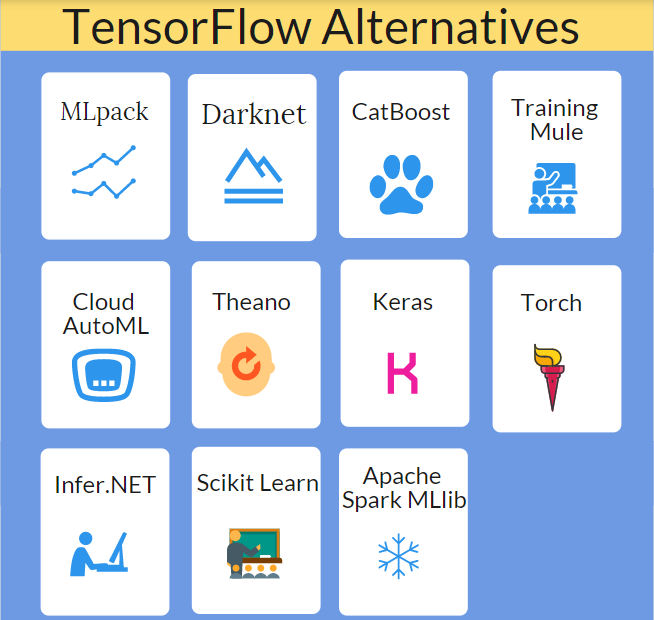
1. MLpack
MLpack is a machine learning library that is written in C++. The goal is to provide easy usage, scalability, and speed. It enables machine learning to provide easy access to new users by providing recommendations. It offers high flexibility and performance to users. Users can achieve this using a modular C++, API, and a set of command lines.
2. Darknet
Darknet is an open-source that follows a neural network framework. It is written using c and CUDA. The installation of the Darknet is easy and fast. It does not take much time. It uses both CPI and GPU.
3. CatBoost
CatBoost is an open-source gradient boosting based on the decision tree library. Yandex researchers and engineers developed it, and many organizations use it widely for keyword recommendations and ranking factors. It is based on the MatrixNet algorithm.
4. Training Mule
With Training Mule, labeling images becomes easy as it provides a set of databases for the best results. It hosts the network and gives easy access to handle the model in the cloud by providing API.
5. Cloud AutoML
Cloud AutoML rains high-quality machine learning models with limited machine learning experts.
6. Theano
Theano is an open-source project issued by the University of Montreal, Quebec (home to YoshuaBengio) under the license of the BSD. It was developed by the LISA (now MILAs) group.
Theano is a library from Python that optimizes the compilation of mathematical expressions, particularly many matrix values. Theano expresses computations using a NumPy syntax and compiles them to run successfully on CPU or GPU architectures. We can’t learn Theano directly because it is very deep in learning. One of the most popular Python projects that make Theano so much easier, studying deep learning is highly recommended. These projects provide Python with data structures and behaviors designed to create profound learning models quickly and reliably while ensuring that Theano develops and executes quick and effective models.
The Lasagne library, for example, provides the classes of Theano to create deep learning, but it will still need a Theano syntax for learning.
7. Keras
Keras is a Python-based open-source neural-network library. It can run on the upper edge of Tensor-Flow, Microsoft Cognitive Toolkit, Theano, or PlaidM. Designers intended it to facilitate quick experimentation with deep neural networks and to be user-friendly, modular, and expandable.
Designers created the API ‘for people, not machines’, and it adheres to the best practices for reducing cognitive load. To create new models, you can combine standalone modules like neural layers, cost functions, optimizers, initialization schemes, activation compatibility, and regularization schemes. As new classes and functions, new modules are easy to add. Models not with separate configuration files are defined with Python code. The main reason for using Keras is based on their guiding principles, mainly on being easy to use. We recommend our own ModelSerializer class for further saving and reloading your model once you have imported the model.
8. Torch
The torch is an open-source machine learning library, a framework for scientific computing, and a language of script based on the programming language of Lua. It provides a wide range of deep learning algorithms and uses the LuaJIT scripting language and an underlying C implementation. It also has a powerful N-dimensional array. The torch is a scientific computer structure with wide support for GPUs’ first learning machine algorithms. Thanks to a simple and rapid language, the LuaJIT and the underlying C/CUDA implementation are simple and efficient to use.
9. Infer.NET
Microsoft released its cross-platform Infer. Net model-based machine learning environment through open source. A high-performance code framework compiles its program to implement an approach that allows substantial scalability, approximate deterministic, and Bayesian inference. Model learning also applies to data trait problems, including real-time data, heterogeneous data, unmarked information and data with missing parts, and data with known distortions.
10. Scikit Learn
They released Scikit-learn in the year 2007. It is an open-source library that is used in machine learning. It was designed based on Matplotlib, SciPy, and NumPy concepts. The scikit-learn framework does not concern with data loading and manipulating data; instead, it is more concerned with data modeling.
11. Apache Spark MLlib
Apache Spark MLlib is another TensorFlow alternative. People use it as a distributed framework for machine learning. For developing open-source projects, many widely use Apache Spark Mllib because it primarily focuses on machine learning to create an easy interface. It contains a library that is used for scalable vocational training. It supports algorithms like decision trees, regression, clustering, and API at a higher level.
Conclusion
In this article, we have seen alternative tools for the TensorFlow machine learning tool.
Recommended Articles
This has been a guide to TensorFlow Alternatives. Here we discussed the basic concept and some of the TensorFlow Alternatives to be known. You can also go through our other suggested articles to learn more –

