


Updated October 22, 2026
What is Speculative Decoding?
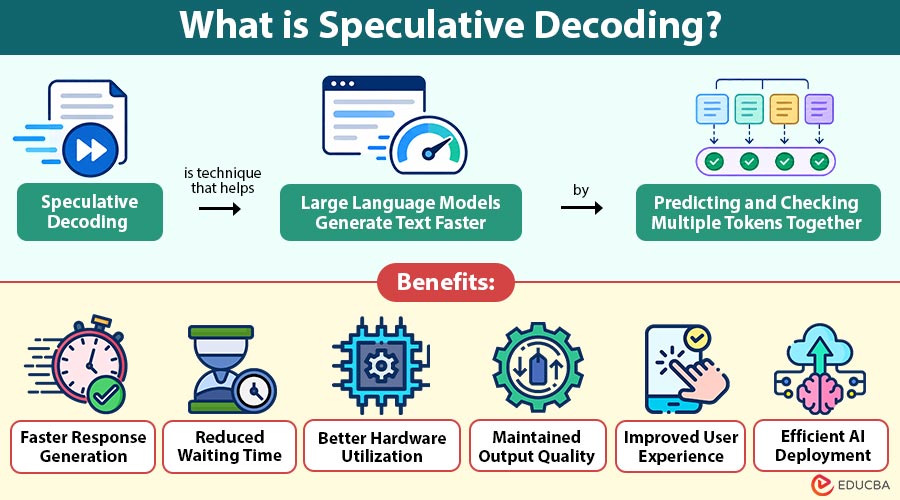
Speculative decoding is a technique that helps large language models generate text faster by predicting and checking multiple tokens together.
Large language models (LLMs) are used in chatbots, AI writing tools, coding assistants, and many other applications. These models usually generate text one token at a time. A token can be a word, part of a word, or a symbol. This process takes time, especially when the model needs to produce a long response.
Speculative decoding helps reduce this waiting time. It uses a smaller, faster model to predict several tokens in advance. A larger model then checks these predictions and decides which ones can be accepted.
For example, when someone asks an AI chatbot a question, a smaller model can quickly suggest part of the answer. The larger model checks those suggestions instead of generating every token separately. This approach helps AI systems respond faster while maintaining the larger model’s output quality. With the correct verification method, it can also preserve the larger model’s original output probabilities.
Table of Contents:
- Meaning
- Working
- Key Components
- Types
- Example
- Benefits
- Challenges
- Difference
- Applications
- Best Practices
Key Takeaways:
- Speculative decoding helps large language models generate responses faster by predicting several tokens in advance.
- A smaller draft model suggests tokens, while a larger target model checks whether those predictions can be accepted.
- The technique can reduce response time without changing the target model’s output probabilities when implemented correctly.
- Its performance depends on prediction accuracy, model speed, hardware, and the cost of checking tokens.
- Speculative decoding is useful in AI chatbots, coding assistants, writing tools, and other text-generation applications.
How Does Speculative Decoding Work?
Speculative decoding works by allowing a faster model to suggest tokens before a larger model checks them. The process involves the following steps:
1. Receive User Input
The AI system receives a question, instruction, or request from the user and prepares to generate a response.
2. Generate Draft Tokens
A smaller AI model quickly predicts several possible tokens that could appear next in the response being generated.
3. Check Predictions
The larger AI model checks the suggested tokens together and determines which predictions can be accepted during verification.
4. Accept Valid Tokens
The system accepts tokens that pass verification and adds them to the response without generating each token separately.
5. Correct Rejected Tokens
When a token is rejected, the system uses the larger model’s probabilities to select a suitable replacement token.
6. Continue Generating
The system repeats the prediction and verification process until the AI model completes the response requested by the user.
The main advantage is that the larger model can check several possible tokens in one operation rather than generating each one separately.
Key Components of Speculative Decoding
Speculative decoding uses several components that work together to improve text-generation speed.
1. Draft Model
The draft model is a smaller and faster AI model that predicts upcoming tokens. Its main responsibility is to generate possible text quickly.
2. Target Model
The target model is the larger AI model responsible for checking draft predictions. It determines which tokens can be accepted according to its own predictions.
3. Draft Tokens
Draft tokens are the words, word parts, or symbols suggested by the smaller model. They are checked before becoming part of the final response.
4. Verification Process
Verification is the process of checking the draft model’s predictions against the larger model. It helps maintain the target model’s intended output behavior.
5. Acceptance Rate
The acceptance rate shows how many suggested tokens pass verification. A higher acceptance rate generally means the system can generate more text in fewer verification rounds.
Types of Speculative Decoding
Different speculative decoding types are used depending on how tokens are predicted and verified.
1. Draft-Target Speculative Decoding
This approach uses two AI models. A smaller draft model predicts several tokens, while a larger target model checks them before accepting them into the final response.
2. Self-Speculative Decoding
This approach uses the same AI model for drafting and verification. It may skip certain processing layers to generate draft tokens faster before checking them using the full model.
3. Tree-Based Speculative Decoding
This approach generates multiple possible token sequences in a tree-like structure. The target model checks different paths to identify acceptable tokens for the final response.
4. Multi-Token Prediction Decoding
This approach uses specialized prediction heads to predict several future tokens. The main AI model then verifies these predictions before accepting them.
5. Retrieval-Based Speculative Decoding
This approach uses existing text patterns or previously generated information to suggest possible tokens. It can reduce the need for a separate draft model during text generation.
Example of Speculative Decoding
Suppose a user asks an AI chatbot:
“What are the benefits of regular exercise?”
The system needs to generate a response explaining how exercise supports health.
A smaller draft model may suggest:
“Regular exercise helps improve physical health.”
The larger model checks the suggested tokens. If they pass verification, the system accepts them and continues generating the remaining response. If a token does not pass verification, the system corrects the response using the target model’s probabilities. This saves time when several draft tokens can be accepted together.
Benefits of Speculative Decoding
Speculative decoding offers several benefits for AI systems that generate text.
1. Faster Response Generation
Helps AI models generate responses faster by checking several predicted tokens together instead of producing them individually.
2. Reduced Waiting Time
Allows users to receive answers more quickly by reducing the time AI systems take to generate text.
3. Better Hardware Utilization
Helps AI systems use available computing resources more efficiently when processing certain text generation tasks.
4. Maintained Output Quality
Uses a verification process that preserves the larger model’s output probabilities while allowing faster text generation.
5. Improved User Experience
Makes AI applications more responsive by reducing delays when generating long answers, detailed explanations, or conversations.
6. Efficient AI Deployment
Improves text generation speed without requiring major changes to the larger AI model’s existing architecture.
Challenges of Speculative Decoding
Although speculative decoding can improve speed, it also has some challenges.
1. Incorrect Predictions
The smaller AI model may predict wrong tokens, which the larger model must check, reject, and replace with suitable ones.
2. Additional Processing
Running two AI models requires extra processing work because one model generates tokens while the other checks their accuracy.
3. Model Compatibility
Finding a suitable smaller model can be difficult because both models must use compatible tokens and work properly together.
4. Memory Requirements
Using two separate AI models may require more memory, making it difficult to run them on devices with the limited resources.
5. Limited Speed Improvement
Speculative decoding may not improve response speed much when the smaller model makes too many incorrect predictions during text generation.
6. Implementation Complexity
Developers must carefully manage both AI models, check predicted tokens, and handle memory usage to keep the system working properly.
Difference Between Speculative Decoding and Traditional Decoding
The table below highlights the key differences between the two:
| Basis | Speculative Decoding | Traditional Decoding |
| Meaning | Predicts and checks several tokens together. | Generates text one token at a time. |
| Model Usage | Often uses a draft model and a target model. | Usually uses one main model. |
| Speed | Can generate responses faster. | May take longer to generate responses |
| Token Generation | Suggests multiple tokens before verification. | Produces tokens sequentially |
| Verification | Checks draft predictions against the target model. | Uses the main model’s predictions directly. |
| Complexity | Requires additional verification logic. | Generally easier to implement. |
| Best Use | Useful when faster text generation is needed. | Suitable for general text generation. |
Applications of Speculative Decoding
Speculative decoding can be used in different AI applications where faster text generation is important.
1. AI Chatbots
Chatbots can use speculative decoding to generate answers faster, helping users receive responses with less waiting time.
2. AI Writing Assistants
Writing tools can use this technique to generate paragraphs, summaries, emails, and other written content more quickly.
3. Code Generation
AI coding assistants can generate code suggestions faster, making programming tasks more convenient for developers.
4. Customer Support Systems
Businesses can use faster language-model responses to help automated support systems answer customer questions more efficiently.
5. Document Summarization
AI tools can use speculative decoding to produce summaries of lengthy reports, articles, and documents with reduced generation time.
6. Language Translation
Translation systems powered by language models can use this technique to generate translated text more quickly.
Best Practices for Implementing Speculative Decoding
Developers can follow these practices to improve the performance of speculative decoding systems.
1. Select a Suitable Draft Model
Choose a smaller model that generates predictions quickly and produces tokens that are likely to pass verification.
2. Monitor Token Acceptance
Measure how often the larger model accepts draft tokens. Low acceptance rates may reduce the expected speed improvement.
3. Adjust Draft Length
Test different numbers of draft tokens to find a suitable balance between prediction speed and verification work.
4. Test on Real Tasks
Evaluate performance using actual chatbot questions, coding requests, and other tasks that users commonly perform.
5. Compare Processing Costs
Measure response time, memory consumption, and computing requirements before deciding whether speculative decoding is beneficial.
Final Thoughts
Speculative decoding helps large AI models generate responses faster. It uses a smaller model to predict several tokens, which the larger model checks before accepting. This reduces waiting time without affecting output quality when properly implemented. Although it requires additional processing, it helps developers build faster and more efficient AI applications.
Frequently Asked Questions (FAQs)
Q1. Why is speculative decoding important?
Answer: Speculative decoding helps large AI models generate text faster. It reduces waiting time by allowing several predicted tokens to be checked together.
Q2. Does speculative decoding reduce AI accuracy?
Answer: Not necessarily. Standard speculative decoding uses a verification method designed to preserve the larger model’s output probabilities, so faster generation does not require sacrificing its original output quality.
Q3. Does speculative decoding always improve performance?
Answer: No. Its effectiveness depends on how quickly the draft model works, how many predictions are accepted, and the computing resources available.
Q4. Can speculative decoding work without a smaller model?
Answer: Yes. Self-speculative decoding allows a single AI model to generate draft tokens and verify them using different processing methods.
Recommended Articles
We hope that this EDUCBA information on “Speculative Decoding” was beneficial to you. You can view EDUCBA’s recommended articles for more information


