

What are Vector Embeddings?
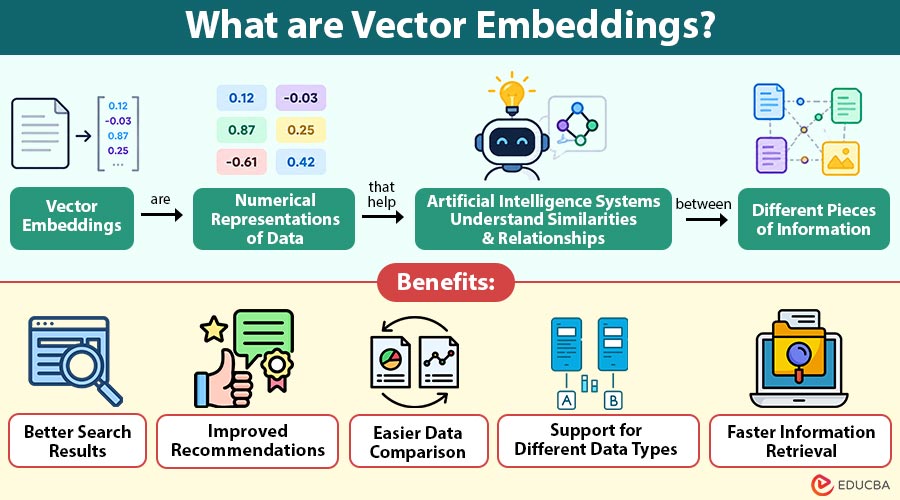
Vector embeddings are numerical representations of data that help artificial intelligence systems understand similarities and relationships between different pieces of information.
Computers cannot understand words, pictures, or sounds in the same way humans do. They need numerical data to process it. Vector embeddings make this possible by converting information into groups of numbers called vectors. These numbers help AI models recognize patterns and find connections between related items.
For example, the words “car” and “vehicle” have similar meanings. An AI system using embeddings can identify this connection because their numerical representations are usually close to each other in vector space.
Similarly, embeddings can help systems recognize related images, documents, products, and other types of information. Vector embeddings are widely used in machine learning, natural language processing, search engines, recommendation systems, and modern AI applications.
Table of Contents:
Key Takeaways:
- Vector embeddings convert text, images, and other information into numerical representations that AI models can process.
- Similar information often has similar vector representations, helping AI systems identify relationships between different items.
- Embeddings are commonly used in search engines, chatbots, recommendation systems, and image recognition applications.
- The quality of embeddings depends on the model, training data, and how well the vectors represent the required information.
How Do Vector Embeddings Work?
Vector embeddings work by converting information into a list of numbers that represents important patterns or features in the original data. An embedding model first receives input, such as a word, sentence, image, or document. It then processes the information and creates a numerical vector. Each vector contains several numbers that together represent the input’s features or meaning.
For example, an embedding model may convert the word “apple” into a vector such as [0.21, 0.54, -0.18, 0.73].
These numbers do not have a fixed meaning individually. Instead, the complete vector helps the system compare the word with other information. When two items have similar meanings or features, their embeddings are often closer together. AI systems can compare these vectors using mathematical methods to find similarities and identify related information.
Types of Vector Embeddings
Vector embeddings can represent different types of information depending on the task and the model being used.
1. Word Embeddings
Word embeddings convert individual words into numerical vectors. They help AI models identify relationships between words and understand similarities in language.
2. Sentence Embeddings
Sentence embeddings represent complete sentences as vectors. They help systems compare sentence meanings, even when different words are used.
3. Document Embeddings
Document embeddings convert larger pieces of text into numerical representations. They are useful for finding related documents and organizing information.
4. Image Embeddings
Image embeddings represent visual features as numbers. They help AI systems compare pictures, recognize objects, and find visually similar images.
5. Audio Embeddings
Audio embeddings convert sound information into vectors. They are used to identify speech patterns, compare audio recordings, and support sound recognition.
Vector Embedding Process
Creating vector embeddings usually involves five steps. These steps help AI systems convert information into a format that can be compared and analyzed.
1. Collect Input Data
The process begins with collecting information such as text, images, audio recordings, or documents that need to be converted into vectors.
2. Prepare the Data
The collected information is prepared for processing. This may involve cleaning text, resizing images, or dividing large documents into smaller sections.
3. Select an Embedding Model
Developers choose an embedding model suitable for the type of information and the task they want the AI system to perform.
4. Generate Vector Embeddings
The model processes the input and produces numerical vectors. These vectors represent patterns and features learned by the model.
5. Store and Compare Vectors
The generated vectors can be stored and compared with other embeddings to find similar information or support different AI applications.
Examples of Vector Embeddings
Here are some simple examples that show how vector embeddings work in different situations.
1. Online Shopping
A customer searches for “comfortable running shoes” on a shopping website. Vector embeddings help the website find related products, such as sports shoes and jogging shoes, even when the product descriptions use different words.
2. Movie Recommendations
A streaming platform uses embeddings to compare movies based on their content and features. If someone enjoys action movies, the system can recommend other movies with similar characteristics.
3. Image Search
A user uploads a picture of a dog to an image search system. Image embeddings help the system find other pictures containing similar dogs or related visual features.
Key Components of Vector Embeddings
Several components help embedding systems convert information into useful numerical representations.
1. Embedding Model
An embedding model is a trained AI system that converts input information into numerical vectors based on patterns it has learned.
2. Vector Dimensions
Dimensions refer to the number of values in a vector. Different embedding models produce vectors with different numbers of dimensions.
3. Vector Space
Vector space is the mathematical space where embeddings are represented. It allows AI systems to compare the positions of different vectors.
4. Similarity Measurement
Similarity methods, such as cosine similarity, help systems measure how closely two vectors are related.
5. Vector Database
A vector database stores embeddings and helps applications search large collections of vectors to find similar information efficiently.
Benefits of Vector Embeddings
Vector embeddings help AI systems work with large amounts of information and identify relationships that may be difficult to find using basic methods.
1. Better Search Results
Embeddings help search systems find relevant information based on meaning rather than depending only on matching keywords.
2. Improved Recommendations
Shopping websites and streaming platforms can use embeddings to suggest products, videos, or songs related to user interests.
3. Easier Data Comparison
AI systems can compare text, images, and other information using numerical vectors instead of processing everything in its original form.
4. Support for Different Data Types
Embeddings can represent words, documents, images, and audio, making them useful for many types of AI applications.
5. Faster Information Retrieval
When used with suitable search methods, embeddings help systems find related information from large datasets more efficiently.
Challenges of Vector Embeddings
Although vector embeddings are useful, developers may face certain challenges while creating and using them.
1. High Computing Requirements
Some embedding models require considerable processing power and memory, especially when handling large datasets or complex information.
2. Dependence on Training Data
Embeddings may produce poor results when the model has not learned enough about the language, industry, or information being processed.
3. Difficulty Understanding Vectors
The numbers inside an embedding are not usually easy for humans to interpret, making it difficult to explain individual results.
4. Storage Requirements
Large collections of embeddings can require substantial storage space, particularly when vectors contain many dimensions.
5. Inaccurate Similarity Results
Embeddings may sometimes identify unrelated information as similar or fail to recognize important differences between related items.
Difference Between Vector Embeddings and Traditional Data Representation
The table below highlights the key differences between the two:
| Basis | Vector Embeddings | Traditional Data Representation |
| Meaning | Represents information as learned numerical vectors | Stores information in its original or predefined format |
| Main Focus | Captures patterns and relationships | Records specific values or features |
| Similarity | Can compare information based on learned meaning | Often relies on exact values or predefined rules |
| Data Types | Text, images, audio, and more | Text, numbers, categories, and other formats |
| Applications | Semantic search and recommendations | Databases, reporting, and basic data processing |
Applications of Vector Embeddings
Vector embeddings are used in different industries and AI systems to search, compare, and organize information.
1. Natural Language Processing
AI models use embeddings to understand relationships between words and sentences in tasks such as text classification and language analysis.
2. Search Engines
Search systems use embeddings to find pages and documents related to a user’s question, even when the wording is different.
3. Recommendation Systems
Online stores and entertainment platforms use embeddings to recommend products, movies, or music based on similarities between items.
4. AI Chatbots
Chatbots can use embeddings to find relevant information from stored documents before generating answers to customer questions.
5. Image Recognition
Computer vision systems use image embeddings to compare pictures, identify similar objects, and organize large image collections.
Final Thoughts
Vector embeddings help AI systems understand and compare different types of information by converting them into numerical vectors. They make it easier to find related content, improve search results, and build useful recommendation systems. As AI applications continue to grow, vector embeddings remain an important method for working with text, images, audio, and other forms of data. Choosing suitable models and testing their results helps developers build more reliable applications.
Frequently Asked Questions (FAQs)
Q1. Can vector embeddings handle new information?
Answer: Yes. Embedding models can convert new information into vectors without requiring complete retraining. However, unfamiliar topics or changing information may affect the quality of the results.
Q2. Do vector embeddings change over time?
Answer: Embeddings generated by a fixed model usually remain the same for identical inputs. However, using a different model or updating the existing model may produce different vectors.
Q3. Can vector embeddings identify duplicate content?
Answer: Yes. Embeddings can help identify content with similar meanings, even when the wording is different. However, additional checks may be needed to confirm exact duplicates.
Q4. Are vector embeddings useful for small businesses?
Answer: Yes. Small businesses can use embeddings to improve website searches, organize customer questions, find related products, and make information easier to access.
Recommended Articles
We hope that this EDUCBA information on “Vector Embeddings” was beneficial to you. You can view EDUCBA’s recommended articles for more information