


Updated October 7, 2026
What is AI Computing?
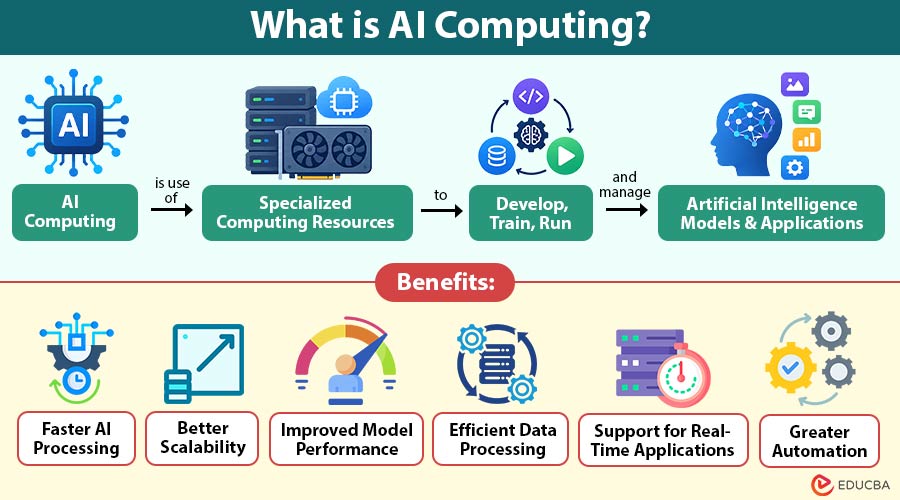
AI computing is the use of specialized computing resources to develop, train, run, and manage artificial intelligence models and applications.
It uses processors, memory, storage, networking, algorithms, and software frameworks to perform AI workloads. Unlike traditional computing, which often focuses on sequential processing, it is designed to efficiently handle large-scale parallel calculations required by machine learning and deep learning models.
For example, training a large AI model may require processing millions or billions of data points. Specialized computing hardware can perform these calculations much faster than conventional processors.
Table of Contents:
Key Takeaways:
- AI computing provides specialized infrastructure to develop, train, deploy, and manage artificial intelligence models efficiently.
- GPUs, CPUs, accelerators, memory, storage, and networking collectively support demanding AI workloads.
- It enables faster processing, scalability, automation, real-time applications, and improved performance across diverse industries.
- It processes large datasets and complex calculations required for the modern machine learning and deep learning applications.
Importance of AI Computing
AI computing is important because modern AI models can require significant processing power.
Traditional computing infrastructure may not handle large-scale machine learning and deep learning workloads efficiently. It provides specialized resources that can accelerate calculations and support more complex models.
It also enables organizations to process large datasets, deploy AI applications, automate tasks, and develop advanced technologies. As AI adoption grows across industries, efficient computing infrastructure becomes a key part of AI strategy.
How Does AI Computing Work?
It combines computing hardware, software, data, and AI algorithms into a processing environment.
The general process includes the following steps:
1. Data Collection
AI systems collect data from databases, applications, sensors, websites, devices, or other sources. The data may include text, images, audio, video, or numerical information.
2. Data Processing
The collected data is cleaned, organized, transformed, and prepared for AI processing. High-performance computing resources help process large datasets efficiently.
3. Model Training
AI models use processed data to identify patterns and learn relationships. Specialized processors perform many mathematical calculations during this stage.
4. Model Deployment
After training, the model is deployed into an application or business environment. Computing resources process new inputs and generate predictions, classifications, recommendations, or responses.
5. Continuous Optimization
AI systems can be monitored and optimized by adjusting models, infrastructure, software, and resource allocation to improve performance and efficiency.
Types of AI Computing
It can be categorized based on where and how AI workloads are processed.
1. Cloud AI Computing
It provides scalable computing resources through online platforms, enabling organizations to train, deploy, and manage AI models efficiently.
2. Edge AI Computing
It processes data near its source, reducing latency and supporting faster AI responses across connected devices and applications.
3. High-Performance AI Computing
It uses powerful systems to process complex workloads, supporting large-scale model training, scientific research, simulations, and analytics.
4. Distributed AI Computing
It divides workloads across multiple connected systems, enabling faster processing and handling AI tasks beyond what a single machine can do.
5. On-Premises AI Computing
It uses organization-owned infrastructure, providing greater control over AI data, hardware, security, configurations, and computing resources.
Key Components of AI Computing
Several components work together to support AI workloads.
1. Central Processing Units
CPUs perform general-purpose computing tasks and coordinate various operations, supporting AI applications alongside specialized processing hardware.
2. Graphics Processing Units
GPUs perform numerous calculations simultaneously, making them highly effective for machine learning, deep learning, and large AI workloads.
3. AI Accelerators
AI accelerators are specialized processors designed to execute AI calculations efficiently, improving performance while reducing processing time and energy consumption.
4. Memory
Memory stores models, datasets, and intermediate calculations, providing AI systems with fast access to information during processing and training.
5. Storage
Storage systems maintain datasets, trained models, applications, logs, and other essential information needed to develop and operate AI systems.
6. Networking
High-speed networking enables computing systems to exchange large datasets efficiently, supporting distributed AI workloads and interconnected data center infrastructure.
7. AI Software
AI software includes frameworks, libraries, drivers, and development tools that help developers build, train, optimize, deploy, and manage AI models.
Applications of AI Computing
It supports wide range of industries and use cases.
1. Healthcare
It supports medical image analysis, drug discovery, patient data analysis, disease prediction, and clinical decision-making.
2. Finance
It enables financial institutions to detect fraud, assess risks, forecast trends, automate trading, and improve customer service operations.
3. Manufacturing
It supports predictive maintenance, automated quality inspection, robotics, production optimization, process monitoring, and accurate manufacturing demand forecasting.
4. Retail
It helps retailers improve recommendations, forecast demand, manage inventory, analyze customers, and deliver personalized marketing experiences effectively.
5. Autonomous Systems
It enables vehicles, drones, robots, and autonomous machines to analyze environments, process information, and make decisions quickly.
6. Generative AI
It provides the processing power to train and run models that generate text, images, audio, video, and software code.
7. Cybersecurity
It supports cybersecurity through threat detection, anomaly identification, malware analysis, behavioral monitoring, and automated security response capabilities.
Benefits of AI Computing
It offers several benefits for organizations developing or using artificial intelligence.
1. Faster AI Processing
Specialized computing resources accelerate AI calculations, reducing model training and processing time while improving overall application responsiveness.
2. Better Scalability
Organizations can increase computing resources as workloads grow, allowing AI infrastructure to efficiently handle changing processing requirements.
3. Improved Model Performance
Powerful processors and optimized infrastructure enable organizations to train larger, more complex AI models with improved performance.
4. Efficient Data Processing
Processes large datasets efficiently, helping organizations perform advanced analytics and develop machine learning applications more effectively.
5. Support for Real-Time Applications
Specialized processors and edge computing reduce processing delays, enabling AI systems to deliver faster responses for real-time applications.
6. Greater Automation
It supports intelligent automation by enabling systems to perform repetitive tasks, analyze information, make predictions, and assist decisions.
Challenges of AI Computing
Despite its benefits, AI computing has several challenges.
1. High Infrastructure Costs
Advanced AI hardware and data center infrastructure can require significant investment. Organizations must carefully evaluate computing requirements and costs.
2. Energy Consumption
Large AI workloads can consume substantial amounts of electricity. Improving energy efficiency is therefore an important consideration for AI infrastructure.
3. Hardware Availability
High-demand AI processors may be limited in availability or expensive, making infrastructure planning harder.
4. Complexity
Managing AI infrastructure can require specialized knowledge of hardware, software, networking, cloud platforms, and machine learning systems.
5. Data Management
AI workloads depend on large datasets. Storing, transferring, securing, and processing these datasets can create operational challenges.
6. Security Risks
AI computing environments must protect models, data, applications, and infrastructure against unauthorized access and other security threats.
Final Thoughts
AI computing powers modern artificial intelligence by combining processors, memory, storage, networking, software, and data infrastructure. It supports diverse applications across industries while improving processing capabilities. Despite costs, energy demands, and complexity, advances in hardware and computing architectures are making AI more efficient, scalable, powerful, and accessible.
Frequently Asked Questions (FAQs)
Q1. What does an AI computing system include?
Answer: An AI computing system includes hardware, software, data, networking, storage, and processing resources that work together to support AI workloads.
Q2. What types of workloads can AI computing handle?
Answer: AI computing can handle machine learning, deep learning, data analysis, model training, inference, simulations, automation, and other computationally intensive workloads.
Q3. Why does AI computing require specialized infrastructure?
Answer: AI workloads involve extensive mathematical operations and large datasets, requiring infrastructure designed to provide high processing capacity and efficient data movement.
Q4. What role does data play in AI computing?
Answer: Data provides the information AI systems use to train models, identify patterns, generate predictions, and produce useful outputs.
Recommended Articles
We hope that this EDUCBA information on “AI Computing” was beneficial to you. You can view EDUCBA’s recommended articles for more information.


