


Updated October 3, 2026
What is AI Sprawl?
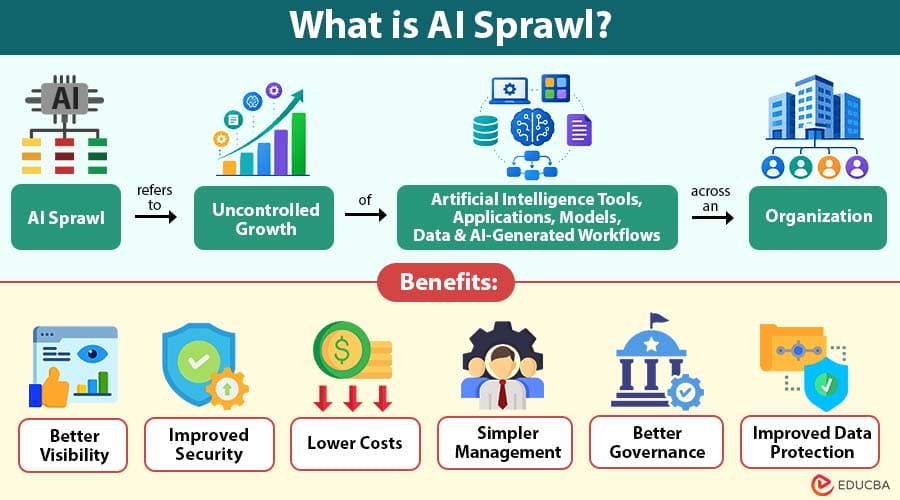
AI sprawl refers to the uncontrolled growth of artificial intelligence tools, applications, models, data, and AI-generated workflows across an organization. It often happens when employees and teams adopt different AI solutions without centralized oversight or clear management policies.
As businesses use AI for writing, customer service, data analysis, software development, marketing, security, and automation, the number of AI systems can quickly increase. Without proper governance, organizations may lose track of which tools are being used, what data they access, and who is responsible for them.
For example, a marketing team may use one AI platform for content creation, the sales team may use another tool for customer analysis, and developers may create several internal AI applications. Without central management, the organization can experience AI sprawl.
Table of Contents:
- Meaning
- How Does AI Sprawl Happen?
- Types
- Common Causes
- Risks
- Example
- How to Manage AI Sprawl?
- Benefits
Key Takeaways:
- AI sprawl occurs when organizations accumulate AI tools, models, applications, and data without centralized oversight.
- Rapid adoption, independent decisions, duplicate solutions, and weak governance commonly contribute to AI sprawl.
- AI sprawl can increase security risks, data privacy concerns, costs, compliance challenges, and maintenance difficulties.
- Centralized inventories, governance, approved tools, regular reviews, and lifecycle management help control AI sprawl effectively.
How Does AI Sprawl Happen?
AI sprawl usually develops gradually, not through one major decision. Employees often adopt new AI tools to improve productivity or solve specific business problems.
Several teams may independently select different platforms for similar tasks. Developers may also create separate AI models or applications using different frameworks and cloud services.
Over time, organizations can end up with many AI tools that have overlapping functions.
For example, five departments may independently use different AI assistants for summarizing documents. Although each tool solves a similar problem, the organization may have separate subscriptions, security settings, data policies, and user permissions.
Types of AI Sprawl
Below are the common types of AI sprawl that organizations may experience as AI adoption expands across different areas.
1. Tool Sprawl
Tool sprawl occurs when organizations use numerous AI tools across departments, creating duplication, complexity, higher costs, and management challenges.
2. Model Sprawl
Model sprawl occurs when organizations deploy many AI models without centralized oversight, increasing maintenance, monitoring, security, and management requirements.
3. Data Sprawl
Data sprawl occurs when AI systems store and process organizational data across multiple platforms, environments, applications, and locations.
4. Application Sprawl
Application sprawl occurs when organizations develop numerous AI applications without consistent architecture, ownership, lifecycle management, or usage monitoring processes.
5. Shadow AI
Shadow AI occurs when employees use unauthorized AI tools without organizational approval, creating potential security, privacy, compliance, and data risks.
Common Causes of AI Sprawl
Understanding the causes of AI sprawl helps organizations identify it early.
1. Rapid AI Adoption
Rapid AI adoption encourages teams to experiment with new technologies quickly, often before organizations establish proper governance, oversight, and controls.
2. Independent Team Decisions
Independent team decisions can lead departments to select AI platforms based on specific needs, creating inconsistent technology environments across organizations.
3. Easy Access to AI Tools
Easy access to AI tools lets employees adopt services quickly, but uncontrolled use can reduce visibility, oversight, and security.
4. Lack of AI Governance
Lack of AI governance makes it difficult to control approved tools, data usage, security requirements, model deployment, and organizational responsibilities.
5. Duplicate Solutions
Duplicate AI solutions emerge when teams independently develop or purchase tools that perform similar functions, increasing costs and unnecessary complexity.
6. Poor Inventory Management
Poor AI inventory management makes it difficult to identify existing tools, models, applications, integrations, owners, and associated organizational risks effectively.
Risks of AI Sprawl
AI sprawl can create several operational and security risks.
1. Security Risks
Each AI application can create another potential entry point for security threats. Poorly configured systems may expose sensitive information or create unnecessary access points.
2. Data Privacy Concerns
Employees may enter confidential information into AI tools without understanding how that data is stored or processed.
3. Higher Costs
Multiple subscriptions, cloud resources, APIs, and AI services can increase technology spending. Duplicate tools may also create unnecessary expenses.
4. Compliance Challenges
Organizations may need to follow privacy, security, industry, or internal governance requirements. Managing compliance becomes harder when AI usage is scattered across many systems.
5. Inconsistent AI Performance
Different teams may use different models and standards. This can result in inconsistent outputs, quality levels, and business decisions.
6. Difficult Maintenance
AI systems require monitoring, updates, security reviews, and lifecycle management. More unmanaged systems increase maintenance work.
Example of AI Sprawl
A large company uses AI across its marketing, sales, finance, customer service, and software development teams. The marketing team uses one AI writing tool, the sales team uses another AI platform for customer analysis, and the customer service team uses several AI chatbots. Meanwhile, developers create separate AI applications using different models and cloud services.
Over time, the company has many AI tools performing similar tasks. Some systems process customer data, while others have unclear ownership or go unused. The company also pays for multiple subscriptions and struggles to monitor security, data access, costs, and compliance.
This situation is an example of AI sprawl, where AI technologies grow across an organization without centralized visibility and management.
How to Manage AI Sprawl?
Below are steps organizations can follow to identify, control, and reduce AI sprawl effectively.
1. Create an AI Inventory
Maintain a central record of AI tools, models, applications, APIs, data sources, owners, and business purposes to improve organizational visibility and accountability.
2. Establish AI Governance
Create clear policies that define how employees select, develop, deploy, and use AI systems, while addressing security, privacy, access, data, and acceptable applications.
3. Define Approved AI Tools
Create an approved list of AI platforms meeting security, privacy, and business requirements to reduce duplication and provide safer options for employees.
4. Assign System Owners
Assign responsible owners to important AI applications and models so they can monitor performance, security, usage, costs, and lifecycle requirements across departments.
5. Review AI Usage Regularly
Regularly review AI tools and applications to identify duplicate, outdated, unused, or unauthorized systems before they increase organizational complexity significantly over time.
6. Control Data Access
Use access controls to determine which AI systems can access specific business information, ensuring sensitive data remains available only to authorized users.
7. Monitor AI Costs
Track subscription fees, API usage, cloud computing expenses, and other AI-related costs to identify duplicate services and underused resources across the organization.
8. Retire Unnecessary Systems
Review and safely remove AI applications that no longer provide business value to reduce maintenance requirements, security concerns, and overall costs.
Benefits of Controlling AI Sprawl
Below are the key benefits organizations can achieve by controlling and managing AI sprawl effectively.
1. Better Visibility
A centralized AI inventory helps organizations identify where AI tools are used, who manages them, and what business purposes they support.
2. Improved Security
Standard security controls reduce unnecessary access, unauthorized tools, unmanaged AI usage, and potential risks across organizational systems.
3. Lower Costs
Removing duplicate, unnecessary, or unused AI tools helps organizations reduce software expenses and use technology budgets more efficiently.
4. Simpler Management
Fewer AI systems make monitoring, maintenance, updates, troubleshooting, and overall technology management easier for teams.
5. Better Governance
Clear AI policies and centralized oversight help organizations manage tool selection, usage, approvals, monitoring, and compliance consistently.
6. Improved Data Protection
Centralized controls help organizations identify how business data is shared with AI systems and reduce potential exposure risks.
Final Thoughts
AI sprawl can develop quickly as organizations adopt more AI tools, models, and applications. Without proper oversight, it may increase costs, security risks, and management complexity. Creating an AI inventory, establishing governance, controlling data access, reviewing usage, and retiring unnecessary systems can help organizations maintain a secure, efficient, and manageable AI environment.
Frequently Asked Questions (FAQs)
Q1. Why is AI sprawl becoming a concern for organizations?
Answer: AI sprawl can make it difficult for organizations to maintain consistent standards, understand technology dependencies, and coordinate AI-related activities across teams.
Q2. How can an organization identify AI sprawl?
Answer: Organizations can look for duplicate AI services, unknown applications, unmanaged models, unclear system ownership, scattered data usage, and AI tools that lack formal approval.
Q3. Who should be responsible for managing AI sprawl?
Answer: Responsibility can be shared among IT, security, data, compliance, and business teams, with clearly assigned owners for individual AI systems.
Q4. Can small businesses experience AI sprawl?
Answer: Yes. Even smaller organizations can accumulate multiple AI subscriptions, browser-based tools, APIs, and internally developed applications without realizing how many systems they use.
Recommended Articles
We hope that this EDUCBA information on “AI Sprawl” was beneficial to you. You can view EDUCBA’s recommended articles for more information.


